AI has reached the stage where nearly every product category claims to be “smart,” and home appliances are no exception. From refrigerators that predict grocery needs to washers that recommend cycles, product teams are increasingly pressured to add some form of intelligence. However, many of these implementations fail to create real value. Consumers appreciate convenience, reliability, energy savings, or improved outcomes – not AI for the sake of technology. A connected device that delivers no measurable improvement becomes a liability, not a competitive advantage.
Meanwhile, manufacturers are dealing with rising cost pressures, shorter product lifecycles, warranty expenses, and constant competition. Adding AI can solve these problems – but only when aligned with a clear user outcome and business ROI. A feature must produce visible benefits, reduce operational cost, or unlock new revenue streams. Otherwise, it simply increases BOM cost, engineering complexity, and long-term support burden.
The goal is not to “make a smart appliance,” but to enable a better outcome than a non-AI version could deliver. In this post, we will discuss when AI truly adds value in home appliances, where it becomes redundant, and how brands can evaluate, structure, and implement intelligence effectively.
- 1. Where AI Actually Creates Value in Smart Appliances
- 2. When AI Is Redundant – or Makes the Product Worse
- 3. The Strategic Implementation: Edge AI vs. Cloud AI
- 4. Developex Core Competency: From Bare Metal to Cloud Ecosystems
- 5. Product Management Framework for AI Integration
- Conclusion: Building the Next Generation of Truly Intelligent Appliances
1. Where AI Actually Creates Value in Smart Appliances
AI integration is a justifiable investment when it solves a critical, recurring pain point for the user or delivers substantial cost reduction for the manufacturer. The following high-value use cases represent the primary ROI Imperatives that should drive current product development strategy.
| AI Use Case | Primary Value Delivered | Technical Mechanism |
| Predictive Maintenance | Reduces warranty claims; enables new service revenue streams. | ML models analyze sensor data (vibration, temperature) to detect anomalies indicative of imminent component failure. |
| Hyper-Personalization | Creates a differentiated, “sticky” user experience (UX) and justifies premium pricing. | Deep Learning algorithms track longitudinal user data to adapt settings, anticipate routines, and refine performance profiles. |
| Advanced Energy Management | Reduces utility costs for the user; supports manufacturer sustainability compliance. | AI scheduling and real-time optimization based on external data (grid prices) and internal data (usage patterns). |
1. Predictive Maintenance and Proactive Diagnostics
For manufacturers, minimizing warranty claims and service costs is a core financial driver. AI provides a powerful mitigation tool through Predictive Maintenance (PdM). Studies find that predictive-maintenance systems can reduce unplanned downtime by 30–50% and cut maintenance costs by about 20–30%, demonstrating that embedding smart diagnostics into appliances can lead to substantial operational savings. Instead of relying on simple, hard-coded fault counters, ML models analyze vast streams of operational data – such as motor vibration frequency or subtle temperature drifts .
This allows the appliance to predict component failure before it occurs. This capability shifts the service model from reactive repair to proactive intervention, where the appliance notifies the service center that a component requires attention within a specific window. The result is a substantial reduction in operational costs and the opportunity to transition to profitable, subscription-based remote monitoring services.
2. Hyper-Personalized Performance and Optimization
A premium appliance is defined by an unparalleled user experience. AI facilitates this through Hyper-Personalization, creating a “sticky” product that seamlessly adapts to the user’s individual habits and environment. This goes far beyond generic settings.
For example, a smart appliance, using internal sensors and learned user routines, can autonomously select the optimal operational profile – whether that means perfecting a specific roast based on visual input or determining the most efficient wash cycle based on local water quality and load size. This adaptive, autonomous functionality drives higher customer satisfaction and brand loyalty, making the product intrinsically valuable and difficult for users to switch away from.
3. Advanced Resource and Energy Management
Energy efficiency is a primary consumer concern and a regulatory necessity. AI delivers sophisticated Energy Optimization by acting as an intelligent load balancer. By securely accessing real-time utility tariff data and grid signals, the AI can schedule energy-intensive tasks (like running a dishwasher or water heater) during windows of lowest cost or lowest carbon intensity, without compromising the user’s immediate needs.
This is far more advanced than a simple timer; the AI predicts the earliest and latest acceptable completion times and intelligently optimizes the energy draw based on external data. This capability provides direct financial savings for the user and firmly positions the brand as a leader in sustainability efforts.
2. When AI Is Redundant – or Makes the Product Worse
The allure of “AI” can lead product teams to integrate unnecessary complexity, turning what should be a simple solution into a costly, over-engineered liability. For a smart appliance feature to warrant AI integration, it must satisfy a simple principle: Does the feature require continuous learning, adaptation, and prediction, or can it be solved with simple, deterministic logic? Ignoring this principle leads to “Superficial Intelligence” – features that consume budget and resources without delivering tangible value.
| Pitfall Area | Description of Redundancy | Why AI is Overkill | Cost/Risk Impact |
| The Trivial Convenience Fallacy | Using complex ML to solve problems that could be managed with a simple rule or fixed schedule. | Answering “Yes” or “No” to a simple sensor reading, or triggering a fixed action based on a timer, does not require a deep neural network. | Increases BOM cost (higher-spec chipset), development time, and firmware size. |
| Data Dependency vs. Scarcity | Designing AI features for appliances where data is sparse, inconsistent, or non-repetitive (e.g., highly seasonal-use devices). | Effective machine learning relies on high-volume, continuous, high-quality data. If the data stream is poor or intermittent, the model will never generalize or perform reliably. | Leads to model drift, inaccurate predictions, poor user experience, and wasted training pipeline resources. |
| The User Training Burden | Features that require significant, ongoing, and repetitive user correction or calibration to function correctly. | The goal of AI is to automate complexity. If the user must constantly “train” the device, the feature is fundamentally flawed and unintuitive. The best AI should be invisible. | Increases service calls, generates negative reviews, and damages the brand reputation by failing to deliver on the “smart” promise. |
| Non-Critical Control Loops | Applying ML to standard, high-frequency internal control tasks that are already robustly handled by simple embedded PID controllers or finite state machines. | Traditional controls are often more reliable, less computationally expensive, and easier to certify for safety-critical operations than an AI black box. | Increases testing complexity, requires expensive hardware for inference, and may introduce non-deterministic safety risks. |
3. The Strategic Implementation: Edge AI vs. Cloud AI
The architectural decision of where to deploy the AI model – on the appliance itself (Edge) or in the remote server (Cloud) – is crucial, influencing cost, latency, privacy, and reliability. This decision must be driven by the feature’s requirements.
3.1 Architectural Decisions: Edge Computing for Smart Appliances
The modern trend heavily favors Edge Computing for appliance AI, particularly for real-time and privacy-sensitive functions. Edge AI runs the inference (the model execution) directly on the appliance’s microcontroller or embedded processor.
This strategy offers several distinct advantages:
- Low Latency: Real-time tasks, such as Predictive Maintenance monitoring or quick control loops for motor protection, cannot tolerate the milliseconds of delay required to communicate with a remote server. Edge processing ensures immediate response.
- Offline Reliability: The appliance remains intelligent even if the user’s Wi-Fi fails or the cloud service experiences an outage. The core safety and smart features are always operational.
- Privacy and Security: Data deemed sensitive (e.g., local video/audio streams or high-granularity usage data) can be processed and analyzed locally, with only aggregated, anonymized metadata sent to the cloud. This minimizes legal and ethical compliance risks concerning user data.
- Cost Control: While the initial hardware cost may be slightly higher, running inference on the edge reduces the long-term, scalable operational expenses (OpEx) associated with continuous cloud data transmission and complex server processing.
Conversely, Cloud AI remains the optimal choice for tasks requiring massive computational resources or non-real-time global data. Examples include initial model training, generating global fleet-wide anomaly reports, or offering complex, computationally heavy features like dynamic recipe recommendations based on global dietary trends.
3.2 Strategic Integration of Low-Power Embedded ML
Successful Edge AI hinges on the ability to deploy complex models onto resource-constrained hardware using techniques like TinyML. This requires deep expertise in:
- Model Quantization and Pruning: Techniques used to shrink the size and complexity of the trained ML model while maintaining prediction accuracy, making it viable for low-power MCUs.
- Efficient Inference Engines: Utilizing optimized runtime libraries and toolchains (e.g., TensorFlow Lite Micro) that can execute the model rapidly using the limited RAM and processing power available on embedded chips.
3.3 Data Governance and Ethical AI in the Home
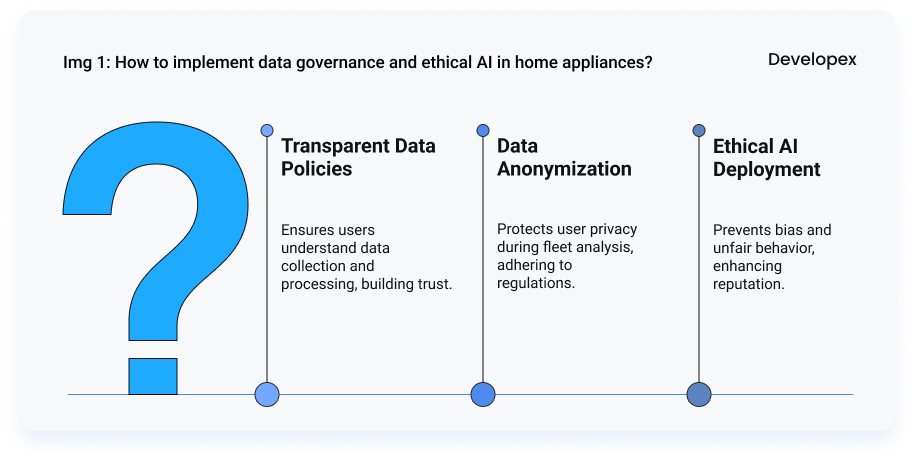
A robust Data Governance strategy is essential. Manufacturers must ensure they have transparent policies for what data is collected, where it is processed (edge vs. cloud), and how it is protected. Securing user trust requires anonymizing data streams for fleet analysis and adhering strictly to regulations like GDPR and CCPA. The ethical deployment of AI means ensuring that the personalized features do not introduce bias or unfair behavior, reinforcing the appliance’s reputation for fairness and reliability.
4. Developex Core Competency: From Bare Metal to Cloud Ecosystems
The complexity of modern smart appliances demands a partner with end-to-end capabilities, ensuring that strategic AI vision translates into reliable, market-ready embedded products. Developex specializes in bridging the gap between low-level hardware control and high-level AI services, providing a comprehensive, full-stack solution for appliance manufacturers.
Our core competencies cover the entire product lifecycle:
- Embedded Systems and Firmware Mastery: Deep proficiency in C/C++ for MCUs and RTOS (e.g., FreeRTOS) for deterministic, low-latency control. Expertise in optimized Device Drivers and HALs.
- Robust IoT Connectivity and Security: Expertise in integrating multi-protocol wireless solutions (Wi-Fi, BLE, Zigbee) and implementing Secure OTA updates and hardware-based encryption from design phase one.
- Full Digital Ecosystem Development: Delivery of the complete external solution, including intuitive Mobile Companion Applications (iOS, Android) and resilient, scalable Cloud Infrastructure (AWS, Azure,or GCP) for fleet management and AI model retraining.
5. Product Management Framework for AI Integration
To prevent feature bloat and ensure capital is allocated efficiently, Product Managers must subject every proposed AI feature to a rigorous, multi-phase vetting process. This framework ensures the final product delivers features that are not only technologically feasible but also commercially valuable and strategically differentiated.
A Three-Phase AI Product Vetting Process
| Phase | Core Question | Strategic Criteria | Key Metrics / Outcome |
| Phase 1: The “Must-Have” Filter | Does the AI solve a critical, well-defined user pain point? | The feature must address a problem that the user actively wants to eliminate (e.g., energy waste, unexpected breakdowns, poor performance). A simple convenience is not enough. | User Pain Score (UPSC), Market Research Gap Analysis. Outcome: Validated Problem Statement. |
| Phase 2: The “Feasibility” Assessment | Is the necessary high-quality data available and is the technology viable within cost? | Vetting the Data Readiness Level (DRL), confirming the existence of necessary training data, and verifying the embedded hardware (chipset, memory, sensors) can handle the required inference processing within the target BOM cost. | Data Readiness Level (DRL), Cost-to-Implement (CTI), Hardware Utilisation Metrics (HUM). Outcome: Validated Technical Solution. |
| Phase 3: The “Competitive Edge” Review | Does this AI feature create a sustainable, defensible competitive advantage? | The feature must be difficult for rivals to copy quickly. It should drive ecosystem lock-in (if applicable) or fundamentally redefine the product category, justifying a premium price and driving brand loyalty. | Feature Stickiness Index (FSI), Differentiation Score (DS), Premium Price Achieved. Outcome: Validated Business Case and Go-to-Market Strategy. |
Conclusion: Building the Next Generation of Truly Intelligent Appliances
The journey from a connected appliance to a truly intelligent one is complex, but the market reward for getting it right is significant. The successful appliance manufacturer of the next decade will be the one that strategically deploys Artificial Intelligence where it delivers demonstrable, non-trivial value – in predictive maintenance, personalized performance, and optimized resource use. They will avoid the pitfalls of superficial intelligence, opting for the lean, efficient power of Edge AI where latency and privacy are paramount.
For executive and engineering leadership, the immediate mandate is clear: halt feature redundancy and focus resources on a robust, full-stack architecture. This shift requires not just a technology upgrade, but a change in product development philosophy, prioritizing a strong embedded software development partner with proven expertise.
Developex stands ready to be this partner, offering the deep technical capability to handle everything from Bare Metal programming and RTOS optimization to scalable cloud infrastructure solutions. By collaborating strategically, manufacturers can successfully navigate the complexities of AI integration, delivering a truly intelligent, high-ROI product that secures market leadership for years to come.