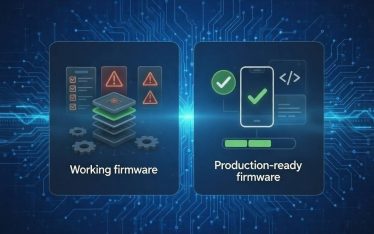

Most SaaS products do not fail because of bad ideas; they fail because the foundations laid during the MVP stage quietly sabotage growth. Founders often repeat the same reassuring mantra: “Let’s just validate the idea first. We’ll scale later.” On the surface, it sounds pragmatic. In reality, it is one of the most expensive assumptions a SaaS team can make.
In fact, MVPs are frequently the first production systems – the base that early customers rely on and the code that future teams must extend under pressure. The gap between an MVP and a “real product” has almost disappeared. Customers now expect enterprise-grade reliability, security, and seamless integrations from day one, regardless of your user count.
For founders, the risk is financial. A rigid MVP often leads to total rewrites, missed market windows, and investor skepticism. For CTOs, the risk is architectural debt that constrains every future decision and increases operational costs precisely when the company should be accelerating. This guide outlines the strategic decisions required to build for the long-term without compromising your runway.
- 1. PoC vs. MVP: Where the Scalability Fallacy Begins
- 2. The Scalability Strategy: Balancing Economic Risk with Architectural Depth
- 3. Architectural Strategy: The Modular Monolith as the High-Growth Engine
- 4. Technology & Cloud: Maximizing Runway and Talent
- 5. Cost Optimization Through Strategic Abstraction (The Build vs. Buy Framework)
- 6. Data Integrity: Preventing the "Terminal Debt" of Poor Architecture
- 7. Governance and Execution: The Scalable MVP Process
- Conclusion: Scaling Beyond the Fallacy
1. PoC vs. MVP: Where the Scalability Fallacy Begins
Before discussing scalable MVPs, it’s critical to clarify a distinction that is often blurred: a Proof of Concept (PoC) is not an MVP. Treating them as interchangeable is where many scalability problems begin.
A PoC exists to answer narrow, high-risk questions – technical feasibility, UX feel, or basic viability. At this stage, architecture quality and code purity are intentionally deprioritized. Hardcoded logic, shortcuts, and throwaway code are acceptable because a PoC is a learning artifact, not a production system. For this reason, the PoC stack may differ entirely from the final product stack, favoring speed of experimentation over long-term efficiency.
The scalability fallacy appears when a PoC quietly turns into an MVP. An MVP is production software – the version real users rely on and pay for. While messiness is acceptable in a PoC, the moment you move to an MVP, you are no longer experimenting – you are laying the foundation of the company.
2. The Scalability Strategy: Balancing Economic Risk with Architectural Depth
Startups often fail by falling into one of two traps: over-engineering (wasting resources on complex tools too early) or creating “disposable” MVPs (ignoring architecture for speed). While over-engineering drains cash, technical debt from rushed shortcuts acts like compound interest – accelerating development today only to increase future costs exponentially.
The financial stakes of ignoring foundational scalability are high:
- High Failure Rates: 60% of MVPs fail to scale due to weak foundations, often requiring a total rebuild within 18 months.
- The Rebuild Tax: Emergency rebuilds typically cost 2–3x the original budget ($50k–$250k+) and increase long-term ownership costs by 15–25%.
- Soft Costs: Performance issues can spike customer churn by 20–30%, while “velocity decay” turns simple tasks into weeks of remediation.
The Strategic Solution: The 10–20% Buffer. The most successful startups treat architecture as “velocity insurance.” According to CISQ/Synopsys report and COCOMO II software economic models, early architectural investment (roughly 10–20% of initial effort) provides ‘velocity insurance’ that can reduce long-term remediation costs by over 50%.
2.1 The Five Dimensions of Modern Scalability
Modern scalability is less about handling a million concurrent users and more about the system’s ability to adapt to changing business requirements without collapsing. For a SaaS MVP, we must look at scalability through three distinct lenses:
Technical (Performance): Ensuring the stack handles growth (e.g., horizontal scaling) so data queries don’t lag as records grow from thousands to millions.
Product (Flexibility): Avoiding “hard-coded” logic. If you need to pivot from a flat subscription to usage-based billing, your architecture must support the shift.
Organizational (Velocity): Ensuring the codebase is modular and documented so you can double your team size without halving individual productivity.
Integration (Connectivity): Using a clean API layer so connecting to a new CRM or ERP doesn’t become a custom-coded nightmare.
Operational (Efficiency): Using managed services and “infrastructure as code” so a small team can manage a complex environment without a massive DevOps department.
3. Architectural Strategy: The Modular Monolith as the High-Growth Engine
The core decision for a scalable MVP lies in selecting the foundational architecture. This choice must deliver maximum speed-to-market while ensuring structural integrity. The consensus among high-growth practitioners favors the Modular Monolith as the optimal starting pattern.
3.1 Monolith vs. Microservices: Choosing the Right Starting Point
For the initial stage of seeking PMF, architectural complexity is an enemy of velocity.
Monolithic architectures are simpler to start with, requiring less up-front planning and facilitating faster development iteration and deployment cycles. They eliminate the high initial complexity and infrastructure overhead associated with managing multiple separate services, which delays getting the product into the hands of users.
In contrast, a microservices architecture requires substantial time and effort for initial design, necessitating the identification of distinct, independent functions and the planning of consistent APIs. This higher initial investment and management complexity are generally not justifiable for an early MVP. Deploying microservices too early can create more complexity than value, turning the MVP into a maintenance nightmare before the core business idea is even validated. The consensus is clear: the initial focus should be on simplicity and speed, reserving microservices for the Decomposition phase when scale necessitates it.
3.2 The Modular Monolith Pattern: Structuring for Evolvability
The Modular Monolith is a pragmatic middle ground: it maintains a single deployment unit while enforcing the strict logical separation found in microservices. This approach minimizes the cost of future scaling by organizing the codebase into distinct modules based on business domains (e.g., Billing, Auth).
Key Principles and Benefits:
- Encapsulation: Modules communicate via defined internal APIs, reducing interdependencies and protecting the system from becoming a “big ball of mud.”
- Reduced Cognitive Load: New developers can master specific domains without needing to navigate the entire codebase.
- Seamless Decomposition: When a module outgrows the monolith, it can be extracted into a microservice with minimal refactoring.
- Organizational Scalability: Clean boundaries allow multiple teams to work in parallel without friction, aligning technical structure with team growth.
By investing 10–20% more effort in upfront structure, you avoid the high costs of untangling tightly coupled code later, ensuring long-term flexibility and steady delivery.
3.3 Infrastructure and Deployment Flexibility
While avoiding premature adoption of complex orchestration tools is necessary, establishing a foundation of deployment flexibility is critical. Using tools like Docker for containerization from day one is essential. Docker standardizes the environment, optimizes resource utilization, and makes deployment consistent across development, staging, and production environments. This immediate adoption of containerization, though seemingly a premature complexity, is the lowest-level abstraction required to prepare the application for cloud-native deployment and eventual decomposition into separate services.
The typical startup architectural evolution moves from the initial Concept Phase (Monolith for validation) to the Stabilization Phase (Modular Monolith for growth preparation), and eventually to the Decomposition Phase (Microservices) when sustained user adoption and complexity demand independent scaling. Containerization facilitates this natural progression, ensuring the code is packaged appropriately for efficient DevOps and automatic scaling later.
4. Technology & Cloud: Maximizing Runway and Talent
The technology stack and cloud environment you choose are the primary drivers of your burn rate. Strategic selection at this stage is critical; research indicates that the majority of MVPs fail to scale specifically due to weak technical foundations, often necessitating a complete architectural overhaul within their first two years of operation. Such a rebuild doesn’t just drain capital – it paralyzes your ability to iterate during a critical growth window.
4.1 The Stack: Minimizing “Talent Debt”
Scale isn’t just about servers; it’s about hiring velocity. Choosing proven technologies ensures you aren’t held hostage by a tiny talent pool or unproven libraries.
- Proven Backends: Node.js, Go, or Python (FastAPI/Django) are the “gold standard” for MVPs. They offer massive community support and pre-built modules that shorten time-to-market.
- Mainstream Frontends: React or Vue.js ensure that user interfaces remain performant and that new developers can contribute on day one.
- The Goal: Choose a stack with a deep talent pool to minimize long-term hiring costs and maintenance risks.
4.2 Cloud Strategy: Speed Over “Lock-in”
Early-stage startups should prioritize managed services over infrastructure control. While “multi-cloud” sounds safe, the speed and cost-efficiency of a single-provider (AWS, GCP, Azure) is superior for an MVP.
- PaaS for Speed: Use platforms like Heroku or Railway initially. They remove the “DevOps tax,” allowing your team to focus 100% on features rather than server maintenance.
- Managed Databases: Use Amazon Aurora or similar. It automates backups and scaling, deferring the need for a dedicated Database Administrator.
4.3 Strategic Cost Offloading
To keep hosting costs low ($500 vs. $5,000/month), you must strategically offload “heavy” or “spiky” tasks:
- Serverless for “Spiky” Tasks: Don’t pay for 24/7 servers for tasks like image processing, overnight backups, or third-party webhooks. Use Serverless Functions (AWS Lambda) to pay only for the milliseconds you actually use.
- Edge Caching (The Quick Win): Implement a CDN (Cloudflare) and a caching layer (Redis) from the start. This reduces the load on your primary database, “buying” you months of extra time on your existing budget before needing a server upgrade.
5. Cost Optimization Through Strategic Abstraction (The Build vs. Buy Framework)
To scale an MVP without draining the runway, founders must adopt a philosophy of ruthless prioritization to optimize development cost. This involves distinguishing between a startup’s proprietary business logic – the specialized functionality that creates market value – and utility components that are better served by third-party integrations. By concentrating engineering talent exclusively on the core 10–20% of the product that provides unique competitive advantages, teams can accelerate market entry and ensure internal efforts are reserved for innovation that cannot be replicated.
5.1 The Strategy: Build the Differentiator, Buy the Rest
A startup’s primary mandate is to validate a business idea, not to solve solved problems. Internal resources should be strictly reserved for Core Intellectual Property: the proprietary algorithms, specialized matching engines, or unique user workflows that define the brand. For everything else, the “Buy” option (integrating existing APIs) should be the default stance.
The hundreds of thousands of specialized services in the modern API economy allows a small team to deploy enterprise-grade features in days. This strategic outsourcing doesn’t just save time; it ensures the product is “compliant by default” by utilizing vendors whose entire business model is built around security and reliability.
| Domain | Recommended Strategy | Strategic Advantage |
| Core Value Prop | Build In-House | Owns the IP; creates a competitive moat. |
| Identity & Auth | Integrate (e.g., Clerk, Auth0) | Inherit MFA and token security instantly. |
| Payments & Tax | Integrate (e.g., Stripe, Paddle) | Transfers the risk of PCI compliance and global tax logic. |
| Infrastructure | Managed Services (PaaS) | Eliminates the need for a dedicated DevOps team early on. |
5.2 The Hidden ROI: Liability Transfer and TCO
The decision to “Buy” isn’t just about saving upfront development hours; it is an exercise in managing the Total Cost of Ownership (TCO). When a team builds a custom authentication or payment system, they inherit a permanent liability of security patches, compliance updates, and maintenance cycles.
By strategically integrating third-party experts, the startup transfers these high-risk liabilities to the vendor. This ensures that as the regulatory landscape changes (such as new GDPR or PCI-DSS requirements), the burden of compliance falls on the service provider, not the startup’s limited engineering team. This “compliance-as-a-service” model effectively buys the company more time to focus on growth while maintaining a professional-grade risk profile for future investors.
6. Data Integrity: Preventing the “Terminal Debt” of Poor Architecture
If application logic is tightly coupled, it slows development; if data is tightly coupled, it demands a high-risk, high-downtime migration that can paralyze a growing company. Data debt is the most intractable form of technical debt. While code can be refactored relatively easily, moving or restructuring live production data is a complex surgical operation. Avoiding this requires a data layer designed for “logical independence” from day one.
6.1 The Isolation Mandate: Logical Ownership
The primary guiding principle for a scalable data model is that services must logically own their data stores, even if they share a single physical database during the MVP phase. In a traditional “big ball of mud” monolith, any part of the code can query any table. This creates unintentional coupling where a simple schema change in the “Users” table might break the “Billing” or “Reporting” modules.
The 10–20% strategic budget buffer is best spent enforcing API-driven data access, even internally. By ensuring that modules only interact with each other’s data through defined interfaces rather than direct database joins, you ensure that any module can be extracted into a standalone microservice later without a painful data divorce.
6.2 The Foundation: PostgreSQL and Schema Governance
For most SaaS MVPs, PostgreSQL remains the gold standard. Its strict transactional integrity and support for advanced features like Row-Level Security (RLS) provide the necessary guardrails for multi-tenant environments. However, the tool is only as good as the governance applied to it.
Future-proofing the schema requires a commitment to Standardized Traceability. Every table must include non-nullable created_at and updated_at timestamps to provide the audit trail necessary for debugging and future data pipelines. Furthermore, adopting strict naming conventions – such as explicit foreign keys (e.g., user_id instead of just id) and specific data types (e.g., DATE over TIMESTAMP when time is irrelevant) – reduces the cognitive load for new engineers and prevents “data drift” as the team scales.
6.3 Deployment Safety and Multi-Tenancy
To maintain long-term integrity, schema changes must be treated with the same rigor as code changes. A mature technical governance process requires that every database migration undergoes a code review and is tested against a copy of production-grade data in a staging environment. Most importantly, every migration must include a verified rollback plan to prevent catastrophic failures during deployment.
For startups targeting enterprise clients, Multi-Tenancy must be an architectural consideration, not an afterthought. Designing the data model to handle logical separation (where multiple customers share infrastructure but remain invisible to one another) ensures that you can meet enterprise security requirements without a total rebuild. Ignoring these modularity principles at the data layer virtually guarantees that your eventual shift to a distributed architecture will be a costly, high-risk event.
7. Governance and Execution: The Scalable MVP Process
Scalability is not a one-time architectural decision; it is a continuous engineering discipline enforced by rigorous governance and operational practices. These practices are essential for sustaining development velocity and ensuring the product remains upgradeable.
7.1 Managing Technical Debt as a Feature
While technical debt may be a strategic choice in the short term to hit immediate release goals, failure to prioritize and address that debt quickly leads to increased development costs and risks to production systems. Preventing technical debt is easier than undoing it.
Founders must establish a regular Refactoring Cadence. Scheduling recurring sessions, even small ones, to clean up accumulated debt is vital. This consistent habit keeps the system healthy and prevents the codebase from becoming complex and challenging to update, which is a common stressor in monolithic systems. This practice ensures sustainable feature development rather than requiring costly, large-scale rewrites later.
7.2 Quality, Testing, and Deployment Automation
Investing in quality early is not about perfection, but about preventing the chaos that scaling a messy process creates. Lightweight quality practices should be standard: every new feature should be reviewed by at least one teammate, and critical customer paths (sign-up, core actions, payments) must be rigorously tested before every release.
Implementing Automated Testing throughout the development lifecycle helps identify and resolve bugs rapidly. Furthermore, integrating Continuous Integration and Deployment (CI/CD) pipelines automates the process of code changes, testing, and delivery. Robust governance, defined by CI/CD and consistent code reviews, ensures that the team can iterate rapidly and reliably. This high velocity directly correlates with a faster ability to gather and act on user feedback, thereby accelerating the path to PMF. If development processes lack rigor, every change carries a high risk, forcing caution that slows iteration and delays the critical validation phase.
7.3 Utilizing Data for Guided Scaling Decisions
The objective of a scalable MVP is to maximize adoption. The initial build must therefore bake in robust analytics from version one. Usage insights, adoption metrics, and churn predictors are essential technical foundations, strengthening the product vision with real user behavior data.
The team must maintain a continuous feedback loop with users and data to guide development and scaling efforts. Neglecting this feedback – the primary mission of the MVP – is a critical failure point. Analytics reveal where adoption is occurring and, critically, where the architectural stress points are emerging. By prioritizing data collection early, founders ensure that their strategic investment in scaling is spent on the exact components the market actually uses, rather than on theoretical or anticipated scaling solutions.
Finally, while initial infrastructure scaling can be reactive, founders should understand that future cost optimization hinges on moving towards Predictive Scaling Approaches. This method uses historical data, seasonal trends, and marketing events to anticipate and provision required capacity before demand peaks, a practice shown to reduce peak provisioning costs significantly in successful e-commerce examples.
Conclusion: Scaling Beyond the Fallacy
The “SaaS Scalability Fallacy” presents a false choice between speed and stability. Founders who view their MVP as a disposable asset often find themselves trapped in a cycle of emergency rebuilds that drain both capital and momentum. Conversely, those who treat early architecture as velocity insurance secure a significant competitive advantage.
By prioritizing a Modular Monolith and maintaining a disciplined Build vs. Buy framework, you create a system that is both lean today and extensible tomorrow. This approach ensures that your engineering resources remain focused on your proprietary innovation, while your infrastructure stays prepared for the inevitable transition to more complex, distributed systems.
Ultimately, the goal of a scalable MVP is to ensure that your technical foundation never becomes the ceiling for your business growth.
Build Your Future-Proof Foundation with Developex
Navigating the balance between rapid market entry and long-term scalability requires more than just code – it requires a partner with deep architectural expertise. At Developex, we specialize in helping startups bridge the gap between initial validation and enterprise-grade growth, ensuring your MVP is built to sustain success from the very first user.
Ready to build a product that scales as fast as your vision? Contact Developex today to consult with our experts and transform your technical strategy into a competitive advantage.