
The embedded software market is undergoing one of its most dynamic transformations in decades. As IoT connectivity, edge AI, automotive intelligence, and industrial automation move from experimental to mainstream, demand for specialized embedded engineers is rising sharply – while qualified talent remains in critically short supply. According to Grand View Research, the global embedded software market was valued at over $17.9 billion in 2024 and is projected to grow at a compound annual growth rate of 9.5% through 2030. Yet this surge in demand is colliding with a talent pipeline that has not kept pace, pushing developer rates upward in high-cost regions and creating strategic pressure on engineering budgets across North America, Western Europe, and beyond.
For technology executives – whether building consumer audio devices, medical-grade IoT hardware, or next-generation automotive systems – the decision of where and how to hire embedded talent is among the most consequential cost decisions they will make this year. Embedded development is not a commodity; it requires deep knowledge of hardware constraints, real-time operating systems, low-level C/C++ programming, communication protocols, and the intersection of software with physical systems. This specialization creates wide variability in what organizations pay: a senior embedded engineer in San Francisco may command $160 or more per hour, while an equally skilled counterpart in Kyiv or Lviv is available for $55–$75. Understanding these differentials – and the trade-offs that accompany them – is essential for any organization seeking to build or scale an embedded product team.
In the sections that follow, this article examines embedded developer rates across the key global hiring markets, draws direct comparisons between in-house hiring, outsourcing, and team augmentation, explores the factors that shape pricing in this niche discipline, and highlights the structural market forces that will influence embedded talent costs throughout 2026 and beyond.
In this post, we will discuss embedded developer rates globally, compare hiring models, and provide strategic insights to help organizations make informed engineering investment decisions.
- 1. Embedded Software Developer Rates by Region and Seniority (2026)
- 2. Global Embedded Developer Rate Comparison Table (2026)
- 3. In-House Hiring vs. Outsourcing vs. Team Augmentation
- 4. Key Factors That Influence Embedded Development Costs
- 5. Market Trends Shaping Embedded Developer Pricing in 2026
- 6. Ukraine and Eastern Europe as Embedded Development Hubs
- 7. Developex: Embedded Systems Expertise at Scale
- 8. Strategic Recommendations for Technology Leaders
- Conclusion
1. Embedded Software Developer Rates by Region and Seniority (2026)
The embedded engineer hourly rate varies dramatically by geography, seniority level, and engagement model. The following regional breakdown reflects blended agency, staff augmentation, and direct contract rates sourced from platforms and surveys including Glassdoor, ZipRecruiter, Accelerance, and Upwork data as of late 2025 and early 2026.
1.1 North America (United States and Canada)
- Junior embedded engineers (0–2 years): $65–$90/hr in the US; $55–$75/hr in Canada
- Mid-level engineers (3–5 years): $85–$120/hr in the US; $70–$100/hr in Canada
- Senior engineers (6+ years): $120–$180+/hr in the US; $100–$150/hr in Canada
Annual salaries for US embedded engineers range from $103,500 to $184,000, with top earners at specialist firms exceeding $200,000 (ZipRecruiter, December 2025)
Total employment cost for an in-house senior engineer including benefits, taxes, and overhead typically adds 30–40% above base compensation
1.2 Western Europe (Germany, UK, Netherlands, France)
- Junior engineers: $55–$75/hr equivalent
- Mid-level engineers: $70–$100/hr
- Senior engineers: $90–$130/hr
Western European embedded development costs remain high, driven by strong demand in automotive (Germany) and telecommunications (UK, Netherlands) sectors
Senior rates in Nordic countries and Switzerland can exceed €110/hr for domain-specialized engineers in safety-critical or automotive contexts
1.3 Ukraine
- Junior engineers: $20–$35/hr
- Mid-level engineers: $35–$55/hr
- Senior engineers: $55–$75/hr
Ukraine fields a talent pool of approximately 238,000–300,000 IT specialists, with Kyiv and Lviv as the primary embedded engineering hubs
ICT exports from Ukraine exceeded $6 billion in 2024, demonstrating the durability of the country’s tech sector even under wartime conditions
Ukrainian engineers deliver strong performance in Fintech, IoT, cybersecurity, and embedded systems – with a reputation backed by more than 4,000 software development companies operating in the country
1.4 Eastern Europe (Poland, Romania, Czech Republic, Bulgaria)
- Junior engineers: $25–$40/hr
- Mid-level engineers: $40–$65/hr
- Senior engineers: $65–$90/hr
Poland and Czech Republic are entering a higher-cost phase as senior-level demand grows; Romania and Bulgaria remain more cost-competitive at $25–$65/hr for most seniority levels
The region offers strong STEM foundations, EU legal frameworks, and cultural alignment with Western clients
1.5 Asia (India, Vietnam, Philippines)
- Junior engineers: $15–$28/hr
- Mid-level engineers: $25–$50/hr
- Senior engineers: $40–$70/hr
India remains the world’s largest outsourcing market by volume, though quality variability is significant; Vietnam and the Philippines are growing rapidly for mid-tier embedded work
Time zone differences of 10–13 hours from North America create real collaboration friction for iterative embedded projects requiring close hardware-software feedback cycles
2. Global Embedded Developer Rate Comparison Table (2026)
The table below provides a structured view of embedded software developer hourly and monthly rates across key hiring markets, organized by seniority level. All figures are in USD and reflect blended outsourcing and staff augmentation rates from current market data.
| Region / Country | Junior ($/hr) | Mid-Level ($/hr) | Senior ($/hr) | Mid-Level ($/mo) | Senior ($/mo) |
| United States | $65–$90 | $85–$120 | $120–$180+ | $8,500–$15,000 | $12,000–$20,000+ |
| Canada | $55–$75 | $70–$100 | $100–$150 | $7,000–$12,000 | $10,000–$18,000 |
| Western Europe (Germany, UK) | $55–$75 | $70–$100 | $90–$130 | $7,000–$12,000 | $10,000–$16,000 |
| Ukraine | $20–$35 | $35–$55 | $55–$75 | $2,500–$5,500 | $5,500–$9,000 |
| Eastern Europe (Poland, Romania) | $25–$40 | $40–$65 | $65–$90 | $3,000–$7,000 | $6,500–$11,000 |
| India | $15–$25 | $25–$45 | $40–$65 | $2,000–$4,000 | $4,500–$8,000 |
| Southeast Asia (Vietnam, Philippines) | $15–$28 | $28–$50 | $45–$70 | $2,200–$4,500 | $5,000–$9,000 |
* Monthly estimates based on ~160 billable hours. In-house costs in US/EU include employer taxes and benefits overhead. Sources: Glassdoor (Jan 2026), ZipRecruiter (Dec 2025), Accelerance, Index.dev, Devico, DistantJob.
3. In-House Hiring vs. Outsourcing vs. Team Augmentation
When organizations evaluate their embedded development investment strategy, the choice between building an internal team, contracting a turnkey outsourcing partner, or augmenting an existing team with specialized nearshore engineers involves trade-offs across cost, speed, quality control, and long-term product knowledge. There is no universal answer, but a clear-eyed analysis of each model reveals where each delivers the best return.
Building an in-house embedded engineering team in North America or Western Europe remains the most expensive option by a significant margin. Beyond base salaries – which for senior US embedded engineers now average $128,000–$168,000 annually according to ZipRecruiter and Glassdoor – employers must factor in benefits, payroll taxes, equity, recruiting fees, onboarding time, and the ongoing cost of retaining specialized talent in a highly competitive market. Total cost of employment routinely runs 30–40% above base salary. Recruiting timelines for senior embedded engineers in the US commonly exceed 12–16 weeks, a timeline that can be devastating for hardware-software development cycles that are already constrained by silicon lead times and certification deadlines. That said, in-house engineers bring unmatched institutional knowledge, full-time focus, and tight integration with hardware and product teams – advantages that matter most for core IP development.
Pure outsourcing – engaging a third-party development firm to own a scope of embedded work – can significantly reduce direct costs, but introduces its own risks. Quality control, domain knowledge transfer, and IP protection vary widely by vendor. For embedded systems work specifically, where firmware bugs may not surface until hardware is in production, the cost of rework can rapidly erode the savings achieved through lower hourly rates. Projects in safety-critical domains such as medical devices or automotive systems require partners with verifiable domain expertise, quality process certifications, and a track record in the relevant vertical.
Team augmentation – adding vetted, dedicated embedded engineers from a trusted nearshore partner to work alongside internal teams – has emerged as the most strategically balanced model for many organizations. Engineers are embedded in the client’s workflow, communicate in the client’s time zone overlap window, use the client’s tools and processes, and build domain knowledge over time. For companies working with partners in Ukraine or Eastern Europe, the 6–8 hour time difference with the US East Coast enables a meaningful window of same-day collaboration, and the 0–2 hour difference with Western Europe provides near-perfect synchronization. The cost savings compared to in-house North American or Western European hiring routinely exceed 50–60% for comparable senior-level talent.
Hiring Model Comparison
| Factor | In-House (US/EU) | Offshore Outsourcing | Team Augmentation (Ukraine/E. Europe) |
| Hourly Cost | $65–$180+ | $20–$75 | $35–$75 |
| Monthly Cost (Senior) | $12,000–$20,000+ | $5,000–$10,000 | $5,500–$9,000 |
| Annual Overhead* | +30–40% | Included in rate | +10–15% |
| Ramp-Up Time | 8–16 weeks | 4–12 weeks | 2–6 weeks |
| Time Zone Alignment | Full | Partial / None | Partial (CET overlap) |
| IP & Security Control | High | Variable | High |
| Scalability | Slow | Medium | Fast |
| Domain Knowledge Retention | High | Risk of attrition | High |
* Annual overhead includes benefits, employer taxes, recruiting, and workspace costs for in-house models. Augmentation overhead reflects coordination and management layer.
4. Key Factors That Influence Embedded Development Costs
Embedded engineer hourly rates are shaped by a complex set of variables beyond geography alone. Organizations that understand these drivers are better positioned to evaluate vendor proposals, negotiate engagements, and avoid overpaying for generalist talent when specialist expertise is required – or vice versa.
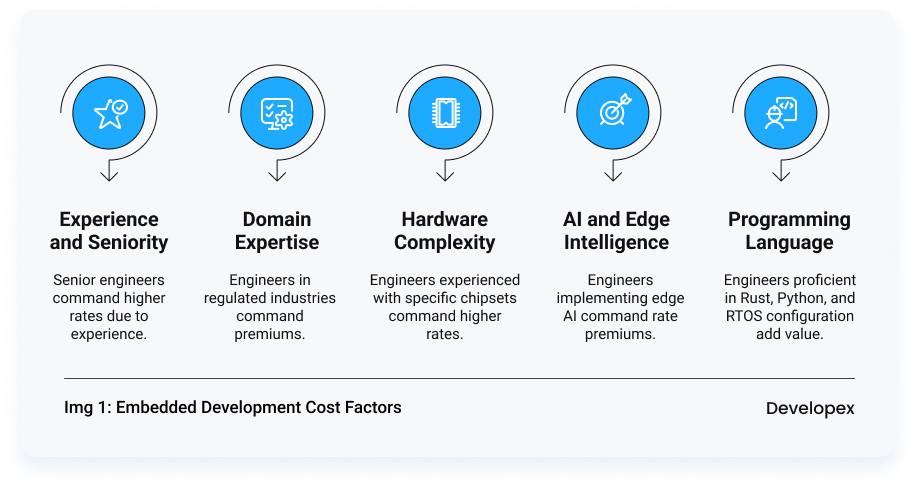
- Experience and seniority: Years of experience and demonstrated delivery record are the single strongest pricing lever in embedded development. Senior engineers with 8+ years in a relevant domain command 2–3× the rates of junior developers across every region.
- Domain expertise and vertical specialization: Embedded engineers with deep experience in regulated or safety-critical industries – medical devices (IEC 62304), automotive (AUTOSAR, ISO 26262), aerospace, or industrial control – command premiums of 20–40% over generalist embedded developers. The certification and compliance knowledge embedded in these engineers is difficult to replicate.
- Hardware complexity and MCU/SoC familiarity: Engineers experienced with specific chipsets, real-time operating systems (FreeRTOS, Zephyr, QNX, VxWorks), or communication stacks (CAN, LIN, I2C, SPI, Bluetooth Low Energy, Zigbee, Matter) are scarce and command higher rates. Complex SoC designs, FPGA integration, and heterogeneous computing architectures add additional premium.
- AI and edge intelligence capabilities: As edge AI becomes a standard expectation for connected embedded products, engineers who can implement TensorFlow Lite, TinyML, or neural network inference on resource-constrained MCUs are commanding 25–40% rate premiums over conventional embedded developers. This gap will likely widen through 2026 and beyond.
- Programming language and toolchain depth: Proficiency in C and C++ remains foundational, but engineers with additional competence in Rust (growing rapidly for firmware safety), Python (for tooling and ML integration), and RTOS configuration add measurable value – and charge for it accordingly.
- Security and OTA update expertise: Firmware security – including secure boot, encrypted OTA updates, hardware root-of-trust, and compliance with frameworks like PSA Certified – has moved from optional to standard in IoT product development. Engineers with this skill set are in short supply globally.
- Time zone and communication alignment: A 10–15% rate premium is common for engineers in time zones that provide 4+ hours of daily overlap with the client team (Index.dev, 2025). For iterative hardware-firmware development, this synchronization premium often represents exceptional value relative to the communication and rework costs it prevents.
- Engagement model and commitment length: Longer-term dedicated engagements typically carry 10–20% discounts versus short-term project contracts. Firms offering flexible scale-up and scale-down capabilities – critical for hardware development cycles with uneven resource demands – may charge modest flexibility premiums.
5. Market Trends Shaping Embedded Developer Pricing in 2026
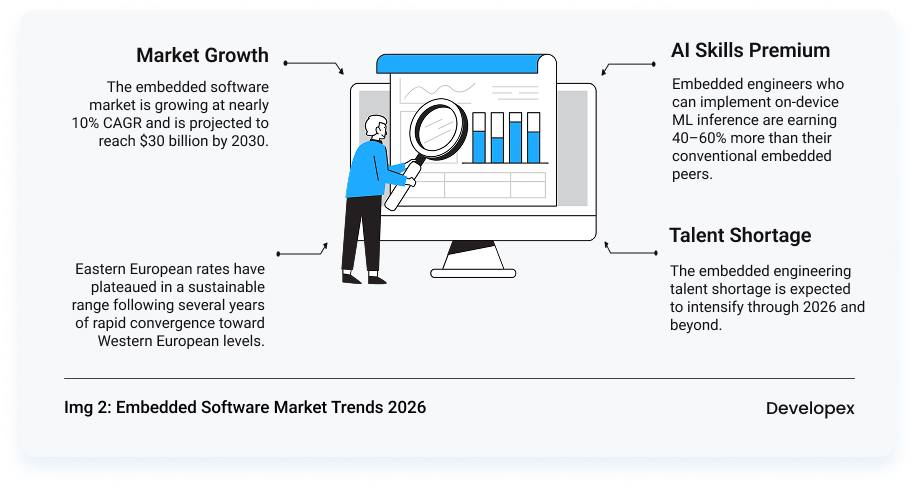
The embedded software sector is hitting a massive stride, fueled by a surge in connected IoT devices—projected to reach 41.1 billion by 2030—and the rapid electrification of automotive systems. This expansion is paired with high-stakes requirements for cybersecurity and functional safety, making the specialized nature of firmware development more critical than ever. Unlike general application development, the years of experience required for hardware-software integration and low-level debugging have created a structural scarcity that keeps talent in high demand.
While AI and edge ML expertise command the highest premiums, regional pricing dynamics offer a strategic path for scaling. Western European rates have held steady between $70–$110/hr, while Eastern European contractors have stabilized at $45–$90/hr. This creates a durable 35–45% cost advantage that persists even as technical parity grows. Ukraine remains a cornerstone of this market; despite geopolitical challenges, the nation maintained over 96% of its pre-2022 outsourcing contracts and saw ICT exports exceed $6 billion in 2024. For organizations looking to navigate the intensifying talent shortage through 2026, the focus has shifted from simple cost-cutting to securing long-term reliability through these resilient nearshore hubs.
6. Ukraine and Eastern Europe as Embedded Development Hubs
For technology leaders evaluating their embedded development cost strategy, Ukraine and Eastern Europe represent the most strategically compelling sourcing option available in 2026. The combination of technical depth, competitive pricing, time zone alignment with European clients, and cultural compatibility with Western development practices is unmatched by any other region at comparable cost levels.
- Technical talent depth: Ukraine fields approximately 238,000–300,000 active IT professionals with strong concentration in embedded systems, IoT, and industrial software. The country has a long tradition of STEM education rooted in Soviet-era engineering culture, producing graduates well-versed in low-level programming, mathematics, and systems design.
- Cost advantage: Ukrainian embedded engineers bill at $20–$75/hr depending on seniority, representing a 50–65% cost reduction compared to comparable US talent. Senior engineers capable of leading complex embedded product development are available at $55–$75/hr – a fraction of the $120–$180+/hr benchmark in North American markets.
- Embedded systems specialization: Ukrainian and Romanian development firms have built specific practice areas around embedded systems and industrial IoT, serving automotive, consumer electronics, medical device, and audio hardware verticals. This concentrated expertise is increasingly difficult to find at volume in Western markets.
- Resilience and continuity: Ukraine’s tech sector has adapted to wartime conditions with redundant infrastructure, distributed team models, and energy independence investments at delivery centers. Major embedded product companies continue to rely on Ukrainian engineering partners with high satisfaction rates.
- Western-aligned work culture and English proficiency: Over 70% of IT professionals in Ukraine have intermediate-to-advanced English proficiency. Work culture, development practices, Agile methodologies, and communication norms align closely with Western European and North American client expectations – reducing integration friction compared to more distant offshore options.
- Regulatory and IP alignment: Ukraine’s status as an EU candidate country and its Diia City legal framework for the IT sector provides a structured environment for IP protection, contract enforcement, and data privacy compliance. Western European companies benefit additionally from full time zone alignment (CET±1 overlap).
- Poland and Czech Republic for premium nearshore: For organizations requiring EU legal jurisdiction, Poland and the Czech Republic offer exceptional embedded talent at $40–$90/hr with full EU data protection and contract frameworks. These markets are best suited for larger enterprise engagements where legal formality and EU location are priorities.
7. Developex: Embedded Systems Expertise at Scale
At Developex, we specialize in embedded systems development for technology companies building consumer electronics, audio devices, IoT products, and smart home solutions. Our team brings decades of combined experience delivering production-ready firmware, Board Support Package (BSP) development, and seamless hardware-software integration for hardware-centric products where engineering precision, reliability, and efficiency are critical. We work extensively with leading MCU families and SoCs, RTOS platforms, BLE and Wi-Fi connectivity stacks, power optimization techniques, and audio DSP pipelines. This allows us to support the full embedded development lifecycle – from low-level bare-metal firmware and driver development to middleware and application-layer integration.
Beyond embedded engineering, we offer full-cycle product development, covering mobile, desktop, and web applications, as well as UX/UI design. This allows us to deliver companion apps, device management platforms, and cloud-connected interfaces alongside firmware, providing a single integrated team for your full product ecosystem. For companies planning growth beyond embedded software alone, this approach reduces coordination overhead, accelerates development, and ensures consistency across all system layers.
Whether our partners need a single embedded engineer or a full cross-functional team, we integrate directly into client workflows, contributing immediately while retaining long-term product knowledge. Our team augmentation model helps companies overcome the global shortage of embedded engineers while maintaining predictable costs, high engineering standards, and the efficiency of Eastern Europe’s engineering culture—enabling faster time-to-market, reduced development risks, and high-quality embedded products without compromise.
8. Strategic Recommendations for Technology Leaders
Optimizing your embedded development investment in 2026 requires a deliberate approach to team architecture, vendor selection, and cost-quality trade-offs – summarized in the seven principles below.
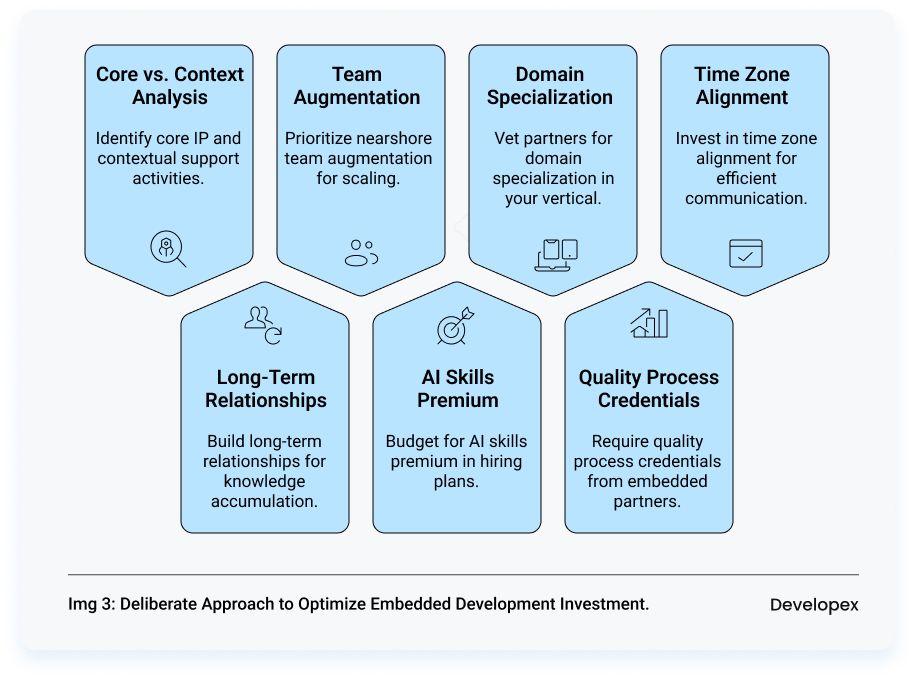
Core vs. Context Analysis. Distinguish core IP work – firmware and system architecture that differentiates your product — from contextual support activities. Reserve senior or in-house engineers for core IP; use cost-efficient augmentation for driver development, test harnesses, and documentation.
Team Augmentation. Dedicated nearshore augmentation in Ukraine or Eastern Europe delivers the best combination of quality, 50–65% cost savings versus US in-house, and delivery reliability. Avoid pure outsourcing; iterative hardware-software feedback loops favor dedicated, integrated teams.
Domain Specialization. Screen partners for experience in your specific vertical – consumer electronics, medical, industrial, or automotive – and verify familiarity with relevant certifications, protocols, and toolchains. Industry-specific depth is far scarcer than general embedded skills.
Time Zone Alignment. Synchronization is critical in embedded work. Prefer European time zone partners for EU clients, or those offering working-hour overlap for North American teams. The 10–15% rate premium typically pays for itself through reduced rework cycles.
Long-Term Relationships. Embedded knowledge of your hardware platform and product architecture accumulates over time. Treat your nearshore partner as a long-term team extension – longer engagements carry 10–20% rate discounts and steadily improve delivery quality as domain familiarity grows.
AI Skills Premium. If your roadmap includes edge AI, on-device inference, or sensor fusion, budget specifically for engineers with verified ML-on-MCU experience. These profiles are scarce globally and require targeted recruiting and rate flexibility.
Quality Process Credentials. For safety-critical work, verify partners have hands-on experience with IEC 62304 (medical), ISO 26262 (automotive), or IEC 61508 (industrial). Request vertical-specific case studies and references before engagement.
Conclusion
Embedded software development has become one of the most strategically important – and most competitively constrained – engineering disciplines of 2026. As connected devices, edge AI, and smart hardware proliferate across every industry vertical, the demand for engineers who combine hardware intuition with systems programming expertise is outpacing supply in every high-cost market. For technology leaders, this creates a clear mandate: build cost-efficient, quality-first embedded development strategies that leverage the genuine talent depth available in Ukraine and Eastern Europe, rather than competing indefinitely for scarce and expensive local engineers in North American and Western European markets.
The data is unambiguous. A senior embedded engineer in Kyiv or Lviv delivering the same capability as a Silicon Valley counterpart costs 55–65% less – not because the quality is lower, but because the market economics are different. The key is finding partners with the domain depth, process maturity, and cultural alignment to integrate seamlessly into your product development cycle. For companies building the next generation of connected products, smart devices, and embedded intelligence, that combination exists today in Eastern Europe – and the window to build those partnerships before rates converge further is now.
If you need embedded development services, contact our team to discuss your project and discover how we can help you accelerate firmware development, scale your embedded team, and bring your device to market faster.