
The moment a prototype first comes to life is an exhilarating milestone for any engineering team. You’ve spent weeks or months wrestling with data sheets, pin mappings, and signal integrity. Finally, the LED blinks, the sensor data populates the dashboard, and the motor turns exactly as commanded. In the heat of that excitement, it is incredibly tempting to tell stakeholders that the software is “done” and that the path to market is clear. After all, if the device performs its primary function under lab conditions, what else could there be to write?
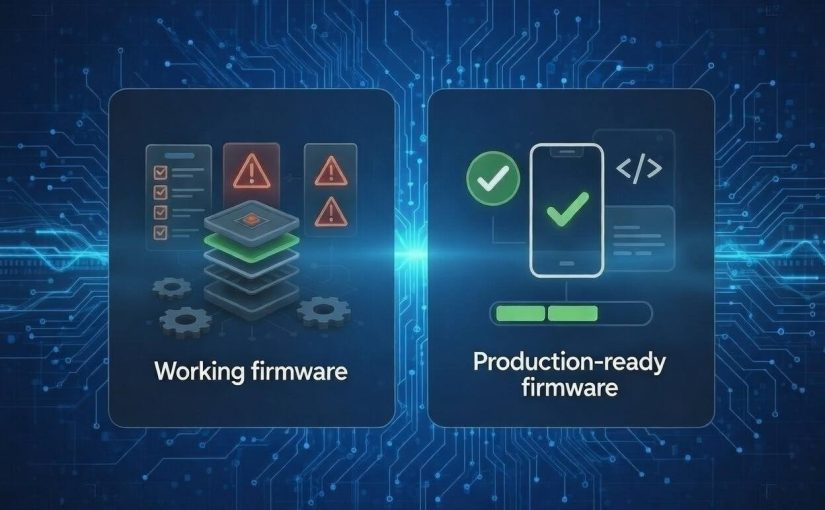
However, this is the exact moment where the most dangerous trap in hardware development is set. There is a massive, often invisible chasm between firmware that “works” and firmware that is “production-ready.” Working firmware is a proof of concept; it demonstrates that the hardware is capable of the task. Production-ready firmware, on the other hand, is a resilient insurance policy for your brand. It is the difference between a product that delights customers for years and a product that generates thousands of Return Merchandise Authorizations (RMAs) because of a minor edge case or a botched update.
The reality of the Internet of Things (IoT) and modern embedded systems is that the “happy path” – the scenario where everything goes right – only accounts for a small fraction of a device’s lifespan. In the field, devices face unstable power grids, fluctuating temperatures, malicious actors, and interrupted connectivity. If your firmware isn’t designed to handle these environmental stressors, your “working” device will quickly become a “bricked” paperweight
In this post, we will discuss the key differences between prototype and production-ready firmware, the technical requirements that separate them, and the processes teams should use to validate production readiness before scaling to mass manufacturing.
- 1. The Dangerous Illusion of "It Works on My Device"
- 2. What Production-Ready Firmware Actually Requires
- 3. Firmware Production Readiness Checklist
- 4. Common Pitfalls That Reveal Unready Firmware
- 5. The Cost of Shipping Unready Firmware
- 6. Building a Production Readiness Culture
- 7. The Staged Strategy: From Deployment to "Go-Live"
- 8. How Developex Ensures Production-Ready Firmware
- Final Thoughts: Bridging the Gap to Market Success
1. The Dangerous Illusion of “It Works on My Device”
The controlled lab environment bears little resemblance to real-world deployment chaos. In the lab, devices operate under ideal conditions – stable room temperature, clean power supplies, minimal electromagnetic interference, and reliable networks. Engineers follow documented test procedures, and skilled technicians immediately diagnose any issues. This sanitized environment creates dangerous overconfidence that evaporates when devices reach customers.
1.1 Real-World Conditions Are Mercilessly Unpredictable
Production firmware must survive environmental and operational stressors that lab testing never replicates. A device that performs flawlessly on a test bench can fail catastrophically when exposed to the volatility of the field.
| Environmental Factor | Lab Conditions | Real-World Reality |
| Temperature | Comfortable 20–22°C (68–72°F) | Scorching 46°C+ (115°F+) desert summers to −29°C (−20°F) northern winters |
| Power Quality | Stable, clean supply | Aging electrical systems, voltage fluctuations, cheap adapters |
| EMI/RF Interference | Minimal, controlled | Microwave ovens, neighboring devices, wireless network chaos |
| Network Connectivity | Reliable, high-speed | High-tier Fiber (Ultra-low latency) vs. Rural/Legacy Copper (High packet loss) |
1.2 The Sample Size Fallacy
Testing 5–10 devices provides virtually no statistical confidence about performance at scale. Consider a bug that manifests once per 1,000 operating hours — it is nearly impossible to discover during limited internal testing. However, when thousands of devices are deployed and running continuously, that “rare” bug begins surfacing regularly, generating a flood of support tickets and negative reviews.
The mathematics of scale are unforgiving: a system that appears “99% reliable” in the lab can become a persistent operational problem when multiplied across thousands of units.
1.3 Hidden Technical Debt: Shortcuts That Become Time Bombs
The rush from proof-of-concept to working prototype often accumulates dangerous technical debt. To meet demo deadlines, developers may implement quick fixes such as hardcoded IP addresses instead of robust network discovery, or commented-out error checks to bypass delays. While these shortcuts save minutes during development, they cost thousands of hours in field support. In production, these omissions translate directly into unrecoverable system states and frequent resets that erode user trust.
1.4 Time Compression Hides Long-Term Failures
Short-term testing misses the “slow-burn” issues that only emerge after weeks of continuous operation. Memory leaks unnoticeable in a 48-hour test gradually consume RAM until the device crashes after a week of runtime. Similarly, flash memory wear accelerates during heavy write cycles, leading to storage corruption months after launch. Real-world daily use also introduces thermal stress on solder joints and components that constant-temperature lab testing never replicates, leading to sluggish performance and hardware instability over time.
2. What Production-Ready Firmware Actually Requires
The difference between prototype firmware and production-ready firmware is not about features – it is about reliability, resilience, security, and scalability. A system that works during a demo may still be fundamentally unfit for real-world operation.
| Feature | Prototype Level | Production-Ready Standard |
| Error Handling | Crashes on unexpected input | Detects, logs, and recovers gracefully |
| Security | Open ports, no encryption | Secure boot, encrypted TLS 1.3 |
| Updates | Manual flashing via USB | Atomic OTA with automatic rollback |
| Diagnostics | Serial console output only | Cloud-based telemetry and crash dumps |
| Power/Memory | “Good enough” for demo | Leak-tested and flash-wear leveled |
2.1 Robust Error Handling and Recovery
Production-ready firmware is built on the assumption that failures are inevitable. Rather than crashing when an anomaly occurs, the system is designed to detect the fault, log diagnostic data, and execute a recovery sequence. If a full recovery isn’t possible, the system enters a fail-safe state – maintaining core safety functions while disabling non-critical features. This ensures that a sensor error or a network timeout doesn’t lead to a total system collapse, but rather a controlled, limited operation mode.
Essential error handling mechanisms include:
- Checking every return value and validating all inputs
- Implementing timeout protection for every network operation
- Watchdog timers that reset the system if the software hangs
- Failsafe mechanisms ensuring critical functions enter safe states during malfunctions
This approach prevents devices from freezing indefinitely and ensures safety-critical systems like medical devices or security equipment never create dangerous conditions during failures.
2.2 Comprehensive Logging and Diagnostics
Diagnostic infrastructure transforms mysterious field failures into debuggable problems. Production firmware includes telemetry systems that report operational status, error conditions, and performance metrics to cloud servers where engineering teams analyze patterns across the entire device population. When a device fails in a customer’s home, detailed logs provide the information needed to diagnose root causes without requiring return shipment for analysis. Crash dumps capture exact system state during failures, enabling developers to reproduce and fix bugs that might otherwise remain mysterious.
This diagnostic infrastructure must be designed in from the beginning – retrofitting it after problems emerge is difficult and often incomplete.
2.3 Security Hardening
Security protects devices against increasingly sophisticated attacks and meets regulatory requirements. Production firmware implements multiple defensive layers:
- Secure boot mechanisms verify firmware authenticity before execution
- End-to-end encryption protects all communications from interception
- Attack vector defenses against buffer overflowsand denial-of-service attempts — relevant primarily to Linux-based and higher-end embedded platforms with network stacks capable of handling such threats; lightweight microcontrollers typically have a smaller attack surface by nature
- Side-channel attack protection which minimizes the risk of data leaks through RF emissions, power consumption analysis, and timing measurements — a highly specialized concern applicable to security-critical devices such as payment terminals, hardware security modules, and cryptographic accelerators
- Regular security audits and vulnerability patching processes
Security isn’t optional or something to address later. Vulnerabilities discovered after shipping trigger expensive recalls and devastating publicity. Regulatory bodies now scrutinize firmware security aggressively, making it a day-one requirement.
2.4 Over-the-Air Update and Rollback Systems
OTA update infrastructure allows manufacturers to fix bugs and add features without customer intervention – but introduces significant risks if implemented poorly. Interrupted updates can permanently brick devices without proper safeguards.
Production-ready update mechanisms use atomic operations where new firmware is fully downloaded and verified before the old version is replaced, ensuring devices remain functional even if updates fail. Rollback capability automatically reverts to the previous firmware version if the new version fails post-installation validation tests, preventing bad updates from permanently disabling devices.
2.5 Resource Management Optimization
Careful resource management determines whether devices perform reliably for years or degrade prematurely. Production firmware optimizes three critical areas: memory management prevents leaks and fragmentation that cause slowdowns and crashes over time. Power consumption receives obsessive attention – every unnecessary wake cycle is eliminated, sleep modes are implemented aggressively, and peripheral devices power down when idle. Flash memory writes are minimized and distributed across the entire memory space to prevent wear-out of frequently-used sectors.
These optimizations seem minor in isolation but collectively determine whether devices meet their operational lifetime and battery life specifications.
3. Firmware Production Readiness Checklist
Evaluating firmware readiness requires a systematic assessment across multiple dimensions. The following table outlines the critical categories and criteria that must be satisfied for firmware to be considered production-ready:
Testing Coverage
Inadequate testing is the #1 reason firmware ships prematurely. Production-ready testing requires four layers: unit tests (individual functions), integration tests (component interactions), stress tests (beyond normal parameters), and compatibility testing (across hardware revisions and component suppliers).
Documentation Beyond Code Comments
Production documentation includes technical architecture (system design), API specifications (interaction protocols), manufacturing procedures (step-by-step flashing instructions), and field troubleshooting guides (customer support resources). Each serves a distinct audience and prevents bottlenecks across the product lifecycle.
Compliance and Certification
Regulatory compliance often surprises unprepared companies with its complexity and duration. For software and firmware, key considerations include industry-specific standards, functional safety requirements, and third-party security audits. Certification timelines vary widely depending on product type and regulatory scope – from several weeks for standard consumer devices to many months for high-risk or heavily regulated products. Discovering compliance issues late in development can trigger costly redesigns, updates, or launch delays.
| Category | Critical Requirements | Verification Method |
| Functional Completeness | All specified features implemented and working; edge cases handled; performance meets specifications across full operating range | Feature testing against requirements document; boundary condition testing; performance benchmarking |
| Testing Coverage | Unit tests for all components; integration tests for system interactions; stress tests under extreme conditions; compatibility across hardware revisions | Automated test suite execution; code coverage analysis; manual exploratory testing; multi-unit validation |
| Documentation | Architecture documentation; API specifications; manufacturing procedures; troubleshooting guides; regulatory compliance documentation | Documentation review; technical writing audit; manufacturing trial run; support team training validation |
| Security & Compliance | Security audit completed; regulatory certifications obtained; industry standards met; vulnerability testing passed | Third-party security audit; certification body testing; penetration testing; compliance verification |
| Field Support Readiness | Diagnostic tools available; support documentation complete; warranty policies defined; spare parts inventory established | Support team training; documentation completeness review; warranty cost modeling; logistics verification |
4. Common Pitfalls That Reveal Unready Firmware
Even when a device passes basic functional tests, subtle “production-level” bugs can destroy its market viability. These issues rarely appear on an engineer’s desk because they are triggered by long runtimes, varying power conditions, and the unpredictable nature of real-world networks. Identifying these pitfalls early is the difference between a successful launch and a costly recall.
The “Big Four” Stability Killers
- Power Management Failures: In the lab, devices have stable power. In the field, inadequate sleep mode implementation can drain batteries overnight, and poor handling of voltage fluctuations can cause constant reboots. Production firmware must obsessively manage every wake cycle and peripheral state.
- Communication Protocol Weaknesses: Prototypes often work under ideal network conditions, but real-world connectivity is far more variable. Common pitfalls include poor retry logic, which can spam servers into a lockout, or a lack of timeout handling that causes the device to “hang” indefinitely on a dropped packet.
- Memory Management Disasters: These are the most insidious issues because they manifest over days or weeks. Memory leaks and heap fragmentation gradually consume RAM until the system crashes. Production-ready code avoids these through static allocation or rigorous long-term soak testing.
- Timing and Synchronization Bugs: Race conditions and clock drift can lead to intermittent failures that are nearly impossible to reproduce in short tests. If your firmware relies on precise multi-threaded execution, it must be hardened against real-time requirement violations that occur during high CPU load.
User Experience (UX) Inconsistencies
Beyond technical crashes, unready firmware often suffers from erratic behavior during high load. If a device feels sluggish or displays confusing error states when a network is slow, it erodes user confidence. Production-level code accounts for the “unhappy path,” ensuring the device remains responsive and provides clear feedback even when background processes are failing or retrying.
5. The Cost of Shipping Unready Firmware
The direct financial impact of premature firmware releases manifests immediately through product returns and warranty claims. When devices fail in customers’ hands, manufacturers must either repair or replace them under warranty obligations. For consumer electronics, return rates above 2-3% indicate serious problems, but firmware issues can drive returns to 10% or higher. Each return involves shipping costs, processing labor, diagnostics, repair or replacement, and return shipping – easily $50-100 per unit even for inexpensive products. For a production run of 10,000 units with a 10% return rate, you face $50,000–$100,000 in direct losses. However, these figures represent only the tip of the iceberg; when you factor in support labor and brand erosion, the hidden costs of firmware bugs can significantly erode your product’s lifetime profitability.
Beyond returns, firmware failures generate a surge in customer support and engineering workload. Support interactions cost $15–30 each, and large-scale issues can create thousands of tickets. Engineering teams are pulled away from new development into firefighting, slowing future releases and increasing opportunity costs.
The longer-term damage compounds quickly. Negative reviews and social media backlash from a failed launch erode customer trust in ways that outlast the fix. In regulated industries, firmware defects can trigger mandatory recalls, legal liability, and multi-million-dollar compliance costs. Most critically, time lost fixing production issues often means missing key market windows — allowing competitors to capture demand before your product recovers.
6. Building a Production Readiness Culture
Shifting from “working” to “production-ready” requires a cultural commitment to Quality Gates. These are mandatory checkpoints where firmware must meet specific criteria – such as security audits and reliability targets – before moving from Alpha to Production. Real-world readiness also requires Realistic Timeline Planning: a common industry rule of thumb is to allocate 40% of the development cycle to stabilization and validation. Unfortunately, inexperienced management often compresses this phase to less than 10%, leading to the “panic-driven” shortcuts that inevitably compromise the final product’s integrity.
To ensure success, companies must adopt a Cross-Functional Review process. Readiness is not just an engineering metric; it involves hardware teams validating that the firmware operates within the device’s physical constraints (RAM, flash storage, CPU headroom, and power budget), manufacturing verifying flashing and provisioning procedures, and support teams confirming they have the telemetry tools needed to diagnose field failures. This 360-degree assessment ensures that when the “Go” decision is made, the entire organization – not just the code – is ready for the market.
7. The Staged Strategy: From Deployment to “Go-Live”
Smart manufacturers avoid “Big Bang” launches in favor of a staged deployment strategy. By releasing a limited number of units to a controlled pilot group, engineering teams can observe real-world performance, identify edge-case bugs, and validate the product under diverse conditions before committing to full-scale production. This approach acts as a final safety net, allowing teams to verify firmware behavior, hardware interactions, and operational workflows, regardless of whether the product is connected.
Ultimately, firmware is only production-ready when it meets both technical and business indicators:
- Technical: Zero critical bugs, passed security audits, and consistent performance benchmarks across all test units.
- Business: Validated manufacturing yields, complete support documentation, and clearly defined recovery procedures for field units, whether through remote updates or manual interventions.
The final go/no-go decision is a consensus-based risk assessment. By establishing success metrics and monitoring feedback loops during staged deployment, firmware development evolves from a one-time handoff into a continuous optimization process that protects product reliability and the brand’s long-term reputation.
8. How Developex Ensures Production-Ready Firmware
At Developex, we ensure production-ready firmware through real-world testing, not just lab validation. Our automated test pipelines, hardware-in-the-loop systems, and long-term stability testing replicate actual deployment conditions to uncover issues like memory leaks, performance degradation, and power failures before mass production.
Our production hardening approach combines:
- Embedded security (secure boot, encrypted communication)
- Firmware optimization (performance profiling, power management)
- Robust error handling (timeouts, validation, recovery mechanisms)
- Safe OTA updates with rollback support
These practices are part of our embedded software development and firmware development services, helping clients ship reliable, secure, and scalable connected products.
Finally, our independent QA teams and cross-functional validation processes ensure that firmware is reviewed not only from an engineering perspective, but also from manufacturing, support, and business standpoints.This, combined with our experience in custom software development and IoT product development, allows us to deliver firmware that remains stable, maintainable, and production-ready over its entire lifecycle.
Final Thoughts: Bridging the Gap to Market Success
The transition from a working prototype to a production-ready device is the most critical phase of the hardware lifecycle. While the prototype proves that your idea is possible, production-ready firmware ensures that your business is sustainable. By treating firmware as a resilient insurance policy for your brand – rather than a mere list of features – you protect your product from the unpredictable environments and technical pitfalls that claim so many IoT launches.
True readiness isn’t a single event but a culture of disciplined testing, strategic deployment, and continuous monitoring. Investing the necessary 40% of your development cycle into stabilization and hardening may seem like a delay, but it is actually the fastest path to a profitable, scalable product. In a competitive market, the winners are not necessarily those who ship first, but those who ship a product that stays in the customer’s home and out of the return bin.
Ready to Harden Your Firmware for Mass Production?
Don’t let hidden technical debt or environmental edge cases derail your product launch. Contact us to consult with our embedded experts on a production-readiness audit or to learn more about our comprehensive firmware development services.