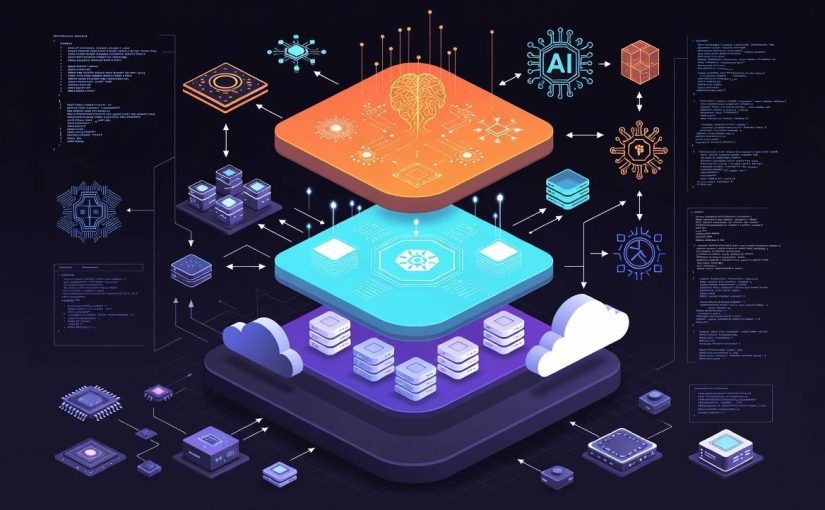
In 2026, the traditional silos between embedded engineering and high-level application development have effectively collapsed. As hardware capabilities scale and the EU Cyber Resilience Act mandates rigorous security standards, the “Modern Development Stack” is no longer just about choosing a language – it is about managing the convergence of Edge AI, RISC-V architecture, and unified cross-platform frameworks.
These shifts are part of the broader industry trends 2026 that are currently redefining how global enterprises approach product lifecycles. This transformation is driven by three critical industry pressures:
- Hardware-Software Fluidity: The requirement for seamless integration across IoT, mobile, and web using a single source of truth.
- Supervised AI Autonomy: Moving beyond simple code completion to agentic workflows that handle boilerplate while engineers focus on system architecture.
- Native-Grade Productivity: Leveraging mature tools like Qt 6.x and Rust to achieve bare-metal performance with the development speed of modern web stacks.
This guide examines the 2026 ecosystem of frameworks and methodologies – specifically tailored for industries where reliability is non-negotiable. We break down the tools enabling teams to ship sophisticated, secure, and hardware-aware products without the legacy friction of traditional embedded silos.
- 1. The New Standard in Embedded Development: From Conservative to Agile
- 2. Unified UI: Qt 6.x and the Rise of Cross-Platform Consistency
- 3. The 2026 Full-Stack Ecosystem: From Edge to Cloud
- 4. IoT Ecosystem 2026: The Shift to Matter and Hybrid Architectures
- 5. AI-Assisted Development: The New Reality
- 6. DevOps and CI/CD for Embedded Systems
- 7. Programming Languages Shaping Development in 2026
- 8. Security-First Development Practices
- 9. Conclusion: Building Resilient Foundations for 2026
1. The New Standard in Embedded Development: From Conservative to Agile
The embedded systems world has historically been conservative, favoring long-term stability over rapid innovation. However, 2026 marks a decisive shift. The traditional “stability-first” mindset has evolved into a high-velocity model where development teams must balance rigid hardware constraints with the need for cloud-like agility. This transformation is driven by a new reality: software is no longer just “supporting” the hardware – it is the primary differentiator for security, maintenance, and speed-to-market.
1.1 Intelligence at the Edge (TinyML)
Modern development now embraces edge AI capabilities that were unthinkable just a few years ago. By moving intelligence directly to the device, organizations reduce latency and cloud costs while significantly enhancing user privacy.
- Predictive Maintenance: Using real-time vibration and thermal analysis to detect equipment failure before it occurs.
- Privacy-First Voice: Enabling offline voice command processing that never sends audio data to the cloud.
- Autonomous Security: Implementing local anomaly detection for high-security environments without data streaming.
1.2 The Rise of RISC-V Open Architecture
The hardware landscape is fundamentally moving away from proprietary vendor lock-in. RISC-V has reached a level of maturity where it is now a viable, high-performance alternative to ARM. This open instruction set architecture eliminates licensing fees and, more importantly, allows developers to design custom silicon tailored to specific workloads – such as AI acceleration or ultra-low-power sensing. Supported by a robust ecosystem from SiFive, NXP, and Microchip, RISC-V ensures that teams have the flexibility to optimize hardware-software integration without being tied to a single vendor’s roadmap.
1.3 Strategic OS Selection: Linux vs. RTOS
Choosing the right operating system is no longer a “one-size-fits-all” decision. In 2026, the choice is determined by the specific trade-offs between complexity and deterministic performance.
| Feature | Embedded Linux (Yocto) | Real-Time OS (RTOS) |
| Primary Use Case | Complex UI, Networking, Multimedia | Safety-critical, Hard Real-time tasks |
| Response Time | Millisecond-level (Soft real-time) | Microsecond-level (Hard real-time) |
| Key Capability | Sophisticated OTA & container support | Deterministic scheduling & small footprint |
| Update Method | A/B Partitioning / Delta Updates | Managed Bootloaders / Secure Flash |
1.4 Advanced Power Management
Power efficiency has transitioned from a secondary “extra” to a core architectural requirement. As battery-powered and energy-harvesting IoT devices proliferate, well-optimized firmware has become a competitive differentiator. Modern stacks leverage Dynamic Voltage Scaling to adjust power in real-time based on CPU load and Context-Aware Sleep cycles that use AI to predict when a device needs to “wake,” minimizing idle consumption. Implementing these techniques can improve device longevity by up to 40%, directly reducing the total cost of ownership for enterprise deployments.
2. Unified UI: Qt 6.x and the Rise of Cross-Platform Consistency
In 2026, the demand for a “consistent brand experience” across hardware platforms has made Qt 6.x the architectural backbone for premium interfaces. Whether the target is a high-end medical monitor or a low-power industrial controller, the goal is identical: native performance from a single codebase. What sets Qt 6.x apart in this era is its Rendering Hardware Interface (RHI), which allows the same UI to run on Vulkan, Metal, Direct3D, or OpenGL, ensuring that your software remains future-proof as graphics standards evolve.
2.1 The Qt Advantage: From MCUs to Desktop
The most significant breakthrough in recent years is Qt for MCUs. It has effectively ended the era of “clunky” embedded screens by bringing smartphone-grade fluid UIs to resource-constrained microcontrollers.
- Designer-Developer Synergy: Tools like Qt Design Studio and the Figma-to-Qt plugin bridge the gap between creative vision and technical execution. Designers export functional QML code directly into the development environment, eliminating the “translation lag” that once plagued complex HMI projects.
- High-Performance Graphics: With native support for 3D rendering and real-time data visualization (via the Qt Graphs module), it is the primary choice for automotive digital cockpits and mission-critical medical displays.
- QML & Productivity: By using QML, teams separate visual design from C++ business logic. In 2026, the QML Compiler (qmltc) further optimizes this by pre-compiling UI files into C++ classes, reducing boot times by nearly 50% on low-end hardware.
2.2 Strategic Comparison: Choosing the Right UI Stack
While Qt remains the leader for high-reliability systems, 2026 has seen the stabilization of alternative frameworks for specific IoT niches.
| Framework | Best For | Performance | Key Trade-off (2026) |
| Qt 6.x / QML | Medical, Automotive, Industrial | Native | Higher initial licensing/learning curve |
| Flutter | IoT Companion Apps (Mobile/Web) | High | Uses more RAM (400MB+ vs Qt’s 90MB) |
| React Native | Consumer IoT Apps (Mobile-first) | Medium | “Fabric” architecture improves speed but still JS-heavy |
| HTML5/JS | Browser-based interfaces | Variable | Heavy CPU overhead; not ideal for battery-only nodes |
Why Industry Leaders Choose Qt
In 2026, the choice of a UI framework is often a regulatory or safety decision as much as a technical one.
- Automotive: Handling complex ISO 26262 ASIL D safety requirements for instrument clusters, where a UI lag could be life-threatening.
- Medical: Meeting strict FDA/IEC 62304 regulatory compliance with predictable, high-reliability UIs that undergo rigorous static code analysis.
- Industrial: Managing vast amounts of real-time sensor data in “single-pane-of-glass” control systems, often utilizing Qt WebAssembly to mirror the physical HMI in a remote browser securely.
3. The 2026 Full-Stack Ecosystem: From Edge to Cloud
In 2026, the software stack for a modern product extends far beyond the physical device. High-performing engineering pipelines no longer treat backend, frontend, and mobile as separate silos; they are integrated into a unified digital ecosystem. Designing these layers as a single, coherent nervous system ensures the hardware is supported at every touchpoint.
3.1 Backend: The Shift to “Serverless Edge” and Microservices
The backend of 2026 is defined by “Serverless-First” architectures and high-concurrency runtimes. Moving away from fixed server capacity, event-driven models like AWS Lambda or Cloudflare Workers allow systems to handle device signals only when they occur, which can slash operational costs by up to 30%.
- Real-Time Data Pipelines: Runtimes like Go (Golang) and Node.js (NestJS) provide the high-throughput necessary for API gateways managing 50k+ concurrent device heartbeats.
- Time-Series Intelligence: Industrial IoT requirements favor specialized databases such as TimescaleDB or Apache IoTDB, which are optimized for sub-second ingestion of massive sensor data streams.
- AI Orchestration: Modern backends are increasingly “AI-Native,” integrating RAG (Retrieval-Augmented Generation) to provide devices with context-aware responses based on cloud-side datasets.
3.2 Frontend: Mission Control via Web & Wasm
The frontend has evolved into a sophisticated “Mission Control” center. The priority for 2026 is zero-latency visualization, enabling operators to monitor and control hardware remotely with real-time precision.
- Next.js & React 19: These frameworks serve as the backbone for industrial portals. By utilizing Server-Side Rendering (SSR) and Server Components, complex telemetry data is delivered with near-instant load times.
- WebAssembly (Wasm): Performance-critical logic, such as 3D Digital Twin rendering or heavy cryptographic tasks, is increasingly ported to the browser via Wasm. This enables high-fidelity interaction with hardware without requiring local software installations.
- TypeScript Standardization: To eliminate the legacy risks of plain JavaScript, end-to-end type safety is now a baseline requirement. This ensures data points from a physical sensor are interpreted correctly by the UI, preventing “undefined” errors in critical monitoring systems.
3.3 Mobile: The Intelligent Gateway
Mobile applications have shifted from being simple “remotes” to acting as the primary Intelligent Gateway for hardware interaction.
- Kotlin Multiplatform (KMP): For logic-heavy applications, KMP allows the sharing of core “brains” – such as networking and data parsing – between Android and iOS. This ensures 100% logic consistency while maintaining the performance of a fully native UI.
- Flutter for Rapid Scaling: When speed-to-market and a unified visual brand are the priorities, Flutter remains a dominant choice for its ability to provide cross-platform consistency from a single codebase.
- Gateway Connectivity: Modern mobile stacks prioritize BLE (Bluetooth Low Energy) and UWB (Ultra-Wideband). These technologies facilitate “zero-touch” provisioning, where a device is automatically recognized and configured as soon as a user enters its proximity.
4. IoT Ecosystem 2026: The Shift to Matter and Hybrid Architectures
In 2026, the Internet of Things has moved beyond simple “connectivity.” The industry is now defined by interoperability and intelligent data reduction. Success in this domain requires a stack that minimizes latency at the edge while leveraging the cloud for long-term intelligence. The goal for any modern architecture is to ensure that a device remains functional even if the wide-area network fails, while still providing the deep analytics that only the cloud can offer.
4.1 The Core Connectivity Stack
The choice of protocol now depends on the device’s “power budget” and the urgency of the data. While MQTT 5.0 remains the dominant standard for 70% of IoT projects due to its reliable pub-sub model, CoAP has solidified its role in ultra-constrained, battery-operated nodes that require RESTful simplicity over UDP.
| Technology | Primary Role (2026) | Strategic Advantage |
| Node.js | Real-time API Gateways | Exceptional I/O handling for 50k+ concurrent connections. |
| Python | AI & Data Pipelines | The “lingua franca” for MLOps and on-server AI inference. |
| MQTT 5.0 | Mainstream Messaging | Enhanced error reporting and shared subscriptions for scale. |
| CoAP | Ultra-Constrained | Minimal overhead; ideal for “sleepy” nodes in smart cities. |
| Matter | Interoperability | Unifies Apple, Google, and Amazon into one local fabric. |
4.2 The Hybrid Edge-Cloud Model: “Process Locally, Store Globally”
The most efficient 2026 architectures follow a tiered approach to data. Instead of streaming raw data to the cloud – which is costly and introduces latency – devices now perform Local Inference.
- The Edge: Performs time-critical tasks – like emergency shutdowns, real-time vibration analysis, or local voice processing. This ensures 99.99% uptime even if the internet link is severed.
- The Cloud: Used for “Heavy Lifting” – historical trend analysis, fleet-wide OTA management via AWS IoT Core or Azure IoT Hub, and retraining deep learning models using aggregated data from thousands of devices.
4.3 Modern Device Management & Mobile Control
Companion applications are no longer “extras”; they are the primary gateway for user interaction. By 2026, Next.js has overtaken traditional MERN stacks for industrial dashboards because its Server-Side Rendering (SSR) delivers the speed required for real-time telemetry.
For mobile, Flutter leads for high-performance visual telemetry, while React Native remains the favorite for teams wanting to share logic with their web dashboards. However, Native (Swift/Kotlin) is still reserved for devices requiring complex Bluetooth Low Energy (BLE) background syncing or high-fidelity sensor integration where cross-platform layers introduce too much latency.
4.4 The Matter Standard: A Watershed Moment
In 2026, targeting the Matter protocol is a commercial requirement for any consumer smart device. Matter-certified products allow devices to work natively across all major ecosystems simultaneously.
Technical Note: Matter runs over IP, utilizing Thread for low-power mesh and Wi-Fi for high-bandwidth tasks like video. This creates a self-healing local network that doesn’t rely on the cloud for basic operations, satisfying the “Local Control” mandate that has become a top priority for 2026 consumers.
5. AI-Assisted Development: The New Reality
In 2026, the industry has transitioned from “AI-assisted” to “AI-orchestrated” development. This shift means the value of a senior engineer has moved from “writing lines of code” to architecting systems and supervising autonomous agents. While earlier years were about AI answering questions, 2026 is the year AI becomes a true partner – moving from simple autocomplete to systems that understand entire repositories, reason about intent, and coordinate multi-step tasks across the terminal, browser, and IDE.
5.1 The AI Trust Paradox: Adoption vs. Reliability
Despite near-universal adoption (with 84–90% of developers using AI daily), 2026 has introduced a “Trust Paradox.” While AI can now generate up to two-thirds of a project’s code, professional confidence in its functional correctness has actually plateaued or declined.
- The Productivity Trap: 45% of developers report that debugging “almost correct” AI code takes longer than writing it from scratch.
- The Context Gap: While LLMs have massive context windows, they often miss the subtle hardware constraints (e.g., race conditions or memory-mapped I/O) inherent in embedded systems.
- The Strategy: Leading teams now use a “Verification Loop.” AI proposes a solution, but a human engineer validates it against a strict set of architectural “Golden Paths” and safety-critical requirements.
5.2 Agentic Toolkit 2026: Choosing Your “Partner”
The market has bifurcated into Visual IDEs for flow and Terminal Agents for complex reasoning. Most experienced engineers now use a multi-tool approach depending on the task.
| Tool | Category | Best Use Case | Key 2026 Feature |
| Cursor | AI-Native IDE | Rapid feature iteration | Composer: Multi-file visual edits with persistent project memory. |
| Claude Code | Terminal Agent | Deep refactoring | Agentic Autonomy: Runs its own tests and fixes bugs independently. |
| GitHub Copilot G3 | Platform Integration | Enterprise CI/CD | Workspace: Drafts entire PRs and documentation from a GitHub Issue. |
| Polycoder | Specialist LLM | Systems Programming | Optimized specifically for low-level C and memory-safe Rust. |
5.3 Security and Regulatory Compliance (AI Act & CRA)
With AI generating significant portions of codebases, the attack surface has shifted. The EU AI Act (fully applicable by August 2026) and the Cyber Resilience Act (CRA) make “AI Oversight” a legal requirement rather than a best practice.
- Shadow AI Risk: 35% of developers still use personal AI accounts, leading to “hallucinated” vulnerabilities or the accidental leak of proprietary logic into public models.
- Automated Review: 2026 workflows integrate AI-powered static analysis (like Snyk or Qodo) directly into pre-commit hooks to catch machine-made errors before they reach the main branch.
- Provenance Tracking: Modern repositories now use metadata to track which segments of code were human-written versus AI-generated, simplifying the mandatory security audits required for high-risk applications.
5.4 MLOps for Embedded Systems: The Final Frontier
AI isn’t just a tool for coding; it’s a feature of the product. In 2026, AgentOps has emerged as the evolution of MLOps, managing the lifecycle of autonomous agents on the device.
Continuous Improvement: MLOps pipelines now extend to the edge. Automated tools like Embedded AI Coder convert trained neural networks directly into optimized C-code for microcontrollers. This allows teams to monitor model drift on deployed hardware and trigger Over-the-Air (OTA) updates when a model requires retraining – all without human intervention.
6. DevOps and CI/CD for Embedded Systems
In 2026, the “it works on my desk” excuse has been retired. The embedded world has finally closed the gap with web development, recognizing that Continuous Integration (CI) and Deployment Automation are just as critical for a firmware image as they are for a cloud microservice. Modern embedded DevOps is built on the principle of “Shift-Left” – moving validation as early in the cycle as possible to avoid the astronomical costs of fixing hardware bugs late in the production phase.
6.1 Virtualization and Validation: The Digital Twin
Before code ever touches a physical PCB, it is validated against a Digital Twin – a high-fidelity virtual replica of the target hardware. Using tools like Renode or QEMU, teams can simulate entire clusters of sensors and processors.
- Early Bug Detection: 80% of logic and integration bugs are caught in the virtual environment before hardware prototypes are even built.
- Parallel Development: Firmware teams can write and test drivers for custom silicon that is still in the design phase.
- Efficiency: This simulation-driven approach accelerates development cycles by up to 40%, significantly reducing the “hardware wait time” that traditionally stalls projects.
6.2 Hardware-in-the-Loop (HIL): Real-World Fidelity
While simulations are powerful, they cannot catch every “hardware quirk” or power-state glitch. In 2026, a pull request is only considered safe once it passes Hardware-in-the-Loop (HIL) testing. Automated pipelines flash the newly compiled firmware onto actual target boards housed in a “device farm.” Tools like LabVIEW or custom Python-based runners execute stress tests on the physical hardware and report real-time results directly back to the GitHub or GitLab CI dashboard.
6.3 Secure OTA Infrastructure: The 2026 Standard
Over-the-Air (OTA) updates have evolved from a “luxury feature” to a mandatory security requirement under the EU Cyber Resilience Act. A resilient 2026 OTA strategy is defined by three pillars:
| Feature | Technical Implementation | Risk Mitigated |
| A/B Partitioning | Dual firmware “slots”; the device boots from Slot A while Slot B updates. | Bricking: If an update fails, the bootloader automatically rolls back to the “known-good” slot. |
| Differential Updates | Only the “binary delta” (changed bits) is transmitted. | Bandwidth/Power: Crucial for LTE-M/NB-IoT devices where data is expensive and battery is limited. |
| Cryptographic Signing | Firmware is signed in a secure HSM and verified by the hardware Root of Trust. | Malware: Prevents unauthorized or malicious code from ever executing on the device. |
6.4 The 2026 Embedded Testing Toolkit
Maintaining high velocity in 2026 requires a tiered testing strategy that ensures every layer of the stack is verified:
- Unit Testing: Frameworks like Unity and Ceedling isolate C/C++ logic from the hardware, allowing thousands of tests to run in seconds.
- Static Analysis: Professional tools like Coverity and Klocwork automatically scan for memory leaks, buffer overflows, and MISRA compliance.
- UI Testing: For Qt-based systems, Squish automates GUI interactions across different screen resolutions, ensuring the human interface is as reliable as the underlying kernel.
Pro Tip for 2026: Treat your Software Bill of Materials (SBOM) as a first-class citizen. Your DevOps pipeline should automatically generate a fresh SBOM with every build. In a world of increasing supply-chain attacks, knowing exactly which third-party libraries are in your firmware is the only way to ensure rapid patching when a new vulnerability is disclosed.
7. Programming Languages Shaping Development in 2026
In 2026, the choice of a programming language is a high-stakes strategic decision. It is no longer just about execution speed; it is about security compliance, memory safety, and long-term maintainability. Driven by the U.S. White House memory-safety mandates and the EU’s Cyber Resilience Act (CRA), the industry has crystallized into clear functional roles where “Memory Safe” is the new non-negotiable standard for any connected device.
7.1 The 2026 Language Landscape: Safety vs. Control
The “Great Language Debate” has moved past tribalism into a pragmatic hierarchy. While Modern C++ (20/23) remains the powerhouse for massive, complex legacy systems, Rust has officially become the default for new mission-critical and safety-certified hardware.
| Language | Primary Role in 2026 | Why it Wins | Trade-off |
| Modern C++ | Complex Systems / Legacy | Unmatched control and massive ecosystem. | Requires “Safety Roadmaps” for compliance. |
| Rust | Safety-Critical Edge | Zero-cost memory safety at compile time. | Steeper learning curve for legacy C teams. |
| Python | AI & Data Pipelines | The “lingua franca” for MLOps and TinyML. | High overhead; limited to the “management” layer. |
| TypeScript | Web & Device Dashboards | Eliminates “undefined” errors in large cloud apps. | Requires a runtime (Node/Deno/Bun). |
7.2 Modern C++: The Evolution of a Giant
C++20 and C++23 have fundamentally modernized the language. Developers now leverage C++23 Modules to finally end “Header Hell,” slashing build times for industrial-scale codebases.
- Compile-Time Power: Expanded constexpr and if consteval allow complex logic to run during compilation, resulting in zero overhead on the final binary.
- The Compliance Strategy: For organizations with 10+ year-old codebases, the trend in 2026 is Modernization over Migration. Updating to C++23 allows teams to use safer abstractions like std::expected or std::span to meet regulatory security standards without the cost of a full rewrite.
7.3 Rust: The “Non-Negotiable” for Security
By 2026, Rust has moved from an experimental favorite to a mandated standard in the Automotive (ISO 26262) and Medical (IEC 62304) sectors. With the release of Ferrocene (a safety-qualified Rust toolchain), Rust is now certified for the highest integrity levels, including ASIL D.
- The 70% Rule: Industry data continues to prove that roughly 70% of high-severity vulnerabilities are memory-related (e.g., buffer overflows). Rust’s ownership model eliminates these by design.
- Incremental Adoption: Through FFI (Foreign Function Interface), most 2026 projects are “hybrid.” Teams wrap legacy C code in a “Rust Shell,” securing the most vulnerable networking components first while preserving existing intellectual property.
7.4 The Productivity Layer: Python & TypeScript
High-level languages have moved from “too slow” to “essential management.”
- AI & TinyML: Python remains the undisputed king of the “training” phase. While the final inference model might run in C++, the experimentation and data orchestration happen in Python.
- TypeScript on the Edge: For devices with enough RAM to run a lightweight engine, TypeScript is used to build robust local management UIs. It brings the same type-safety benefits to the device interface that it brought to the cloud five years ago.
8. Security-First Development Practices
In 2026, security is no longer a layer added at the end of development; it is the foundation. With the full enforcement of the EU Cyber Resilience Act (CRA) – which mandates incident reporting by September 2026 – and the U.S. Executive Order 14028, non-compliance now carries heavy financial penalties (up to €15M or 2.5% of global turnover). The “Security-First” means moving to a Secure-by-Design architecture that protects the device from silicon to cloud.
8.1 The Root of Trust: Hardware-Level Protection
Software security is only as strong as the hardware it runs on. In 2026, the industry has standardized on the Hardware Root of Trust (RoT) to protect the entire device lifecycle.
- Secure Boot: Every power-on cycle begins with a cryptographic handshake. The bootloader verifies the firmware’s digital signature against keys stored in a Hardware Security Module (HSM) or a Secure Element (SE). If the signature is invalid, the device halts, preventing “permanent denial of service” or malware persistence.
- Encrypted Communication: Cleartext data is a relic of the past. TLS 1.3 and DTLS 1.3 (for constrained IoT) are now mandatory, ensuring end-to-end encryption.
- Isolation: Modern MPUs utilize TrustZone or Secure Enclaves to isolate sensitive cryptographic operations from general application code, meaning even a compromised OS cannot “leak” private keys.
8.2 Compliance as a Business Driver
Navigating the 2026 regulatory landscape requires aligning with industry-specific standards from Day 1. Retrofitting security late in the cycle is now estimated to be 10x more expensive than early implementation.
| Industry | Primary Standard | Key 2026 Requirement |
| Automotive | ISO/SAE 21434 | Full-lifecycle risk management for Software-Defined Vehicles. |
| Industrial (IIoT) | IEC 62443 | Defense-in-depth with defined Security Levels (SL 1–4). |
| Medical | IEC 62304 / FDA | Rigorous documentation of SBOM and active vulnerability monitoring. |
| Consumer IoT | ETSI EN 303 645 | Elimination of default passwords and mandatory 5-year update support. |
8.3 The Secure Development Lifecycle (SDL)
To meet the “CRA-Ready” status, integrate security into every sprint through a modernized SDL:
- Threat Modeling: We identify attack vectors – such as side-channel attacks or cloud spoofing – during the architectural phase before a single line of code is written.
- Safety-Critical Coding: Strict adherence to MISRA C:2023 or CERT C eliminates the “undefined behavior” that leads to 2026’s most common exploits.
- SBOM & Vulnerability Management: Every build generates a Software Bill of Materials (SBOM). If a vulnerability is found in an open-source library, we can identify and patch the entire affected fleet within the 24-hour window required by ENISA.
- Digital Provenance: For code assisted by AI, we track the “origin” of the logic to ensure no “black box” code makes it into safety-critical or regulated systems.
The 2026 Verdict: Security is no longer a cost center; it is a market-access requirement. Devices without a verifiable chain of trust and an automated update path are effectively locked out of the global market.
9. Conclusion: Building Resilient Foundations for 2026
The software and embedded development landscape in 2026 is defined by a shift from hype to practical, future-proof utility. Success no longer depends solely on individual technologies – it comes from coherent systems, adaptable teams, and processes that integrate security, testing, and observability from day one. To thrive, organizations must balance innovation with stability, adopting modern tools without accumulating technical debt.
At Developex, we help organizations navigate this complex environment by combining specialized embedded software and firmware development with strategic foresight. We focus on building products that stand the test of time through a commitment to:
- Full-Stack Mastery: Our teams work across the entire architecture – from firmware and embedded Linux to modern C++, Rust, Qt, cloud backends, and DevOps pipelines – ensuring every product is robust, modular, and scalable.
- Strategic Growth: We prioritize proven technologies and clear upgrade paths. This allows our clients to avoid long-term technical dead ends while maintaining the agility to pivot as the market evolves.
- Flexible Collaboration: With adaptable engagement models, we allow internal teams to scale expertise as needed, providing the specific T-shaped skills required for 2026’s complex regulatory and technical demands.
Teams that invest in resilient architectures and sustainable practices today are the ones that will lead tomorrow. By leveraging modern frameworks thoughtfully, organizations can deliver high-quality, secure, and maintainable products that delight users and stand the test of time.
Looking to future-proof your embedded or cross-platform product? Talk to Developex to explore how our engineering expertise can support your roadmap today – and for the next decade.