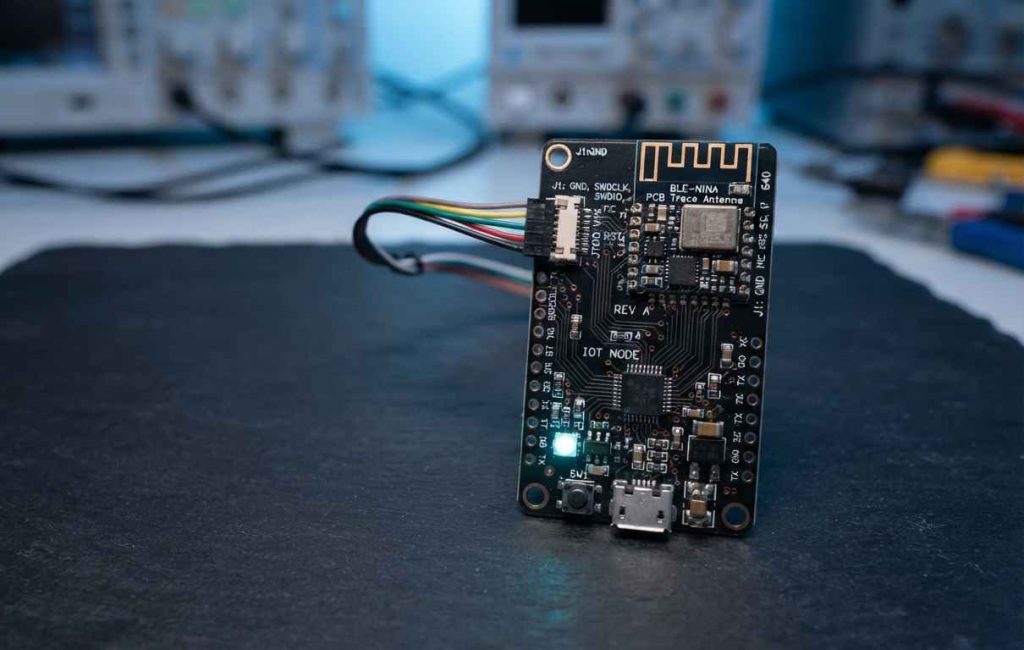
Every hardware team knows this moment. The EVT (Engineering Validation Test) build arrives, the hardware tests go reasonably well, and then someone asks: “Where is the firmware?” The answer, somewhere between Alpha and “we’re working on it,” sets off a chain of delays that nobody put in the project plan, because nobody treated firmware as something that needed a place in it.
Firmware is the quiet schedule risk in most embedded product programs. Hardware delays are visible and concrete: a PCB revision, a supplier lead time. Firmware delays tend to stay invisible until they are expensive. Features that looked straightforward take much longer to integrate on real silicon. A late schematic change forces a driver rewrite. A validation cycle that was supposed to be quick turns up a pile of bugs and pushes the release candidate back.
Most of these problems are not technical failures. They are planning failures: decisions made, or not made, that set the engineering team up for a schedule they can never hit. This post covers the five most common firmware roadmap mistakes behind embedded launch delays, why each one happens and what it costs, and how to track the cross-track dependencies that make firmware planning so fragile.
Why Firmware Planning Fails
Firmware sits in an awkward middle space. It is not hardware, so it rarely gets the lead-time discipline that teams apply to component procurement or PCB fabrication. It is not traditional software either, so it often misses the sprint and milestone discipline software teams have built over the years. It is understood deeply by firmware engineers and only partly by everyone else.
As a result, firmware often gets planned informally, in engineering conversations that run alongside the real project plan instead of feeding into it. Milestones are implied rather than defined. Dependencies are known to the firmware lead but never reach the project or product manager building the launch schedule. When those hidden dependencies turn into delays, they feel like surprises, even though a better planning framework would have predicted them.
Terms used in this post
Hardware builds follow the usual EVT (Engineering Validation Test), DVT (Design Validation Test) and PVT (Production Validation Test) stages. For firmware, we use the milestones below, which follow the Developex Firmware Roadmap Template. Teams name and define these differently, so adapt them to your own process.
| Firmware milestone | What it means here |
|---|---|
| Alpha | First stable iteration: core drivers and primary device logic implemented and running on evaluation boards or early hardware. |
| Beta | Stabilization phase: features are in and the team drives the bug count down. If bugs are reported faster than they are fixed, the Pre-RC target is at risk. |
| Pre-RC | Firmware that has passed internal QA with no critical defects, ready for integration with Software FC. Declaring Pre-RC is a formal Go/No-Go decision. |
| RC | Release candidate firmware, tested by the Validation team with feature-complete software. |
With that in place, here are the five mistakes.
Mistake #1: Treating Firmware as a Downstream Activity
The most damaging assumption in embedded development is that firmware work starts once the hardware is stable. It is easy to see how it forms, since you cannot run firmware on hardware that does not exist yet. But a large part of the work does not depend on final hardware. Bootloader architecture, memory map design, the hardware abstraction layer (HAL), communication protocol stacks and peripheral driver frameworks can all be developed and tested in simulation or on evaluation boards. A team that waits for EVT hardware before writing drivers starts the race late.
The pattern that follows is predictable. EVT hardware arrives and hardware engineers want to run tests, but the firmware is not ready. Hardware sits idle for weeks while firmware catches up. The EVT test cycle gets compressed, issues are found but not fully resolved, and the project moves toward DVT with insufficient firmware validation and a team that is already behind. Every later stage inherits the deficit.
The fix is structural: put firmware on the project plan from the moment hardware design begins. Firmware Alpha should be ready when EVT hardware arrives, not started when it arrives. “Ready” here means the code is written and has run on evaluation boards or in simulation. It does not mean validated on EVT silicon, which is what the integration phase is for (see Mistake #3). This requires a firmware roadmap integrated into the hardware schedule from day one, with firmware milestones explicitly mapped to hardware build events. If your project plan does not show that link, you have this problem, even if you have not felt it yet.
Mistake #2: No Firmware Feature Freeze Discipline
Software product managers know feature freeze well: at some point before a release, the team stops adding features and focuses on stability, testing and defect resolution. Embedded firmware teams need the same discipline, but they rarely have it, because nobody has set it up as a formal project gate.
Instead, features keep being added or changed throughout DVT. Sometimes it is in response to hardware changes, sometimes because late requirements arrive, sometimes because engineering judgment evolves as the team gets deeper into integration. Each change resets part of the validation work already done. A feature added in week three of DVT may invalidate reliability tests completed in week one. A power management change made to fix a battery life finding may introduce a regression in the wireless stack that only surfaces in the first validation cycle.
The cost is hard to measure because it looks like normal progress. The team is busy and productive, features get built and bugs get fixed, but the firmware never converges because the target keeps moving. This is classic scope creep, one of the best-known causes of project overruns in any kind of development.
The solution is to set an explicit firmware feature freeze ahead of each validation stage and enforce it as a hard project gate. Before the freeze, every pending feature must be committed and resourced, explicitly deferred to a post-launch firmware update, or removed from scope. After the freeze, only defect fixes above an agreed severity threshold go in. This feels restrictive in the short term and saves time in the medium term.
Mistake #3: Underestimating Hardware–Firmware Integration Complexity
| What teams estimate | What integration actually involves |
|---|---|
| “We just need to write the driver” | Driver development, integration, timing calibration on real silicon, and regression testing across all dependent subsystems. |
| “The datasheet covers everything” | Production silicon often behaves differently from datasheet assumptions: errata, timing deviations and undocumented behavior are routine. |
| “We tested this in simulation” | Simulation rarely captures power domain sequencing, bus contention, interrupt latency under load or thermal effects. |
| “It’s a minor hardware change” | Any component swap, resistor value change or PCB revision that touches a peripheral interface can require driver re-validation. |
| “We have two weeks for integration” | Integration on a first EVT build tends to take longer than planned, and the overrun is hard to predict. |
| “The firmware engineer will handle it” | Integration issues need coordinated debugging between firmware engineers, hardware engineers and sometimes silicon vendor support. |
Experienced firmware teams estimate the time to write code in isolation well. Integration is different, because integration problems are, by definition, the ones you did not know about until they appeared. Even strong teams rarely get that estimate right on the first try.
The practical implication is a simple planning rule: add an explicit buffer on top of whatever your firmware team estimates for integration, and make it larger when the hardware design is new or uses complex peripherals with few reference designs. The right percentage depends on your own history, so check past projects and use what they show.
Beyond buffering, the best mitigation is to start integration as early as possible, on evaluation boards and reference hardware before EVT where feasible, so the unknowns surface before they sit on the critical path to a hardware build milestone.
Mistake #4: Missing the Software–Firmware Dependency Chain
Firmware does not exist in isolation. In any connected product, such as a smartphone-paired IoT device, a consumer electronics product with a companion app or an industrial device with a management interface, the firmware track and the software track are tightly coupled. Failing to plan that coupling explicitly is the fourth major planning error, and the one most likely to blindside a product manager who is watching firmware milestones but not the cross-track dependencies.
The chain works like this. The host application, meaning the mobile app, desktop app or web dashboard that users interact with, cannot reach Feature Complete (FC) without stable firmware to integrate against. Software FC depends on a stable API, stable communication protocols and predictable firmware behavior. If firmware is still changing when the software team expected stable integration, the software team cannot complete and stabilize its own feature set. Software FC slips. Software Release Candidate slips. Validation Cycle 2, the final system-level validation before mass production sign-off, slips. The launch date slips.
This cascade is common in connected products and easy to miss in project plans that treat firmware and software as separate lanes. The fix is to make the dependency explicit: treat the firmware Pre-RC milestone as a hard gate for Software FC, and make any slip at Pre-RC trigger an immediate replanning conversation that includes the software schedule owner.
This is the principle behind Developex’s approach to IoT product development: firmware and software tracks are planned and reviewed together, with cross-track dependencies surfaced and tracked from the earliest planning stages.
Mistake #5: Treating Certification as Something That Happens After Firmware Is Done
Many teams put regulatory certification at the end of the plan and assume it will fit once firmware is finished. In practice, certification puts hard requirements on firmware, with fixed windows that do not move when your firmware does.
Submission windows are fixed. Certification labs for FCC, CE, UKCA, MIC and other regional marks book slots in advance. If firmware is not ready when your slot arrives, you wait for the next one, which can add weeks to the schedule depending on lab capacity and certification type.
Labs need a representative build. Test labs generally need a firmware build that is representative of the final product, especially for anything that affects radio behavior, power settings or emissions. Testing a placeholder build and planning to certify the real one later usually means paying for retesting and losing more time.
Changes after testing can force a retest. Firmware changes that affect RF behavior, power control or emissions after testing typically mean retesting. How other changes are treated depends on the certification scheme and the lab, so ask early rather than assuming. For wireless products, FCC Part 15 testing requires RF-related firmware settings such as power control to be locked, and CE marking under the Radio Equipment Directive (RED) calls for similar stability. Both should appear as explicit firmware gates in your DVT milestone plan.
Security compliance now lives in firmware. The EU Cyber Resilience Act (CRA) entered into force on December 10, 2024. Manufacturers’ vulnerability and incident reporting obligations have applied since September 11, 2026, and the main requirements, including secure-by-design requirements, vulnerability handling, security updates and CE marking, apply to products with digital elements placed on the EU market from December 11, 2027. Much of the technical implementation sits in firmware, so it needs to be built and validated during DVT and PVT, not added after launch. For radio equipment, RED also carries its own cybersecurity requirements for internet-connected devices under Delegated Regulation (EU) 2022/30.
Medical devices are a different league. If your product is a medical device, expect a much heavier process. Standards such as IEC 62304 and the EU Medical Device Regulation (MDR) require documented software lifecycle evidence and traceability, so bring in your regulatory consultant from the start of the project.
The practical resolution is to create a certification dependency map at the beginning of the project: every required certification, the firmware stability each one needs, and the submission windows that match your target launch date. Work backwards from those windows to set the firmware feature freeze and Pre-RC milestones. If those milestones are not achievable given the team’s capacity and the hardware schedule, the launch date needs to move. It is far better to learn that at the planning stage than at the DVT review.
How to Identify and Track Firmware Dependencies Before They Become Delays
The five mistakes share a root cause: dependencies that exist in the real world but are invisible in the project plan. Making them visible is the highest-leverage thing a product manager can do to protect a firmware schedule.
Map your five tracks before you build your timeline. In a typical connected embedded product, development runs along five interdependent tracks: Documents (MRD, FRD, software requirements), Hardware (WS, EVT, DVT, PVT), Firmware (Alpha, Beta, Pre-RC, RC), Software (Feature Complete, Release Candidate) and Validation (Validation Cycle 1, Validation Cycle 2). Here MRD, FRD and WS stand for Market Requirements Document, Firmware Requirements Document and Working Sample. Before you put a single date in the plan, draw these tracks on a whiteboard and draw arrows between them. Every arrow is a dependency. Every dependency that is not in your plan is a hidden schedule risk.
Assign a dependency owner, not just a milestone owner. Most plans assign owners to milestones: the DVT build, Software FC, the certification submission. They rarely assign anyone to the dependency between milestones. Who is responsible for making sure firmware Pre-RC is stable enough for Software FC to begin? Often nobody, which means that when it breaks, nobody acts until the delay is already measured in weeks. A named owner for each cross-track dependency, whose job is to monitor it and escalate when it is at risk, turns invisible risks into managed ones.
Use a firmware milestone tracker, not a Gantt chart alone. A Gantt chart shows when milestones are scheduled. It does not show whether their preconditions are being met. A separate, live tracker that records each firmware milestone, its dependencies, its completion status and its open blockers gives the team a single source of truth for firmware readiness.
That is what Developex’s free Firmware Roadmap Template provides. It comes with a Firmware Roadmap & Milestone Tracker in Google Sheets that maps all five development tracks, surfaces cross-track dependencies, and gives product managers and executives a clear view of firmware progress, as current as your last update, without digging through engineering tickets.
Review dependency status weekly, not only at milestone reviews. By the time a missed dependency shows up at a milestone review, the delay has already happened. Make it a short standing item in your cross-functional sync: “what is at risk in the next two weeks?” Five minutes on that question regularly surfaces problems that would otherwise stay hidden until they are critical.
Put schedule buffers at dependency boundaries, not just at stage gates. Most plans include contingency before major gates, such as a week before DVT or before certification submission. That helps but is not enough. The riskiest points are the handoffs: firmware to software for integration, firmware to the validation team for Validation Cycle 1, Pre-RC firmware to the certification lab. Buffer placed at these transitions absorbs the delays that most often occur there, without compromising the overall milestone schedule.
What Good Firmware Planning Looks Like
Good firmware planning is not pessimism or arbitrary padding. It makes the real structure of embedded development visible: parallel tracks, hard dependencies between them, regulatory gates that cannot be negotiated, and integration work that is usually more complex than first estimates suggest. In practice, that looks like this:
- The firmware lead is in every product planning session from the start of the project.
- Firmware milestones sit in the same plan as hardware builds, certification submissions and software release targets.
- Every cross-track dependency is named, owned and reviewed weekly.
- Feature freeze dates exist for every validation stage and are enforced as policy, not suggestions.
- The project manager knows in any given week whether firmware is on track to support the next hardware build, with enough lead time to act if it is not.
The gap between where most teams are and where they need to be is rarely about engineering talent. It is about planning structure. For more on closing that gap, see our embedded development services and our guide to EVT, DVT and PVT for product managers.
How Developex Helps Teams Avoid These Mistakes
Developex has been building embedded products alongside hardware companies since 2001, across IoT, consumer electronics, gaming peripherals and audio devices. We have seen many variations of the five mistakes above, and our engagement model is built to prevent them.
Our firmware planning starts at the proposal stage. Before a line of code is written, we map the development tracks, identify cross-track dependencies and define the firmware milestones that gate hardware builds, software integration and certification submissions. We assign dependency owners, run weekly cross-track dependency reviews, and place buffers at the boundaries where delays actually occur. Our reporting is structured so that non-technical stakeholders get what they need to decide: a green light for DVT, a recommendation to delay a certification submission, or an early warning that a dependency is at risk.
If your team is preparing for an embedded product launch and you want this kind of structure in your process, explore our firmware and embedded development services or get in touch.
Free resource for product managers and engineering leads
The Developex Firmware Roadmap Template maps all five development tracks — Documents, Hardware, Firmware, Software and Validation — to a visual timeline and includes a Google Sheets Milestone Tracker for monitoring dependencies and firmware readiness.
→ Get free Firmware Roadmap Template