Hardware product development is not a straight line. It is a structured process built around three critical validation stages – EVT, DVT, and PVT – that determine whether your product reaches mass production on time, within budget, and in the shape customers actually expect. Yet for many product managers who come from a software or business background, these acronyms feel like the exclusive language of engineers. You sit in planning meetings nodding along, not entirely sure what each phase means for your roadmap, your sprint commitments, or the launch date you already promised your stakeholders.
The problem is not just vocabulary. When product managers do not deeply understand what happens inside each validation stage, they make planning decisions that look reasonable on a slide deck but unravel badly in the factory. They underestimate firmware timelines, assume hardware fixes are quick, and confuse “prototype working in the lab” with “ready for production.” According to research from CoLab Software, 90% of manufacturing companies experience product launch delays – and a delay as short as six months can cut product profitability by 33% over the product’s lifetime. In the embedded and consumer electronics space, these numbers hit harder, because timelines are tight and competitive windows are narrow.
In this post, we will discuss what EVT, DVT, and PVT actually involve, how firmware fits into each stage, the most common planning mistakes product managers make, best practices for managing embedded projects, and why choosing the right development partner can make all the difference.
What Are EVT, DVT, and PVT? A Plain-Language Overview
EVT, DVT, and PVT stand for Engineering Validation Testing, Design Validation Testing, and Production Validation Testing. They are the three major build-and-test phases that take a hardware product from a working prototype concept through to mass production readiness. Each stage has a distinct goal, a different set of questions it is trying to answer, and different consequences if teams rush through it or skip its exit criteria.
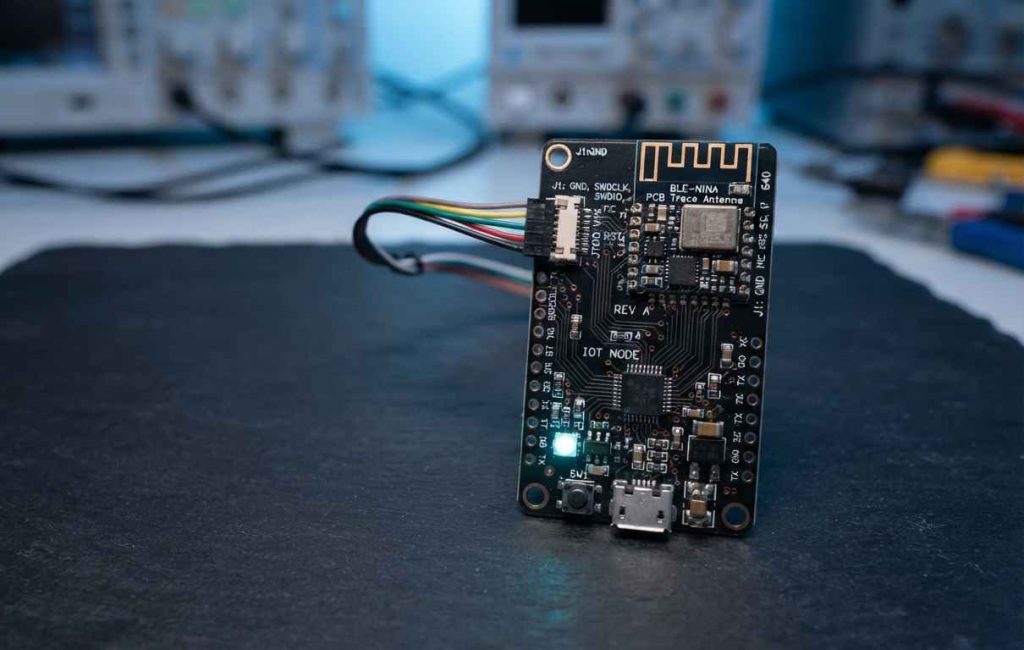
EVT (Engineering Validation Testing) is the earliest formal build phase. The goal here is to validate that the core engineering decisions work – that the hardware architecture functions as intended, the fundamental components interact correctly, and the major technical risks have been identified and resolved. EVT units rarely look like the finished product. They may be assembled on development boards, with components soldered by hand, and the firmware running on them is typically a basic feature implementation, often described informally as a “v0.1 build.” At EVT, the team is asking: does this concept actually work? The answer is almost always “mostly, but with some significant issues to resolve.”
DVT (Design Validation Testing) is the bridge between a validated engineering concept and a manufacturable product. By DVT, the design should look and feel like the final product, including the enclosure, finishes, and human-facing components. The firmware at this stage is more mature – often at v0.5 or a release candidate – and the team is running the kind of tests that will eventually support regulatory certification. DVT is where the full system is tested as an integrated whole, not just its individual parts. Common DVT tests include drop testing, temperature cycling, EMC/EMI testing, and software interoperability validation. DVT prototypes are also the units used for marketing materials, investor demonstrations, and sometimes early regulatory submissions.
PVT (Production Validation Testing) is the final checkpoint before mass production. PVT builds use final production tooling, components from production suppliers, and go through the actual factory assembly line – often producing between 100 and 1,000 units depending on the product. The questions being answered at PVT are about process, not design: Can the factory build these at volume? Are yields acceptable? Are any assembly steps causing defects? Is the firmware flashing reliably at scale? A successful PVT gives the entire organization the green light to begin mass production.
For product managers, the crucial insight is that each stage has exit criteria – specific tests that must pass before the next stage begins. Skipping or softening these criteria to preserve a schedule is the single most common cause of expensive delays later.
How Firmware Fits Into the Hardware Validation Lifecycle
Firmware is not a side feature you add after the hardware is done. In embedded products, firmware is woven into every validation stage from EVT onward, and treating it as an afterthought is one of the fastest ways to blow your schedule. The global embedded software market was valued at $17.67 billion in 2024 and is projected to grow at a CAGR of 7.6% through 2033, according to Straits Research – a reflection of how central firmware has become to hardware product value.
Here is how firmware responsibility evolves across the three stages:
| Stage | Firmware Maturity Expected | Key Firmware Tasks | PM Risk if Underprepared |
|---|---|---|---|
| EVT | Alpha — core drivers and primary device logic functional | Bootloader, core peripheral drivers, basic communication protocols, integration with test tools | Discovering chip/MCU incompatibilities late; no working build for hardware tests |
| DVT | Beta → Pre-RC — full feature set implemented, internal QA in progress | Complete functional implementation, OTA mechanism, power management, stabilized interfaces, readiness for Software FC alignment | Firmware not ready for regulatory/certification submissions; failing system-level tests |
| PVT | RC (Release Candidate) — validated against Software FC, passed Validation Cycle #2 | Factory provisioning, serial number flashing, production test firmware, golden sample validation | Production line stalls due to flashing failures; late-stage bugs blocking MP sign-off |
The most important principle for product managers to internalize is this: firmware has its own supply chain. Just like hardware components have lead times, firmware features have development timelines, integration dependencies, and testing cycles. If the hardware team selects a new sensor or changes a communication protocol in EVT, the firmware team needs time to adapt – and that time is rarely built into the hardware schedule.
This dependency is also why the number of connected IoT and embedded devices – roughly 18.8 billion globally by end of 2024 and projected to grow to 41.1 billion by 2030 according to IoT Analytics – matters for product managers. Devices that connect, update over the air, and integrate with cloud services require significantly more firmware planning than simple standalone embedded products. If your product is in this category, your firmware roadmap needs to be treated with the same rigor as your hardware BOM.
The Most Common Firmware Roadmap Mistakes That Delay Hardware Launches
Most embedded product delays do not come from hardware problems alone. They come from the intersection of hardware changes and inadequate firmware planning. After working on dozens of embedded product launches, the following patterns emerge as the most damaging – and most preventable – firmware mistakes that product managers make.
Starting firmware development too late
Waiting until EVT units arrive to begin writing drivers means weeks of idle hardware and compressed timelines. Firmware development should start alongside or even slightly before the first EVT build.
No dedicated firmware milestone in the roadmap
Without explicit firmware milestones tied to EVT, DVT, and PVT exit criteria, firmware readiness gets treated as a soft dependency rather than a hard gate.
Underestimating hardware-software integration time
Peripheral timings, power domain interactions, and I2C/SPI bus behaviors often deviate from datasheets. Integration debugging can take as long as initial development — and this rarely appears in roadmap estimates.
Ignoring regulatory compliance timelines
FCC, CE, and similar certifications often require near-final firmware on DVT hardware before labs will schedule a test. If firmware is not ready at DVT, certification submissions slip — and the entire launch window slips with them.
Treating OTA updates as a post-launch feature
Releasing without a secure, reliable OTA mechanism means every firmware bug — including security vulnerabilities — requires a costly field service operation or a product recall. The EU Cyber Resilience Act requires mandatory security patching for connected products sold in European markets.
Assuming the firmware team is interchangeable with the software team
Embedded firmware requires specialist knowledge: RTOSes, hardware abstraction layers, bare-metal programming, and toolchain management. Assigning a web or mobile developer to embedded tasks because headcount is tight is a guaranteed way to introduce critical bugs and delays.
How to Structure Your Firmware Planning for Each Stage
Good embedded project management starts with treating firmware planning as equal in rigor to hardware planning. The following framework helps product managers build a firmware roadmap that aligns with hardware validation stages rather than conflicting with them.
The foundation is the firmware feature gate model. For each validation stage, define a specific firmware feature set that must be complete and stable before that stage’s units are built. This is not a wish list – it is a hard gate. If firmware is not at the required maturity when hardware builds are kicked off, the stage should be delayed or scope should be reduced.
Free resource: If you are not sure where to start, Developex has put together a practical tools, including Firmware Roadmap Template, designed specifically for product managers working on embedded hardware. It maps firmware milestones directly to EVT, DVT, and PVT stages and is free to download – a useful starting point before your next planning cycle.
Before EVT kicks off, firmware must have: a working bootloader, initial chip bring-up code, drivers for the core peripherals (display, wireless module, sensors), a basic communication stack if the product connects to anything, and a logging mechanism that allows hardware engineers to debug during assembly and test. Without these, hardware test engineers cannot do their jobs.
Before DVT builds, firmware must include: the full intended feature set in functional (if not polished) form, an OTA or firmware update mechanism, power management implementation, production-facing interfaces such as factory test modes and diagnostic APIs, and a software architecture that supports parallel security and regulatory testing. DVT is also when the firmware team should begin working on the production test firmware – the software that runs on the factory line to validate each unit. Critically, this is also the stage where the Software track and the Firmware track must converge: the host application (mobile or desktop) cannot reach Feature Complete (FC) without stable, feature-complete firmware to integrate against. If firmware slips at DVT, the software schedule slips with it – one of the most common and underappreciated cross-track dependencies in embedded product development.
Before PVT, firmware must reach release candidate status. This means: all known bugs above a severity threshold are resolved, the OTA mechanism has been tested end-to-end, production test firmware is validated on golden samples, and the firmware version that will ship to customers is frozen and in source control. PVT is not the time to be adding features.
Beyond milestones, the most important embedded development best practice for product managers is to ensure hardware and firmware teams are in the same planning cycle. Weekly cross-functional syncs between hardware, firmware, and manufacturing engineering – not just at milestone reviews – dramatically reduce the number of surprises that arrive when builds happen.
Understanding Embedded Product Launch Delays: Why They Really Happen
The conventional explanation for embedded product delays focuses on hardware problems: tooling failures, component shortages, supplier quality issues. These are real. A single IQC/OQC sync-up issue between a vendor’s outgoing quality inspection and your factory’s incoming quality inspection can add four days to a week of delay at EVT alone. But hardware issues are often visible and, when they occur, the team rallies around them.
The more dangerous delays are structural – built into the project from the beginning because of poor planning assumptions. According to Gartner, 45% of product launches are delayed by at least one month, and of those delayed launches, 20% on average fail to meet their internal targets. In the hardware space specifically, the average new product development project exceeds its original schedule by 120 percent, according to the Center for New Product Development.
One of the most insidious delay patterns in hardware validation is what the industry calls the “continuous build” trap. This happens when a critical problem is discovered during EVT reliability testing, a fix is quickly developed and applied, but the next build is labeled “DVT” even though the fix has not been fully validated. Teams stay on the original DVT schedule and kick off unvalidated mass production tooling in parallel. When the unvalidated fix turns out to be insufficient, an additional build is required – adding weeks of delay that could have been avoided by simply holding the DVT gate until EVT issues were truly resolved.
For product managers, the lesson is counterintuitive but critical: holding a gate when exit criteria are not met is faster than proceeding and discovering the problem later. The cost of rework escalates dramatically as you move through the validation stages. A firmware bug caught in EVT costs a sprint to fix. The same bug discovered in PVT may require new firmware validation, re-certification testing, and new golden samples – adding months to the schedule.
Management consulting firm OakStone Partners estimates that a product delay can cost a company upwards of 15 to 35 percent of Net Present Value, depending on the competitive environment. For product managers, that number needs to live in every conversation about whether to soften a gate or compress a milestone.
Embedded Development Best Practices for Product Managers in 2025–2026
The embedded development landscape is evolving quickly. In 2025, AI-driven development tools are increasingly being used to generate, test, and debug embedded code, with large language models and code assistants appearing in firmware workflows for the first time at scale. Simultaneously, regulatory pressure is increasing: the EU Cyber Resilience Act, officially adopted in December 2024, will require manufacturers selling connected products in European markets to comply with mandatory cybersecurity risk assessment, secure development practices, vulnerability management, and patching capabilities.
Against this backdrop, here are the embedded development best practices that product managers should be actively promoting within their organizations:
Shift firmware testing left
Run unit tests, static analysis, and integration tests in simulated environments before hardware is available. Catching defects before firmware touches physical hardware reduces reliance on scarce test boards and prevents late-stage bugs.
Treat firmware architecture as a product decision
The choice of RTOS, memory partitioning, bootloader design, and update mechanism all have direct consequences for roadmap flexibility, OTA safety, and regulatory compliance. Product managers should be in the room when these decisions are made.
Plan for modularity from day one
Breaking firmware into independent components — drivers, middleware, and application layers — makes it possible to update parts of the system without re-validating the whole. This has direct implications for post-launch agility and the cost of adding features.
Include supply chain risk in your firmware planning
Component changes — even minor substitutions — can require driver updates, re-certification, and re-validation. When hardware is considering a component swap, firmware and certification implications must be part of the impact assessment.
Establish a hardware-in-the-loop (HIL) testing environment by DVT
HIL testing allows the firmware team to run automated regression tests on real hardware without manual intervention for every test cycle. This dramatically accelerates DVT firmware validation and reduces the chance of regressions slipping into PVT.
Budget for firmware maintenance, not just development
Firmware often supports devices for 10–15 years. Security patches, feature additions, and platform updates are part of the product’s lifetime cost. Product managers who only budget for initial development are setting up their organizations for difficult conversations later.
Why Firmware Planning Errors Are a Product Management Problem, Not Just an Engineering Problem
There is a persistent misconception that firmware planning is the engineering team’s responsibility, and the product manager’s job is simply to set the deadline and track progress. This view is exactly why firmware delays are so common and so damaging.
Firmware planning errors are, at their core, scope management failures – and scope management is a product management responsibility. When a product manager adds a feature requirement at DVT that the firmware team cannot implement without redesigning a core subsystem, that is a scope management failure. When a product manager agrees to a launch date without validating that the firmware team has capacity to reach release candidate status by PVT, that is a resource planning failure. When a product manager treats security features as optional enhancements rather than launch requirements, that is a risk management failure.
The firmware roadmap needs to be owned by the product manager in the same way the feature roadmap is. This does not mean the product manager writes code – it means the product manager ensures that firmware milestones are explicitly represented in the project plan, that dependencies between firmware and hardware are tracked and communicated, that scope changes are evaluated for firmware impact before being accepted, and that the engineering team has what it needs to succeed at each validation stage.
In practice, this means including the firmware lead in product planning sessions, creating firmware-specific milestones in your project management tool, and establishing a clear policy about feature freeze dates – the point after which no new firmware requirements will be accepted for a given validation stage. Feature freezes are uncomfortable conversations to have, but they are far less uncomfortable than explaining to your CEO why the launch is delayed by three months because a late-added feature required a RTOS upgrade.
How Developex Supports Embedded Product Teams Through EVT, DVT, and PVT
At Developex, we have been working with hardware product teams across IoT, medical devices, industrial automation, and consumer electronics for over 20 years. We understand that the gap between a working prototype and a mass-production-ready embedded product is where the most value is created – and the most risk is realized. Our embedded engineering team brings both the technical depth to execute at every stage and the project management experience to help product managers navigate validation milestones without the surprises that delay launches.
Our approach to embedded product development is built around three principles: early firmware integration, cross-functional planning, and transparent milestone management. We do not treat firmware as a downstream activity that begins when hardware is “ready.” Our firmware and hardware engineers work in parallel from the earliest concept stages, ensuring that architectural decisions on the hardware side account for firmware implications, and vice versa. This parallel development model is increasingly recognized as a best practice across the industry, with research showing it shortens time-to-market and reduces the likelihood of costly redesigns.
Developex also brings a practical understanding of firmware roadmap planning, which means we can help your product management team set realistic milestone dates, identify firmware risks before they become schedule problems, and structure your EVT-DVT-PVT progression in a way that minimizes rework and maximizes your probability of hitting your mass production target. Whether you are building your first embedded product or scaling an existing platform, we are equipped to work as an extension of your team – providing the embedded engineering expertise that bridges the gap between great product vision and manufacturable reality.
One practical way to start building that structure right now is our free Firmware Roadmap Template – a resource we created after seeing the same planning gaps repeat across product teams of all sizes.
Free Download: Firmware Roadmap Template for Product Managers
If you are building or managing an embedded hardware product, our Firmware Roadmap Template is the fastest way to get your firmware planning aligned with your hardware validation schedule. The template organizes the full product lifecycle into five parallel tracks – Documents, Hardware, Firmware, Software, and Validation – and maps each track’s milestones to a visual timeline.
It also includes an accompanying Firmware Roadmap & Milestone Tracker (Google Sheets) that lets product managers monitor key milestones, dependencies, and risks without navigating complex PM tools. It is designed to translate the technical workflow into a single, clear framework for executive reviews and cross-team planning.
This template gives product managers a ready-made framework for mapping firmware milestones to hardware validation stages, tracking readiness gates, and communicating firmware status to non-technical stakeholders. No engineering background required, and completely free to use.
Download the free Firmware Roadmap Template →
A Practical Checklist: What Product Managers Should Verify at Each Stage Gate
Knowing what the validation stages mean is only useful if it changes how you operate. The following checklist gives product managers a concrete set of questions to ask – and get honest answers to – before approving each stage transition.
Conclusion: Hardware Validation Is a Product Management Discipline
EVT, DVT, and PVT are not just milestones that engineers manage while product managers wait for good news. They are the structured expression of a product team’s ability to translate a vision into a manufacturable reality – and every stage requires active, informed leadership from the product manager.
Understanding what each stage demands from firmware, what the exit criteria mean, and what happens when teams move too fast is not optional knowledge for PMs in the embedded space. It is the foundation of a realistic roadmap, a credible launch plan, and a product organization that can actually deliver on its commitments. The embedded software market is projected to reach $34.16 billion by 2033 – and the teams that win are the ones where product managers and engineers share a common understanding of the validation process and hold each other accountable to it.
Free resource for product managers and engineering leads
If you are managing your first embedded product launch, or your team has experienced painful delays in the past, start here. Download our free Firmware Roadmap Template — it takes ten minutes to adapt to your project and will immediately make your firmware planning more visible and structured. You can also explore additional Free Resources for Product and Engineering teams, or reach out to discuss how Developex can support your EVT-DVT-PVT journey from the very beginning.
→ Get free Firmware Roadmap Template