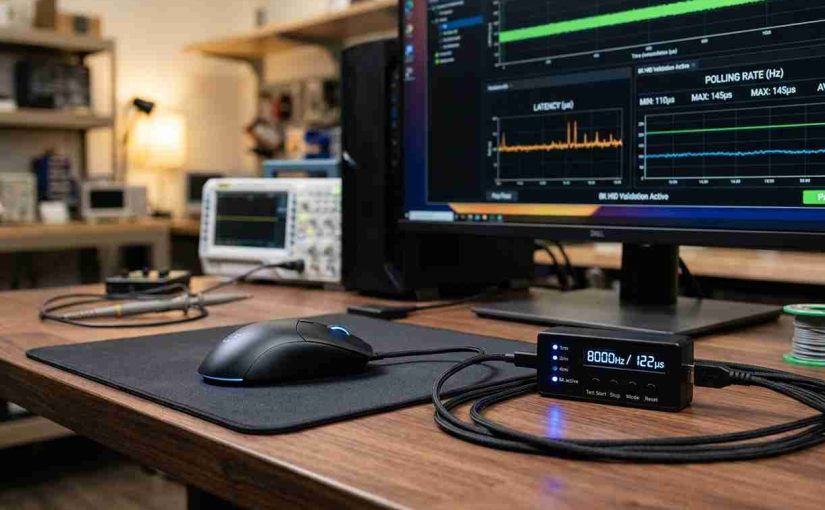
8K HID latency validation means proving that a 125-microsecond report cadence survives RF noise, USB host scheduling, dongle firmware queues, battery states, and missed-packet recovery before EVT, DVT, and reviewer sampling. A low average latency number is not enough. The launch risk is jitter, dropped reports, stale input, and power regressions that customers reproduce outside the bench.
1. 8K HID latency validation has turned wireless peripheral validation into a system test
8K HID validation is a system test because 8000 reports per second leaves 125 microseconds between target reports, and each boundary in the path has a failure mode that breaks that cadence. The release claim depends on six systems: device firmware, the radio link, dongle firmware, the USB connection into the host, the host operating system scheduler, and the battery power governor. The protocol layer is defined: the USB HID Device Class Definition v1.11 (USB-IF, 2001) specifies HID interrupt-transfer behavior, and the USB 2.0 Specification (USB-IF, 2025) governs the dongle-to-host timing budget. The validation question is narrower than standards conformance: whether a specific mouse, keyboard, or game controller build sustains 125-microsecond delivery while firmware, RF, USB, host load, and power states are stressed at the same time.
2. Average latency hides the failures that damage 8K HID latency validation
Mean latency absorbs the events users notice: a 2-millisecond spike during rapid input, a duplicated report that double-fires a click, a stale report that lands a frame late, or a recovery gap after the radio drops a packet. Clean samples suppress each failure in the average. Release evidence needs 95th- and 99th-percentile latency, inter-report spacing, duplicate- and stale-report counts, and recovery time after RF loss. For Developex release sign-off, an 8K HID claim is credible only when the product proves worst-case report timing against thresholds set before testing. The Bluetooth SIG 2025 roadmap targets ultra-low-latency HID at rates up to 1000 Hz (Bluetooth SIG, 2025); an 8K proprietary-radio path sits above Bluetooth LE HID-over-GATT assumptions and needs separate USB and RF validation.
3. Six validation gates show whether 8K survives real operating conditions
Six validation gates determine whether an 8K HID product survives customer operating conditions. Use them as release gates: end-to-end input-to-host latency from physical actuation with a photodiode or switch fixture and a logic analyzer; report-interval stability captured at the host with USBPcap and Wireshark 4.x; missed and duplicate report detection from packet sequence counters; RF coexistence under controlled attenuation and 2.4 GHz interference; dongle USB behavior behind real hub topologies under CPU/GPU load; and battery and thermal behavior during a long-run 8K session. The Bluetooth Core Specification v6.2 introduced LE shorter connection intervals with a 375-microsecond minimum and 125-microsecond resolution (Bluetooth SIG, 2025). The Bluetooth LE timing point is useful background; proprietary 8K HID still needs validation on final hardware across radio, dongle, USB host, firmware, and power states.
| Metric | Failure it exposes | How to measure it | Pass/fail evidence | Owner |
|---|---|---|---|---|
| Average latency | Nothing; it masks spikes | Mean of host-captured reports | Necessary baseline, never sufficient | QA |
| p95/p99 latency | Tail spikes users feel | Percentile analysis over a long run | p99 within threshold, sustained | QA |
| Inter-report jitter | Uneven cadence, visible stutter | Spacing between consecutive reports | Jitter band held at sustained 8K | Firmware |
| Dropped/duplicate reports | Missed or double-fired input | Packet sequence counters | Zero unexplained gaps or dupes | Firmware |
| RF recovery time | Stale input after packet loss | Controlled attenuation plus interference | Recovery under threshold post-loss | RF / Firmware |
| Dongle USB timing | Collapse behind hubs and load | Capture behind real hub topology under load | Polling interval honored under host load | Dongle firmware |
| Battery/thermal regression | Silent rate drop in low power | Long-run profiling across power states | Rate held across battery and thermal range | Firmware / Hardware |
| OTA/reconnect behavior | Post-update timing regression | Re-run the suite after a field update | No regression vs. pre-update evidence | QA / Product |
4. Wireless peripheral teams get burned at five system boundaries
Five system boundaries create the 8K HID failures that a mean latency number hides.
- RF retries refill a dropped slot but deliver stale input milliseconds late.
- Dongle firmware queues smooth the mean while leaving inter-report jitter visible at the host.
- USB endpoint timing collapses behind a shared hub when the descriptor’s polling interval (bInterval) is not honored on a loaded interrupt IN endpoint.
- Battery governors drop report rate in low-power states.
- An over-the-air firmware change alters timing after launch when scheduler, radio-retry, queueing, or power-state code changes and the release suite is not rerun.
The radio environment adds a regulated 2.4 GHz constraint: Wi-Fi 6 (IEEE 802.11ax-2021) shares the ISM band; FCC 47 CFR § 15.247 (FCC, 2026) defines U.S. operating limits for frequency-hopping and digitally modulated intentional radiators in 2400-2483.5 MHz; and ETSI EN 300 328 V2.2.2 (ETSI, 2019) defines adaptivity, medium-utilization, and receiver-blocking requirements. Devices that fall back to a Bluetooth LE mode move to HID over GATT Profile over ATT and need separate validation.
5. A defensible response turns 8K into measured release evidence
An 8K HID claim becomes release evidence through six concrete moves.
Define pass/fail thresholds
for each metric before testing, so results cannot be rationalized after the fact.
Instrument the full path
physical actuation, radio, dongle, USB capture with USBPcap and Wireshark, and the host input stack with Linux hid-tools, evtest, libinput, and pyusb.
Use firmware counters and packet sequence IDs
to tie every report to its origin.
Automate the suite as regression
on hardware-in-the-loop rigs driven by pytest 8, Robot Framework 7, or OpenHTF, with Perfetto traces for host-side scheduling.
Test RF coexistence
on final-form hardware instead of engineering boards.
Compare wired and wireless modes
to isolate the radio’s contribution.
Preserve captures as release evidence.
6. Specialists help when firmware, RF, HID, and QA ownership overlap
8K validation crosses firmware scheduling, radio behavior, dongle queues, host USB traces, and automated regression. Generic software QA covers application behavior; an 8K HID release problem requires embedded firmware debugging, firmware architecture review, dongle firmware review, RF scenario design, USB HID report-descriptor analysis using USB HID Usage Tables v1.7, embedded QA automation, OTA testing, and reconnect testing. Specialists earn their place when a defect spans ownership boundaries: isolating a jitter spike requires correlating firmware counters, dongle queues, and host USB captures in one defect record. Bluetooth qualification adds a separate layer for a device exposing Bluetooth LE mode, including Bluetooth PTS v8.14.0 against TCRL Package 104. Firmware security is part of release readiness: NISTIR 8259A (NIST, 2020) defines software-update capabilities, including authenticated updates, rollback capability, authorization controls, and update configuration, for an 8K device shipping over-the-air firmware. The deliverable is a reproducible defect report tied to firmware evidence, not a subjective lag ticket.
7. 8K claims belong behind release gates before reviewer samples ship
8K is a system-stability claim, not a sensor reading or a marketing toggle, and product leaders should put the claim behind release gates before reviewer samples leave the building. Require release evidence for the 125-microsecond report cadence, 99th-percentile jitter, missed-report counts, RF coexistence under realistic interference, dongle USB timing behind hubs, recovery after radio packet loss, and post-OTA regression. Ownership has to span firmware, QA, and product leadership because no single team controls the full input path. Interoperability pressure comes from the environment, not a clean bench: customer PCs combine 2.4 GHz Wi-Fi, USB hubs, CPU/GPU load, power-state transitions, and firmware updates. A bench demo is not evidence. Worst-case timing, captured and signed off against thresholds set in advance, is the only result that makes an 8K HID claim defensible at launch.
Request an embedded QA audit for wireless HID latency, RF coexistence, firmware recovery, and release-readiness coverage.