Zephyr 4.4.0’s qualified Bluetooth Host (listing 332380) reduces stack-conformance work — it does not qualify your product. Reading that release as “Bluetooth is handled” stalls launches. Reuse the qualified Host design where your build matches it, then validate the custom services, controller integration, bonding, OTA, power states, and mobile interoperability your product adds on top — and collect the evidence your Bluetooth SIG listing depends on before release.
1. Zephyr 4.4.0 gives BLE teams a qualified Host baseline
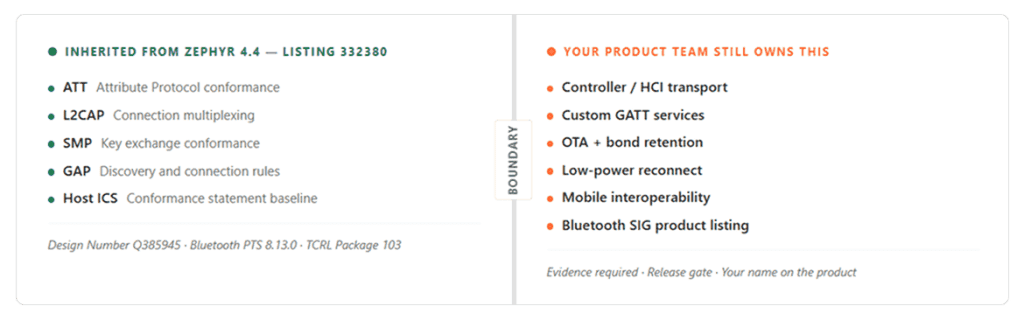
The practical win for a program manager is fewer conformance cycles to budget. Zephyr RTOS 4.4.0 ships a pre-qualified Bluetooth Host under Design Number Q385945 and qualification listing 332380 (docs.zephyrproject.org, 2026). That listing means the upstream stack already cleared the Bluetooth SIG conformance suite for the Host layer — your team inherits that evidence instead of regenerating it. The work that remains is matching your configuration to the qualified design and proving the parts you change. Qualification scope varies by release, so the inherited coverage is a starting position, not a guarantee. Teams confirm what the qualified Host actually covers by reading its Host Implementation Conformance Statement (Host ICS) and the records produced through Bluetooth PTS and AutoPTS. Reuse the baseline where your build matches; plan validation everywhere it diverges.
2. The qualification boundary sits below the product risks executives own
The risks that reach an executive’s desk — warranty returns, a stalled launch, a failed customer demo — live above the layer Zephyr qualified. A qualified Bluetooth Host covers conformance of the stack components between the application and the radio: attribute access (ATT), connection multiplexing (L2CAP), pairing key exchange (SMP), and the discovery and connection rules of the Generic Access Profile (GAP). It does not cover your controller, the transport between Host and controller (HCI), the radio’s Link Layer, your custom Generic Attribute Profile (GATT) services, or your application firmware — and that is where product behavior is decided. The boundary also carries a commercial obligation: the Bluetooth SIG requires every Bluetooth product to complete qualification before sale or distribution, and unqualified products face customs holds and enforcement action (bluetooth.com, 2026). Inheriting a qualified Host shortens that path; it does not complete it for the finished device your name ships on.
“A qualified Host answers conformance questions about the stack; it does not answer whether your product reconnects after sleep, preserves bonds after OTA, or produces the evidence your listing depends on.”
3. Five qualification inputs deserve a release-gate review
Five inputs decide whether your release gate has real evidence behind it or just an upstream claim. First, design match: does your build correspond to the qualified design, or have you diverged? Second, enabled features: the build flags and hardware description you ship (Kconfig and Devicetree) determine which qualified features are active. Third, the controller boundary: the qualified Host stops at the transport to the radio, so your controller and its link to the Host remain yours to validate. Fourth, custom behavior: any profile or service you add sits outside the qualified design. Fifth, listing evidence: your records must support a listing through the Bluetooth Qualification Workspace. Bluetooth PTS 8.13.0 supports TCRL Package 103 and profiles including HOGP 1.2 and HIDS 1.1, and validates Host parts above the Host Controller Interface (HCI) (bluetooth.com, 2026). Capture the Host ICS, PTS project files, and test logs as gate artifacts.
| Area | Covered by qualified Host | Still product-specific | Evidence to collect | Release owner |
|---|---|---|---|---|
| Host conformance | ✓ Yes — Q385945, listing 332380 | Config match to qualified design | Host ICS, PTS records | Firmware lead |
| GATT services | ✗ No | All custom services and permissions | Service test logs, permission map | Firmware lead |
| Controller / HCI | ✗ No | Controller firmware, Host-to-radio link | Integration logs, version freeze | Firmware lead |
| Bonding / security | ~ Partial — key exchange only | Bond storage, key survival across updates | Bond-persistence test results | Security owner |
| OTA | ✗ No | Image swap, rollback, bond retention | Rollback tests, post-update reconnect | Firmware + QA |
| Low-power reconnect | ✗ No | Sleep/wake timing after parameter updates | Power-state reconnect logs | QA |
| Mobile interoperability | ✗ No | Pairing across phone OS versions | Device matrix, packet captures | QA |
| Bluetooth SIG listing | ~ Baseline only | Product-level qualification record | Workspace submission package | Product lead |
4. Product teams get burned at the Host-to-product boundary
The failures that damage a launch cluster at the seam between the qualified Host and everything your product does with it. A device that passed conformance still fails in the field when it does not reconnect after a sleep cycle, when an over-the-air update erases stored bonds, when a custom service exposes the wrong permissions, or when pairing is unstable across mobile operating system versions. A controller firmware revision that does not match the Host, or a low-power timing regression after a connection parameter update, produces the same symptom set.
Migration adds its own edges: the Zephyr 4.4.0 release notes remove and deprecate Bluetooth APIs, including a removed command-builder helper (bt_hci_cmd_create()) and a deprecated connection-interval field (bt_conn_le_info.interval) (docs.zephyrproject.org, 2026). None of these are stack-conformance defects. They are product defects, surfacing where stored security keys, privacy addresses, and image swaps through MCUboot meet your application.
5. A practical response turns qualification scope into release evidence
Turning scope into evidence is a finite engineering task, and it protects both the launch date and the compliance file. Start by mapping every feature your build enables back to the Host ICS, then freeze the stack and controller versions so the evidence you collect describes the product you actually ship. Re-run the conformance suite through AutoPTS where your configuration diverges from the qualified design. Build a BLE regression suite that exercises the failure modes directly: power-state reconnect tests, OTA rollback tests, and a mobile device matrix backed by packet captures. Zephyr’s own tooling supports this — the Twister test runner and the BabbleSim radio simulator cover much of it before hardware-in-the-loop rigs confirm timing on the real radio. Preserve the output as listing evidence.
6. Specialists help when Zephyr internals meet hardware-specific behavior
The decision facing engineering leadership is not whether the qualified Host helps — it does — but whether your team has the bandwidth to own the boundary work alongside the rest of the program. Outside firmware specialists earn their place where product behavior crosses the stack, controller, application, security, and QA layers at once: Zephyr migration, Bluetooth Host integration, controller and transport validation, driver bring-up, automated regression, qualification evidence review, and release-readiness testing. The Bluetooth SIG’s 2025 market update projects Bluetooth device shipments above 5.3 billion units in 2025 and approaching 8 billion by 2029, with single-mode Bluetooth LE shipments growing at a 22% compound annual rate (bluetooth.com, 2025). Developex works across firmware, host, controller integration, and QA so these boundaries get tested together — the way they fail in the field, not in isolation on separate benches.
7. The right takeaway is a smaller stack risk and a sharper product test plan
The correct conclusion for leadership is narrow and useful: Zephyr 4.4.0’s qualified Host lowers your stack-conformance risk, and it sharpens — rather than replaces — the product test plan you still owe. Your product still requires its own qualification, and your release gate still has to prove that custom services behave, that updates preserve bonds, that the device reconnects, and that pairing holds across the phones your customers carry. Security expectations now sit beside conformance: the NISTIR 8259A baseline, published in 2020, defines core cybersecurity capabilities for IoT devices, and the broader NISTIR 8259 series guides manufacturers from design through support (nvlpubs.nist.gov, 2020). Ownership is the real deliverable — firmware, QA, and product leadership each holding a defined part of the boundary. Treat the qualified Host as a baseline you build evidence on top of, not a signoff you inherit.
Zephyr 4.4.0’s qualified Host is a starting point. Your product listing, regression evidence, and release gate are the finish line. Tell us about your Zephyr BLE build below — and we’ll help you map what’s already covered, what still needs evidence, and what to test before your release gate locks.