Bluetooth Core 6.2 readiness means proving firmware, host behavior, RF test access, and security assumptions before a wireless peripheral reaches EVT or DVT. Treating a Core 6.2 module as a chip-vendor checkbox — picking a part, shipping it with “6.2 support” printed on it, and moving on — is what causes late-stage surprises: failure in HID latency, stale controller buffers, LE Audio carried over USB, secure ranging, and over-the-air RF validation discovered after the enclosure is locked.
Bluetooth Core 6.2 added four features that affect release readiness
Treat Core 6.2 as a system change, not a marketing line, because each addition touches firmware, host, and test plans you have already budgeted. The Bluetooth SIG published the Bluetooth Core Specification v6.2 with four enhancements: faster connection timing (Shorter Connection Intervals), stronger distance-measurement security (Channel Sounding Amplitude-based Attack Resilience), audio data carried over the USB host link (HCI USB LE Isochronous Support), and broader radio test coverage (LE Test Mode Enhancements).
The Bluetooth SIG lists exactly four Core 6.2 enhancements and makes Expedited Specification Update 28108 (Erratum 28108: Alignment of BR/EDR with LE ACP and C/I Requirements) mandatory when claiming Core 6.2 compliance (bluetooth.com, 2025). None of these are cosmetic. Each one changes how a peripheral behaves under load, how it survives a security audit, or how it gets tested on a bench. A team that reads “6.2” as a module attribute inherits four validation obligations it never scoped, and inherits them late.
The business risk is late validation, not Bluetooth branding
The cost of a Core 6.2 claim is roadmap scope, test equipment, and support exposure you commit to the moment marketing prints the number. Bluetooth ships at scale — device shipments are projected above 5.3 billion in 2025, with single-mode Bluetooth LE shipments growing at 22% CAGR (Bluetooth SIG/ABI Research, 2025) — so a wrong claim propagates across large volumes and long support tails. Each feature maps to a different liability: HID responsiveness drives perceived product quality, the audio transport decides which dongles work, secure ranging underwrites access-control trust, and qualification evidence decides whether you ship at all. When any of these is claimed but unvalidated, the failure surfaces as field returns, blocked certification, or a support burden the original schedule never funded.
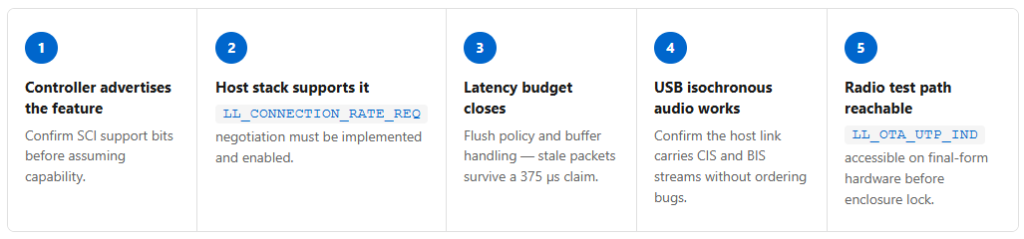
Teams should check five Bluetooth 6.2 dependencies before locking hardware
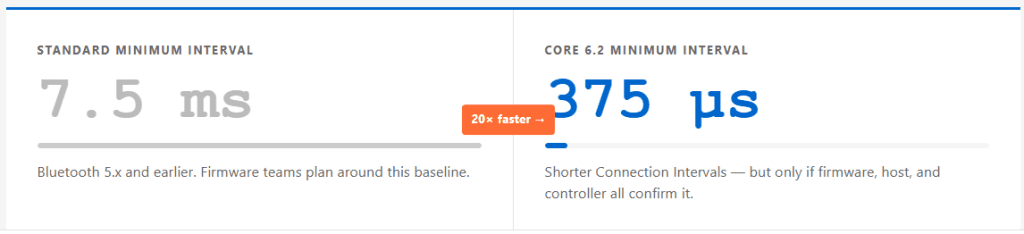
Lock the dependencies before you lock the hardware, because every Core 6.2 feature has a precondition that is cheap to verify on the bench and expensive to discover at DVT. Core 6.2 cuts the minimum connection interval from 7.5 ms to 375 µs (Bluetooth Core Specification v6.2, 2025), with the SIG’s 2025 roadmap targeting HID polling up to 1000 Hz. That speed exists only if controller feature bits, the rate-negotiation handshake, and the host all agree.
Five Bluetooth 6.2 failure modes create late peripheral regressions
Late regressions cluster around five predictable failure modes, and each slips past unit tests because it appears only under integration load.
-
01Stale input Flushable data not configured explicitly. The automatic flush timeout defaults to infinite — a controller delivers old HID packets, and a 375 µs claim degrades to multi-millisecond lag. Fix: set
HCI_Write_Automatic_Flush_Timeoutexplicitly. -
02Rejected rate procedures A busy controller returns
LL_REJECT_EXT_INDand silently keeps the slow interval. The device claims 375 µs but delivers 7.5 ms under load. -
03Packet-ordering bugs in the audio transport The HCI USB LE Isochronous path introduces serialization bugs visible only on the host link under real audio load across CIS and BIS streams.
-
04Weak ranging assumptions The Normalized Attack Detector Metric (NADM) requires ≥90% correct attack classification. A design tuned only for accuracy fails the security bar (bluetooth.com, 2025).
-
05Inaccessible over-the-air test mode The specification gates
LL_OTA_UTP_INDbehind an encrypted link and an explicitly enabled mode. After enclosure lock, the RF test path may be unreachable.
A staged response separates launch-critical claims from firmware-gated features
Separate what you claim from what you ship by sorting every Core 6.2 feature into three buckets: claim only features with pass/fail evidence, gate risky behavior behind a firmware flag you can disable, and defer features that lack test coverage.
The discipline is concrete: capture host-controller logs (HCI), run hardware-in-the-loop regression, and validate on final-form hardware before any feature graduates from gated to claimed.
| Core 6.2 feature | Product claim it enables | Integration risk | Evidence required before launch | Decision |
|---|---|---|---|---|
| Shorter Connection Intervals | Ultra-low-latency HID, up to 1000 Hz | Rate handshake rejected; slow interval retained | Negotiation in link-layer trace; latency held under load | Claim if validated |
| Flushable ACL data | Fresh, no-lag input | Stale packets from infinite default flush timeout | Explicit flush policy set; aged-packet test passed | Gate |
| HCI USB LE Isochronous | LE Audio over a standard USB dongle | Packet ordering/serialization bugs on host link | Isochronous stream verified across CIS and BIS; log clean | Gate |
| Channel Sounding NADM | Secure, distance-bounded access | Accuracy tuned, attack resilience untested | ≥90% correct attack classification | Defer |
| UTP over-the-air test mode | In-enclosure RF validation | Test mode unreachable after enclosure lock | Encrypted-link OTA test on final-form hardware | Claim on proof |
Specialists help when Bluetooth behavior crosses firmware, host, RF, and QA
Bring in specialists when a problem refuses to stay in one discipline — when latency, audio transport, secure ranging, and qualification evidence turn out to be the same bug seen from four angles. Cross-stack issues are where internal teams lose weeks, because the firmware owner, the host integrator, and the RF lab each see a partial symptom. Outside help earns its keep on stack integration, radio behavior on the physical layer, Bluetooth conformance evidence (PTS, TCRL, IXIT), and automated regression that captures host-controller and link-layer traces.
Security expectations are now explicit: NISTIR 8259A defines core IoT device cybersecurity capabilities including secure software update, data protection, logical access to interfaces, and cybersecurity state awareness (nvlpubs.nist.gov, 2020). Developex works across firmware, host, RF, and QA so these seams get tested together, the way they fail in the field, rather than in isolation on four separate benches.
Bluetooth Core 6.2 readiness belongs in the roadmap before certification
Put Core 6.2 decisions into architecture and test planning before qualification pressure starts, because every late wireless feature decision costs more than the same decision made at design time. Bluetooth Core 6.2, the EU Cyber Resilience Act (Regulation (EU) 2024/2847), and NISTIR 8259A converge on the same requirement: a wireless feature claim requires validation evidence captured before launch. The applicable certification baselines — ETSI EN 303 645 for consumer IoT and IEC 62443-4-2 for component security — require behavior to be proven, not asserted.
«Bluetooth 6.2 is only a product advantage after the host, controller, enclosure, RF test path, and firmware update path prove the same behavior under load.»
Decide early which features you will claim, which you will gate, and which you will defer — and make the release gate, not the datasheet, the place that decision is enforced.
Bluetooth 6.2, the EU CRA, and NISTIR 8259A all point the same direction: wireless feature claims now require validated evidence, not documentation written after the fact. Tell us about your wireless peripheral project below — and we’ll help you decide what to claim, what to gate, and what to defer before DVT.