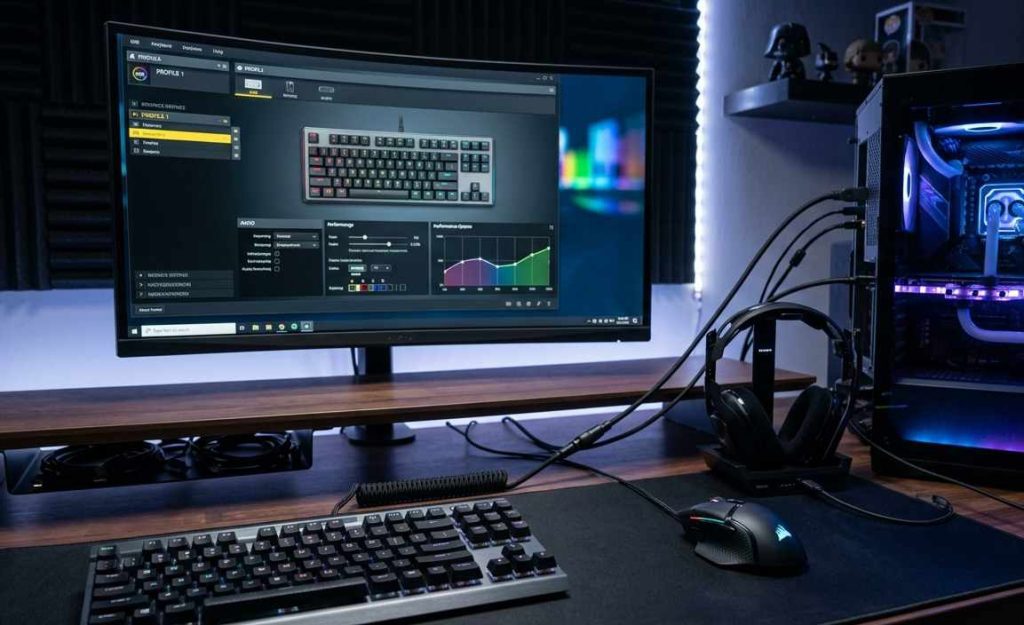
Firmware-controlled mouse clicks need firmware-grade testing because sensor calibration, threshold logic, haptic timing, wireless reports, and profile state drift independently across battery, temperature, sleep, firmware update, and production conditions; QA must validate the full sensing-to-HID path, not only button registration. At engineering validation, the click feels right. Two weeks later, after a deep-discharge battery cycle, the same unit fires earlier than the user dialed in. Peripheral teams inherit this failure mode when the click stops being a switch and becomes a chain of sensor reads, threshold logic, haptic pulses, and wireless reports.
Superstrike turns the mouse click into a calibrated firmware event
Logitech’s G PRO X2 Superstrike, branded as Superstrike Technology, replaces the physical mouse click with a coordinated firmware path: an inductive sensor senses trigger-plate travel, firmware decides actuation, and a haptic actuator manufactures the sensation. Public reporting describes the Haptic Inductive Trigger System (HITS) with 10 actuation steps, 5 reset levels, and 0.6 mm of click travel, alongside the HERO 2 optical sensor for tracking (Tom’s Hardware, 2025). For OEMs, the primary click input becomes a software-defined event with calibration drift, timing variance, and configuration state. Analog sensor readings flow through an ADC, firmware applies a virtual actuation threshold, rapid-trigger reset logic governs when the next click fires, and a Linear Resonant Actuator (LRA) must pulse inside the same acceptance budget as actuation and HID reporting. Each layer fails independently. The microswitch QA playbook covers none of them.
Haptic clicks shift launch risk from switch choice to system validation
A firmware-controlled haptic mouse click shifts OEM launch risk from component selection to system validation. When click feel becomes a marketing claim, every production unit must deliver the same travel, threshold, haptic pulse, and HID report timing. PC Gamer reports the Superstrike claims latency reduction up to 30 ms (PC Gamer, 2025), a delta competitive players measure and publicize when units vary. For an OEM, the launch risk is not that the design fails review. The launch risk is that the design works once on the engineering bench and drifts in production. Click-to-report latency depends on the sensing front end, the RTOS scheduler, the 2.4 GHz wireless link, USB-C wired fallback, USB HID 1.11 packet timing, and the HID report descriptor. Logitech G HUB profile changes, onboard profile recall, and battery saver mode each shift the timing chain. Users do not blame the haptic actuator or the wireless stack; they blame the brand.
Click technology comparison: validation surface widens with each generation
| Mechanical microswitch | Optical switch | Inductive haptic | |
|---|---|---|---|
| Click source | Metal dome closes contact | Infrared beam interrupted by stem | Inductive sensor senses trigger-plate travel; firmware fires haptic |
| Firmware role | Debounce, report | Debounce, report, edge timing | Threshold logic, reset logic, haptic timing, report |
| User-tunable behavior | None | Limited firmware debounce profiles | Actuation point, reset point, haptic intensity, polling rate |
| Primary failure modes | Contact wear, double-click after life cycling, bounce | Beam misalignment, dust, stem wear | Calibration drift, threshold mismatch unit-to-unit, haptic timing miss, false rapid-trigger reset, profile loss after sleep or update |
| Validation required | Switch cycle life, debounce timing | Cycle life, optical alignment, debounce | Full sensing-to-report chain, HIL motion rigs, profile persistence matrix, regression on every firmware build |
| Business risk | Late-life warranty claims | Misfire returns under contamination | Brand-defining feel drifts across units; competitive users measure and broadcast variance |
Peripheral teams need to check the full click path before DVT
For firmware-controlled mouse clicks, peripheral teams need to verify the full path before design validation testing (DVT): sensor travel, threshold decision, haptic output, profile state, and host report.
NIST found that testing activities account for 30% to 90% of the labor required to produce working software (NIST, 2002), so DVT discovery moves a click-feel defect into a labor-heavy phase.
A checklist for engineering leaders before DVT:
- confirm actuation threshold calibration holds across unit-to-unit manufacturing tolerance
- measure haptic pulse timing relative to the actuation event on a single clock domain
- verify HID report timing under load, idle, and sleep transitions
- exercise the rapid-trigger reset logic at maximum click cadence
- validate that profile settings survive sleep, reboot, firmware update, and battery exhaustion
- characterize temperature sensitivity and thermal cycling across the ranges cited in IEC 60068-2-1:2007, IEC 60068-2-2:2025, and IEC 60068-2-14:2009
Each item is a measurable acceptance criterion. Software-only tests do not observe the complete electromechanical path, which is why firmware validation before DVT belongs in the program plan, not in the bug backlog.
Five failure modes turn adjustable clicks into support tickets
Five recurring failure modes turn a software-defined mouse click into a returns problem.
- First, left and right buttons drift apart over the production batch because each inductive sensor calibrates independently and tolerance stacks.
- Second, the actuation threshold a user dialed in on a hot day misfires on a cold one because temperature compensation was tuned, not characterized.
- Third, the haptic pulse arrives outside the accepted timing window after the report fires, breaking the illusion of a real click.
- Fourth, rapid-trigger reset logic releases prematurely under high-cadence input, registering phantom releases competitive users reproduce on stream.
- Fifth, the user’s profile settings — actuation point, reset point, haptic intensity — disappear after a sleep cycle, firmware update, or low-battery shutdown, matching the companion app profile-persistence failure class on simpler peripherals.
A production response starts with measurable click behavior
“When a mouse click becomes a firmware-controlled event, QA has to validate the timing relationship between travel, actuation, haptic feedback, and HID reporting, not only whether a button registered.”
The production response for a firmware-controlled haptic click is defining correct click behavior in measurable terms, then building a rig that proves the behavior on every build. Acceptance starts with a click-to-report latency budget. For a peripheral specified at 8,000 Hz polling (product specification, 2025), the nominal report interval is 0.125 ms (calculated from polling frequency, 2026), and the full sensing-to-host chain must land within a stated acceptance multiple. Travel sensing, actuation event, haptic pulse start, and HID packet emission should be captured on a single clock domain so timing relationships are unambiguous.
Captured on a single clock domain.
Captured on a single clock domain.
Captured on a single clock domain.
Captured on a single clock domain.
Hardware-in-the-loop testing for peripherals with motion-controlled actuators replaces human thumbs with repeatable force and travel inputs. Profile matrices — combinations of actuation point, reset point, polling rate, and power state — execute the same scripted click sequence on every firmware change. ISO/IEC/IEEE 29119-1:2022 provides test-architecture framing for deciding what to measure before execution begins.
Specialists help where firmware, metrology, and automation meet
Prototype work for a firmware-controlled haptic click uses embedded firmware and mechanical engineering resources. Production repeatability requires rigs, timing instrumentation, and regression frameworks that connect firmware, metrology, RF, and CI. NIST frames software testing infrastructure as a measurement and test-method problem, not only a code activity (NIST, 2002).
The toolchain crosses disciplines:
- motion-controlled actuation rigs to apply repeatable force profiles
- logic analyzers such as Saleae Logic 2 to capture the SPI or I2C bus traffic alongside the PWM haptic driver waveform
- precision power instruments such as the Joulescope JS220 to correlate latency with energy state
- J-Link RTT for firmware trace logs at line rate
- and a regression harness — pytest, Robot Framework, GitHub Actions — to run the click matrix on every commit
Embedded QA automation for connected devices is the mechanism for catching drift before shipment. The work sits between firmware, RF, mechanical metrology, and CI engineering. It is the gap where late-stage launch defects live.
Reliable haptic clicks require early architecture and repeatable test evidence
Reliable haptic mouse clicks require early firmware architecture and repeatable test evidence because the click path crosses mechanical tolerance, scheduler timing, companion app state, wireless link reliability, and firmware updates. NIST defect-cost data reports operation-and-maintenance fixes at 470 to 880 times requirements-stage fixes (NIST, 2002), which makes late validation a launch-cost risk. Profile storage must survive power loss without corruption. The signed firmware update path needs a recoverable rollback story so a bad release does not brick units in the field; OTA and firmware update readiness should be a program gate, not a sprint task. NISTIR 8259A defines baseline cybersecurity capabilities device manufacturers should provide, including secure update and data protection (NIST, 2020). Regulation (EU) 2024/2847 — the Cyber Resilience Act — sets cybersecurity requirements for products with digital elements sold into the EU. Cybersecurity framing is not regulatory advice; it is launch risk. An OEM treating the haptic click as a switch replacement will discover at scale that it is a connected, configurable, updatable subsystem under quality standards aligned with ISO 9001:2015 and product security obligations — and that the embedded firmware architecture for hardware products must reflect all of them from the start.