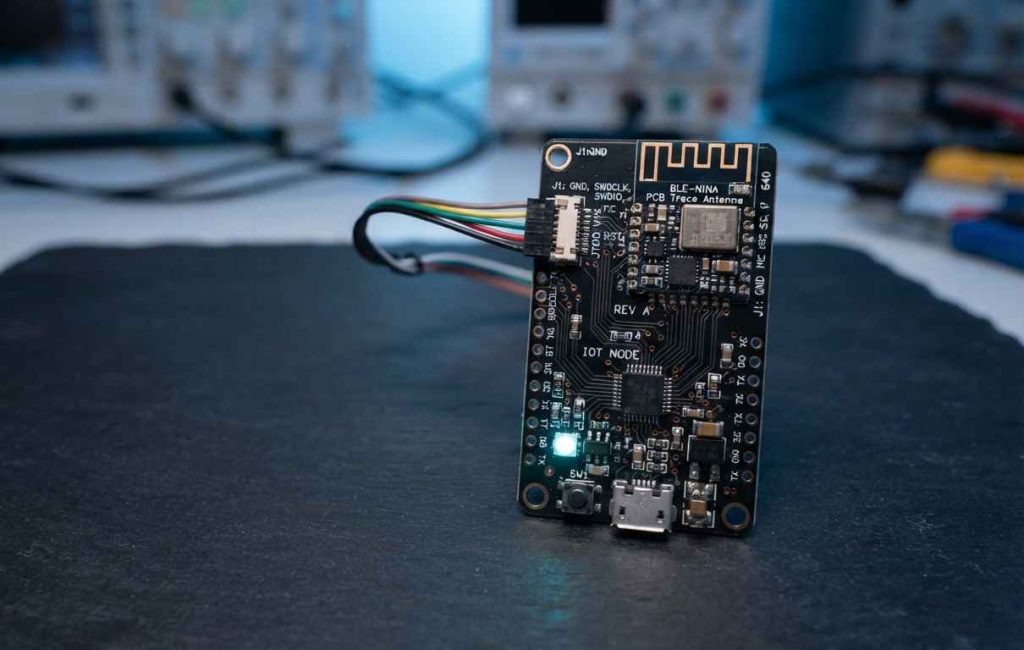
Zephyr 4.3.x on nRF54-class hardware is release-ready only after BLE lifecycle, RF transmit power, USB host behavior, MCUmgr image handling, and OTA rollback paths are forced to fail and recover on product hardware in the lab, with retained evidence for each release gate. A clean build is not enough because Zephyr 4.3.1 fixed bugs across those product-critical paths.
Zephyr 4.3.1 turns release notes into an nRF54 validation map
Zephyr 4.3.1 is a validation map for any team shipping nRF54-class peripherals: read the maintenance release as a list of paths the project has already shown failed in released code. The Zephyr Project shipped v4.3.1 on June 23, 2026 as a maintenance release following v4.3.0 (github.com, 2026). Zephyr 4.3.1 fixed issues cluster in the subsystems a connected product ships on. The list includes corrected radio transmit power on nRF54Lx parts, a firmware-update component that misidentified which image slot was active, a separate update path that erased the slot it was running from, a Bluetooth connection-object reference leak, a crash in the Bluetooth radio test commands used for certification, and an interrupt-time assertion in the USB stack. Treating 4.3.1 as a routine bump means re-shipping bugs the release explicitly closed. The actionable read: every fixed issue names a test you should already be running.
The release risk sits where BLE, USB, RF power, and OTA paths intersect
The Zephyr 4.3.1 fixes for Bluetooth connection handling, RF transmit power, USB interrupt handling, and MCUmgr slot logic are not isolated firmware trivia; each maps to a line item on your risk register. A Bluetooth connection-lifecycle leak surfaces as app instability and memory exhaustion in the field: the fault returns as a support ticket after launch. Wrong radio transmit power moves measured current draw, putting your battery-life claim and your RF certification margin in question at once. A USB enumeration fault breaks the manufacturing fixture and the field-service tool, not the end-user demo, so it hides until production.
Zephyr 4.3.1 lists 123 fixed GitHub issues and 43 CVE records by visible release-list count (github.com, 2026). The release risk concentrates where Bluetooth LE, USB, RF power, and the update path overlap in connected devices that combine wireless communication, host connectivity, and OTA maintenance.
Five validation blocks turn Zephyr 4.3.x notes into executable tests
Create five executable validation blocks from Zephyr 4.3.1 notes, each with an owner, environment, pass signal, and release gate.
Bluetooth connect/disconnect churn: release-gate cycles plus Frame Space Update negotiation across Bluetooth Controller, GATT, and L2CAP on an nRF54L15 DK.
Transmit-power and current profiling against the release baseline with a Power Profiler Kit II; issue #99588 reported nRF54Lx default radio transmit power above 0 dBm and high transmission current while profiling the heart-rate peripheral sample with PPK II (github.com, 2025).
Bluetooth radio test commands for certification.
USB enumeration, suspend/resume, and disconnect/reconnect across host OSes.
Firmware upload, erase, confirm, rollback, and power-loss interruption.
Automate the blocks in Twister and pytest under the Zephyr SDK so each produces signed evidence.
| Zephyr issue area | Product risk | Validation block | Pass signal | Owner |
|---|---|---|---|---|
Bluetooth connection lifecycle (bt_conn) |
Instability, memory pressure | Connect/disconnect churn | No retained refs | Firmware QA |
| RF transmit power | Battery/RF mismatch | Current and RF profiling | Matches release baseline | Firmware + RF |
| MCUmgr active slot | Bricked device | Slot upload/erase/rollback | Active image preserved | Firmware |
| USB device stack | Fixture/service failure | Host enumeration and interrupt-path tests | No assertion | QA |
| Radio test mode (DTM) | Certification delay | Test-command validation | Commands complete | Firmware + Certification |
Four Zephyr 4.3.x scenarios show where late-cycle products get burned
Four concrete Zephyr 4.3.x failure modes show how a missed test becomes a business incident. First, when firmware slots sit on different flash devices, the update component writes the incoming image over the running one: issue #99762 reports that MCUmgr uploads firmware to the wrong slot and makes the device unbootable when MCUboot slots span separate flash parts (github.com, 2025). For a fleet, wrong-slot upload is a brick discovered after rollout. Second, a firmware-loader mode that erases its own slot leaves no path back. Third, the Bluetooth connection-object leak blocks clean disconnect cleanup, so memory degrades during endurance deployment until the product reboots itself. Fourth, a mutex taken at interrupt time in the USB stack trips an assertion and halts the stack during host enumeration, suspend/resume, or disconnect/reconnect testing. The update protocol itself, SMP messages with CBOR-encoded payloads, is part of what each scenario stresses. Lab injection covers the four failure modes before DVT; field discovery turns them into update recovery, support, certification, or manufacturing incidents.
A practical response starts with a scoped regression matrix
The correct response is not “test everything”; that never finishes and never ships. Build a scoped regression matrix tied to the variables that change release risk: board revision, Zephyr tag, bootloader configuration, flash layout, Bluetooth role and features, USB class, host operating system, update transport, image-signing policy, rollback policy, the exact point of power loss during an update, and the manufacturing-test command path. Include networking classes such as CDC ECM and CDC NCM on the next-generation USB device stack, device_next. The MCUmgr firmware-loader self-erasure case proves why scope matters: issue #100715 describes firmware-loader self-erasure in Zephyr 4.2 and 4.3 as a “Major”-impact bug caused by erasing the slot the loader runs from (github.com, 2025). The self-erasure failure is invisible unless your matrix includes a recovery-mode row. Run the matrix with West and Twister across an nRF54L15 DK and an nRF54LM20A DK, flashing and tracing through SEGGER J-Link so coverage spans silicon variants.
Firmware QA specialists help when lab coverage spans radios, hosts, and update paths
Cross-subsystem validation needs firmware, QA automation, hardware-in-the-loop rigs, RF measurement, and update-path experience working from one plan. On a release team, those skills sit across firmware engineering, QA automation, RF engineering, security, and manufacturing test ownership rather than a single workstream. Firmware QA specialists help by delivering scripted firmware-update and SMP test runs, Bluetooth lifecycle automation, USB host farms across the product support matrix, current profiling with calibrated instruments, deliberate failure injection at power-loss points, signing keys validated against PSA Crypto and Mbed TLS 3.6.6, and signed release sign-off evidence. The security baseline is explicit: NIST IR 8259A defines a secure, authorized, verified software-update mechanism as a core IoT device capability (nist.gov, 2020). Your rollback path is part of secure software-update capability, tracked through CVE and GHSA records, not an optional extra. Teams that have shipped connected hardware for Logitech, Dell, and Intel treat update recoverability and host-matrix coverage as standing line items.
Zephyr 4.3.x validation is a release gate, not a dependency task
Accept Zephyr 4.3.x onto an nRF54-class product only after product-specific validation passes for Bluetooth lifecycle, RF transmit power, USB host behavior, firmware-image handling, and over-the-air recovery, not when the build is green. The maintenance release closed real bugs in every one of those paths; a clean compile proves none of them.
“A Zephyr update is not validated when it builds; it is validated when BLE, USB, OTA, and rollback fail in the lab instead of in the field.”
Treat the gate as a security obligation too: EU CRA Regulation (EU) 2024/2847 applies from December 11, 2027, with reporting obligations from September 11, 2026 (eur-lex.europa.eu, 2024). A broken update path is a security defect, not only a quality one. Make 4.3.x a release gate with named owners and retained evidence, and the version bump stops being a late-program surprise.