Firmware CI/CD has moved beyond build servers and unit tests
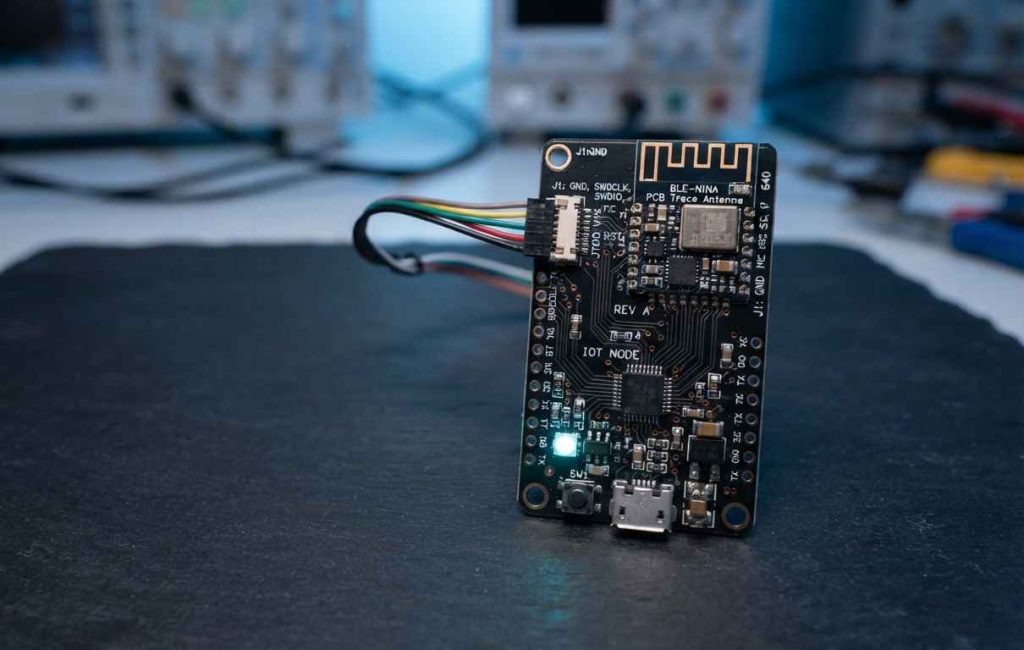
Build automation alone does not validate connected-product release readiness. Compiling code, running static analysis, and executing unit tests on every commit is a software-only gate supported out of the box by Jenkins, GitLab CI/CD, and Buildkite, with CMake and Ninja driving builds across Zephyr RTOS and FreeRTOS targets and BitBake/OpenEmbedded driving Yocto Project targets. The release-critical question is whether the physical product participates in the pipeline. Software-only CI proves a binary exists. Device-aware CI flashes that binary onto hardware with tools like OpenOCD and pyOCD, cycles power, stimulates inputs, captures logs, and verifies telemetry against expected behavior. Physical-device CI has measured precedent: the PHiLIP on the HiL project reported an automated CI deployment across 22 embedded platforms running 98 peripheral tests every night (PHiLIP on the HiL, 2021). Connected-hardware pipelines need evidence from the product, not just the firmware image that a bootloader like MCUboot will later install.
| Pipeline level | What it validates | What it misses | Tools | Release use | Evidence produced |
|---|---|---|---|---|---|
| Software-only CI | Compilation, static analysis, unit logic | All physical behavior — boot, power, radio, update paths | Jenkins, GitLab CI/CD, CMake, Ninja | Every-commit gate | Build logs, unit results, artifacts |
| Simulator/emulator CI | Instruction-level logic, driver paths, modeled peripherals | Real timing, RF behavior, power events, analog edges | Renode, QEMU | Fast pre-hardware filter | Emulation traces, coverage data |
| Device-in-the-loop CI | Real boot, power cycling, radios, updates, recovery | Mass-scale manufacturing variance | OpenOCD, pyOCD, pytest, Robot Framework | Release-candidate gate | Serial logs, power traces, video, telemetry, firmware version |
| Production test | Per-unit assembly, calibration, final flash | Pre-release design defects (caught too late) | Factory test jigs, in-circuit test | Manufacturing line | Per-unit pass/fail records |
Physical-device coverage turns CI/CD into launch-risk control
Device-in-the-loop CI controls launch risk by forcing release candidates through physical operating states before shipment. A clean build proves the binary exists; it does not prove the product survives first boot, a brownout reset, wake from deep sleep, correct sensor sampling, Bluetooth LE pairing, Wi-Fi reconnect after a router drop, USB Power Delivery renegotiation, an over-the-air update, rollback after a failed update, a telemetry handshake, or a factory reset to a known state. Every listed behavior is a product state where shipping hardware fails after passing unit tests. Late discovery moves the cost into launch delay, RMA exposure, emergency QA cycles, and support escalation. The economics are documented: NIST estimated inadequate software testing infrastructure cost the U.S. economy $59.5 billion annually, with $22.2 billion recoverable through feasible improvements (NIST Planning Report 02-3, 2002).
Five checks reveal whether the pipeline tests the product customers use
Executives can audit their firmware CI/CD pipeline in five questions, without reading a line of code. Each question exposes whether CI/CD validates product behavior or only engineering artifacts.
Can the pipeline build and flash a real device automatically, not just produce a binary?
Can it cycle power and trigger reset modes on demand?
Can it stimulate buttons, sensors, USB, and general-purpose I/O the way a user would?
Can it drive real connection flows over Bluetooth LE, Wi-Fi, Thread, and Matter?
Can it preserve serial logs, traces, firmware version, test video, and telemetry as durable artifacts?
A “no” to any audit question marks a release decision made on incomplete evidence. NISTIR 8259A defines IoT device cybersecurity capabilities as technical features implemented through device hardware and software (NISTIR 8259A, 2020) — a reminder that product behavior cannot be reduced to documentation, and release confidence cannot be reduced to documentation.
Four physical-world gaps turn clean builds into field failures
Generic CI misses failures that appear only when real silicon meets real power and real radios. Four gaps recur in connected products. First, an update path that builds cleanly still bricks the device, because the memory layout the bootloader expects diverges from the image installed over the air. Second, radios lose state: a Bluetooth LE bond corrupts after a deep-sleep cycle, or Wi-Fi fails to reconnect after a router loses power, though both passed on the bench. Third, power events corrupt data: a battery brownout scrambles stored settings, or a USB Power Delivery renegotiation fails after wake. Fourth, telemetry lies: the device reports update success before flash verification completes. Bootloader, radio, power, and telemetry defects do not appear in a compiler; they appear in serial logs and power traces captured over debug interfaces such as UART, SWD, and JTAG. FirmSec analyzed 34,136 firmware images and found 128,757 third-party-component vulnerabilities tied to 429 CVEs (FirmSec, 2022).
A practical response starts with one device-in-the-loop release gate
A practical response starts with one release gate around the single highest-risk user journey. Pick the journey that would hurt most if it failed in the field, then assemble a pool of golden devices and automate flash, reset, and power control around them. Run a fast smoke test on every release candidate; run longer radio, update, and power-cycle tests nightly. Store every artifact, quarantine flaky tests so they do not erode trust, and keep emulator and simulator runs — on Renode or QEMU — as a quick pre-hardware filter. Orchestrate with existing tools: pytest and Robot Framework for test logic, OpenOCD, pyOCD, and dfu-util for device control, and SPDX, CycloneDX, and SLSA v1.0 for supply-chain evidence. Emulation helps but does not suffice: P2IM ran 79% of the 70 sample firmware images without manual assistance and found 7 unknown bugs during limited fuzzing of real firmware (P2IM, 2019).
- Run a fast smoke test on every release candidate; run longer radio, update, and power-cycle tests nightly.
- Store every artifact, quarantine flaky tests so they do not erode trust, and keep emulator and simulator runs — on Renode or QEMU — as a quick pre-hardware filter.
Specialists help when firmware, QA, and hardware constraints collide
Device-in-the-loop CI depends on firmware, QA, hardware, companion-app, security, and release-engineering work happening together. Building it well means designing test fixtures and relay-driven power cycling, planning RF isolation so radios under test do not interfere, orchestrating runs, flashing firmware, capturing serial logs, validating updates and rollback, coordinating companion-app behavior, triaging failures, and maintaining a software bill of materials while keeping the system owned and maintainable as the product evolves. A team without embedded context lacks the scope needed to maintain the gate. Developex works across firmware, electronics, QA automation, companion apps, security, and release engineering, the multidisciplinary span required for device-in-the-loop CI. The standards landscape adds evidence requirements: ETSI EN 303 645 V3.1.3 sets 68 consumer-IoT security provisions (ETSI EN 303 645 V3.1.3, 2024), NIST SP 800-218 SSDF and IEC 62443-4-1 define secure-development practices, ISO/IEC 27001:2022 frames the management system, and the EU Cyber Resilience Act, Regulation (EU) 2024/2847, requires documented security-update and vulnerability-handling processes. Treat ETSI, NIST, IEC, ISO/IEC, and EU regulatory requirements as engineering evidence your pipeline must produce — not legal advice.
Embedded firmware CI/CD now belongs in the product architecture plan
Late CI/CD decisions create release risk for embedded products. When device-in-the-loop testing is treated as a last-mile QA scramble instead of an architectural choice, teams find physical-state failures after fixture design, QA scheduling, and release evidence should already be stable. Put device-in-the-loop CI in the architecture and release plan from the start. The minimum viable pipeline is short to state and hard to fake: build, flash, stimulate, observe, recover, and store evidence — on real hardware, on every release candidate.
“Firmware CI/CD is not finished when the binary compiles; it is finished when the product proves it can boot, connect, update, recover, and report evidence on real hardware.”
The EU Cyber Resilience Act adds dated obligations: reporting obligations for actively exploited vulnerabilities apply from 11 September 2026, broader application starts 11 December 2027, and penalties reach EUR 15 million or 2.5% of worldwide annual turnover (Regulation (EU) 2024/2847, 2024).
Developex combines embedded and firmware engineering with QA test automation to design device-in-the-loop pipelines that prove product behavior before release.