When a company decides to build an IoT product, the first instinct is usually to go looking for an “IoT developer.” But IoT software development is genuinely cross-disciplinary and spans at least five interconnected layers — device firmware, connectivity protocols, gateway software, cloud backend, and mobile or web application — and each layer requires distinct skills, tools, and domain knowledge.
The practical consequence is that “hiring an IoT developer” is usually the wrong frame. The right question is: which layers of the IoT stack does your project need, which of those can your existing team cover, and how do you fill the gaps? In this post, we will discuss what the IoT software stack actually requires, why building a full in-house IoT team is harder than it looks, and when team augmentation with a specialized partner is a more practical path to shipping a connected product on schedule.
What the IoT Software Stack Actually Requires
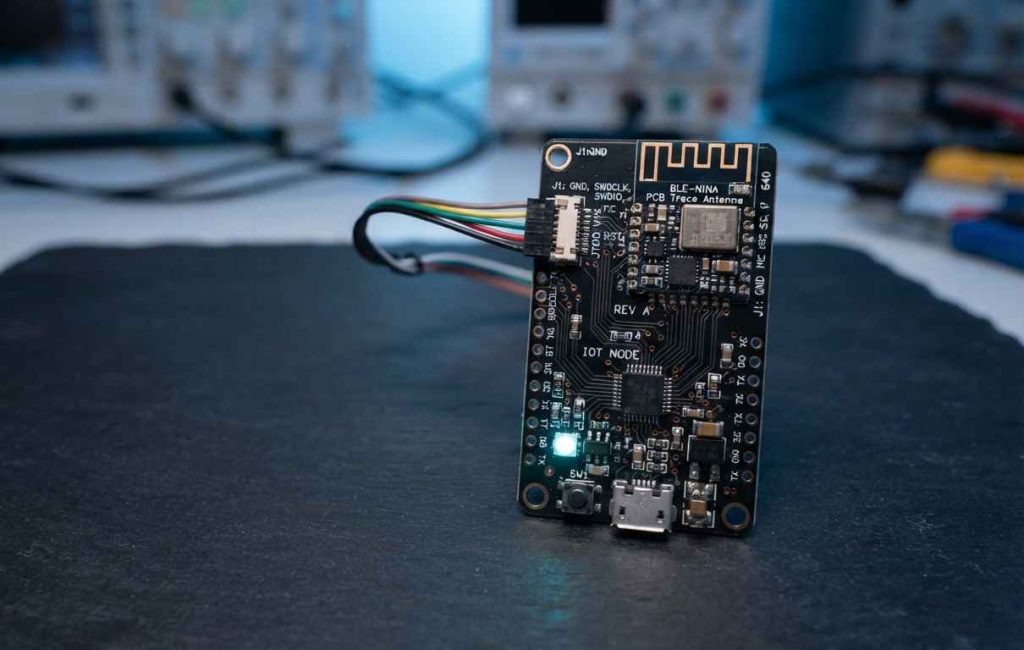
Device firmware runs directly on the microcontroller: reading sensors, managing low-power modes, handling protocols at the chip level, and implementing OTA updates. It’s low-level C/C++ under tight memory and timing constraints, where a bug that’s trivial on a server can brick a field-deployed device.
Connectivity is the protocol layer — BLE for proximity-controlled consumer devices, Wi-Fi for stationary indoor hardware, MQTT or HTTPS for cloud communication, LoRaWAN or NB-IoT for wide-area deployments. Protocol choice drives power budget, range, and certification cost, and getting it wrong usually means a hardware revision, not a software patch.
Cloud backend ingests device telemetry, authenticates devices, manages the fleet, and serves the application layer. Platforms like AWS IoT Core, Azure IoT Hub, and Google Cloud IoT handle much of the plumbing, but a production-grade backend still needs real cloud architecture, database, and security expertise.
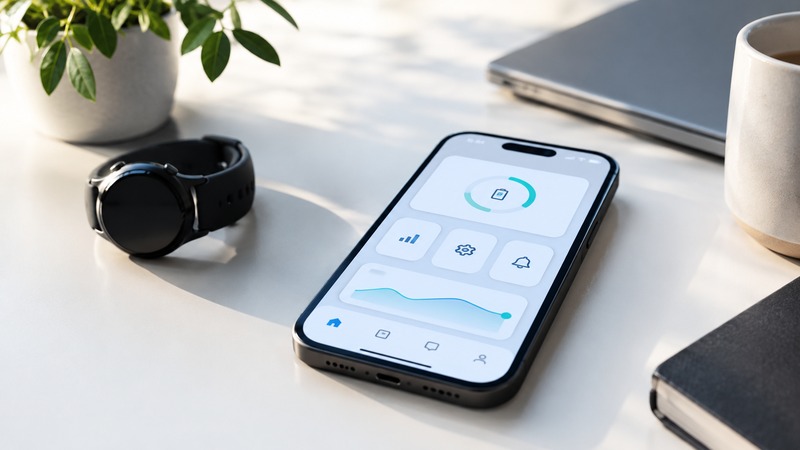
Mobile and web applications are what users actually touch: pairing, live status, configuration, alerts, OTA update UX. BLE provisioning in particular is where most consumer IoT apps lose users, and getting it right requires the app and firmware sides working in sync.
Security isn’t a layer of its own — it has to be designed into every layer. Secure boot, encrypted device-to-cloud communication, signed OTA updates, and proper device identity aren’t optional for a connected product sold in the EU under the Cyber Resilience Act, and buyers elsewhere increasingly expect the same.
Why “Hire an IoT Developer” Rarely Works as Expected
A genuinely full-stack IoT engineer — real depth in firmware, connectivity, cloud, and mobile — doesn’t exist in useful numbers. IoT is younger as a commercial discipline than web or mobile development, so most engineers who are good at it have specialized in one or two layers rather than all of them. A job posting asking for all four ends up drawing candidates who each map to a different role, and the hiring manager is left comparing apples to oranges.
The numbers back up the scarcity: 32.7% of enterprise developers now work in the industrial IoT sector, and demand for specialized firmware and connectivity talent keeps outpacing supply as the number of connected devices grows.
Most IoT projects don’t fail because any one layer was built badly — Cisco and McKinsey research puts the failure-to-scale rate at 60–75%, and the recurring cause is underestimated integration complexity between layers, not a bad firmware engineer or a bad backend engineer.
Building a full in-house IoT team from scratch typically runs into three compounding problems: a thin candidate pool for firmware and cloud-IoT-specific roles, a long time-to-hire for the roles that matter most, and integration friction once engineers hired for different layers actually have to work together.
How IoT Teams Are Actually Structured in Practice
Companies that ship IoT products successfully rarely hire one “IoT developer.” They map the product to the layers it needs and make a deliberate call on what to staff in-house versus bring in externally.
| IoT stack layer | Engineering role | Hiring difficulty | Typical strategy |
|---|---|---|---|
| Device firmware | Firmware / embedded engineer | Very high — thin pool, long time-to-hire | Augment from a specialist partner |
| Connectivity protocols | Embedded connectivity specialist | High — often overlaps with firmware | Augment or combine with firmware hire |
| Cloud backend | Cloud / backend engineer (IoT-aware) | Medium — broader pool, IoT experience helps | In-house or augment, depending on team |
| Mobile app | iOS / Android developer | Medium — large pool, BLE experience is scarce | In-house if the team has mobile capability |
| Security | Security or embedded security specialist | Very high — often consulted rather than hired | Consulting or augmented specialist |
| System integration | Senior IoT architect / tech lead | Very high — needs cross-layer understanding | The most critical augmentation decision |
Firmware and system integration are consistently the hardest roles to fill in-house — and the roles where mistakes are most expensive to fix. Cloud and mobile are easier to hire for, and easier to recover from if a hire doesn’t work out. That asymmetry drives most of the practical build-vs-augment decisions.
What to Keep In-House and What to Augment
This split is a control-and-continuity decision more than a cost decision.
Keep in-house what’s central to your competitive advantage and needs ongoing institutional knowledge: product and UX decisions, the cloud architecture that shapes how device data is processed and exposed, and the mobile app if consumer experience is a differentiator. These are areas where domain knowledge of your specific product compounds over time, and external engineers ramp up more slowly.
Augment what requires deep, narrow technical specialization or is project-phase-specific. Firmware is the most common augmentation call in IoT — the talent pool is thin, time-to-hire is long, and skills like specific MCU families, RTOS environments, and BLE stacks are narrow enough that a generalist embedded engineer isn’t a real substitute. Connectivity protocol work, BSP development, and security hardening tend to fall into the same category.
The value of augmentation compounds when the partner has actual IoT experience, not just spare engineering capacity. A team that has already shipped connected products knows where the typical bottlenecks sit — BLE provisioning edge cases, OTA rollback logic, certification requirements for a given connectivity protocol — and designs around them from the start instead of discovering them mid-integration. On top of the rate advantage, that’s the real payoff: fewer rework cycles and fewer of the delays that quietly cost both time and budget when a generalist team takes on its first IoT project.
The highest-value augmentation setup is firmware and application engineers working the same project side by side, not as separate vendor engagements. The BLE GATT profile, the MQTT topic structure, the OTA update protocol — these decisions touch both firmware and app, and they need both sides in the same conversation. When firmware and app work are split across vendors who define their interface independently, integration is where the expensive problems show up. When one partner team handles both alongside your in-house engineers, those problems get caught in a conversation instead of a two-week debug session.
IoT Developer Rates in 2026
Rates vary by layer and region. The ranges below reflect product development work, not staff augmentation through an established partner, which typically prices more predictably.
In-house (North America): average US IoT software developer pay sits around $109,905, but that’s the broad middle of the market — firmware and embedded engineers with IoT experience command $130,000–$180,000 at mid-to-senior level, and cloud/mobile engineers with BLE experience run $120,000–$160,000. Add 30–40% on top for benefits, taxes, and recruiting.
Nearshore augmentation (Eastern Europe): senior firmware and embedded engineers from established partners in Ukraine and Poland typically bill $45–$70/hr; cloud backend and mobile developers run $35–$60/hr.
“A small augmentation team — firmware engineer, cloud engineer, mobile developer, tech lead — usually lands 50–65% below the equivalent in-house cost in North America.”
Time-to-productivity is the most underestimated cost. For firmware roles, where the engineer needs to learn the hardware platform, toolchain, and communication protocols before writing meaningful code, ramp-up routinely takes 8–12 weeks. Through an experienced augmentation partner, that ramp typically drops to 2–3 weeks.
How Developex Approaches IoT Development
Developex has been building software for connected products since 2001. Our work covers the stack end to end — firmware on microcontroller platforms from vendors like STMicroelectronics, Nordic Semiconductor, NXP, Texas Instruments, Microchip, and Cypress, BLE and Wi-Fi connectivity, companion mobile apps (iOS/Swift, Android/Kotlin), desktop configuration tools built in Qt/C++, and cloud backends on AWS, Azure, and Google Cloud.
The part that matters most operationally: firmware and app engineers work on the same project, not separate engagements. The device communication protocol — BLE GATT, MQTT, or a proprietary scheme — gets defined jointly before either side writes production code, which removes the category of integration bug that causes most IoT delays.
We work both as a end-to-end device ecosystem development partner and as an augmentation provider, embedding engineers alongside your internal team for whichever layers your hiring is constrained on. For more on how we handle connected products end to end, see our Smart Home & IoT development services.
Practical Steps for IoT Hiring in 2026
Building an IoT team is sequential, not parallel — early decisions on protocol, cloud platform, and firmware architecture constrain everything downstream.
Map the five layers against your actual product requirements — connectivity protocol, cloud platform, MCU family — to see which roles are truly essential in the first six months versus later.
It’s the longest lead time, the hardest to fill in-house, and everything else — BLE characteristics, MQTT topics, OTA mechanism — depends on what firmware exposes. If firmware is late, everything is late.
The protocol definition is a joint call; making it in a 30-minute meeting up front is far cheaper than discovering the mismatch during integration testing six months later.
If your team has mobile or cloud capability but is firmware-constrained, our IT Team Augmentation model adds firmware engineers alongside your existing team without the overhead of a permanent hire — see current benchmarks in our Embedded Software Developer Rates for 2026.