The mobile app industry is no longer just growing — it is maturing at speed. According to recent market data, global mobile app revenue reached an estimated $540 billion in consumer spending in 2025, with projections pointing to $600–620 billion by the end of 2026. Users are spending nearly 90% of their mobile time inside apps, and the average person has over 80 apps installed on their device — yet uses only about a third of them actively. As competition intensifies, the mobile app features a product offers have become the primary factor separating apps people keep from the ones they delete. That gap between installed and used is the central challenge every product team faces today.
What separates the apps people keep from the ones they delete within a week? It comes down to features — but not features in isolation. It is about the right capabilities, implemented thoughtfully, that reduce friction, build trust, and deliver genuine value on every session. The bar has risen dramatically. In 2025, over 28% of all new apps launched featured AI-based functionality, and 70% of mobile apps now use AI features to improve the user experience. Users have adapted to these intelligent experiences and now expect them as a baseline — not a bonus.
For businesses planning or evolving a mobile product in 2026, understanding which features are non-negotiable and which ones create genuine competitive differentiation is critical. Getting this right is the difference between an app that earns loyalty and one that quietly disappears from users’ home screens. In this post, we will discuss the must-have foundational features every mobile app needs, the modern capabilities that drive real growth in 2026, and how to approach building them the right way.
1. Must-Have Mobile App Features: The Foundation Every App Still Needs
Before chasing the newest trends, it is essential to get the fundamentals right. Many apps fail not because they lack AI or AR — but because they get the basics wrong. These are the features that users simply expect, and their absence is felt immediately.
1.1 Fast, Reliable Performance
Performance is not a feature — it is a prerequisite. Apps that take longer than three seconds to load face significant drop-off rates, and users who encounter crashes rarely give a second chance. This means optimizing cold start times, minimizing API call latency, and handling edge cases like poor connectivity gracefully. Apps that leverage local caching, offline modes, and background sync retain users significantly better than those that require a perfect network connection for every interaction.
1.2 Smooth and Intuitive Onboarding
First impressions are irreversible. A confusing or lengthy onboarding flow is one of the fastest paths to uninstall. The best onboarding in 2026 is progressive — it reveals complexity only when users are ready for it, uses contextual prompts rather than upfront tutorials, and gets users to their first “aha moment” as quickly as possible. Asking for permissions at the moment they are needed (rather than all at once at launch) has also become a standard practice that meaningfully improves conversion.
1.3 Push Notifications Done Right
Push notifications remain one of the highest-ROI engagement tools when used correctly. The keyword is correctly. Notification fatigue is real, and apps that blast users with irrelevant messages face permission revocation and uninstalls. The rule is simple: every notification should have a clear reason to exist for that specific user at that specific time. Smart segmentation, behavioral triggers, and user-controlled preferences transform push from an annoyance into a valued service.
1.4 Accessibility and Inclusive Design
An accessible app is not just an ethical obligation — it is a business opportunity. Supporting screen readers, dynamic text sizing, sufficient color contrast, and keyboard/voice navigation opens your app to a wider audience and improves experience for all users. App stores have also become increasingly attentive to accessibility compliance, making it a factor in discoverability.
1.5 Secure Authentication
Biometric authentication (Face ID, fingerprint) is now the expected standard for login. Multi-factor authentication should be available for sensitive actions, and session management must be handled carefully to avoid exposing users to unnecessary risk. If your app stores personal or financial data, security is not optional — it is the most fundamental feature of all.
2. Mobile App Development Trends 2026: AI-Powered Personalization
Artificial intelligence is no longer a differentiator in mobile apps — it is the baseline expectation. In 2026, AI is described as the foundation, not a feature, with apps being architected around machine learning models from day one rather than retrofitting AI as an afterthought.
The most impactful expression of AI in mobile apps is hyper-personalization. This goes far beyond showing a user’s name or remembering their last order. Modern personalization engines dynamically adjust content, UI flows, feature access, pricing, and marketing messages at the individual level. According to industry research, 92% of businesses have already started embracing AI-backed personalization techniques, and the retention impact is measurable. Two users opening the same app in 2026 may encounter entirely different experiences — different recommended content, different navigation shortcuts, different onboarding paths — all shaped by behavioral data.
Predictive UX is another dimension of AI that is rapidly becoming standard practice. Rather than waiting for a user to take an action, the app anticipates what they need next based on past behavior, time of day, location, and contextual signals. This reduces friction at every step of the user journey and significantly increases session depth and frequency.
On-device AI is growing in importance alongside cloud-based models. With Apple’s Neural Engine and Google’s Tensor chips now embedded in most flagship devices, running lightweight machine learning models locally means faster inference, better privacy, and functionality that works even without an internet connection. For sensitive applications — healthcare, finance, enterprise tools — on-device AI is often a privacy requirement, not just a performance optimization.
Conversational AI has also matured dramatically. AI-powered chatbots are now present in 41% of customer service apps, improving resolution times by 22%. In 2026, however, these are not the rule-based chatbots of 2020. They handle multi-step reasoning, understand context across a conversation, and escalate to human agents intelligently. Apps that implement in-app AI agents for onboarding, support, and product guidance see measurable improvements in activation rates and customer satisfaction scores.
For teams building or upgrading mobile products, AI integration should start with a clear problem to solve — not with a desire to add “AI” to a feature list. The strongest AI implementations are invisible: they simply make the app feel smarter, faster, and more relevant.
3. Performance, 5G, and Edge Computing: Speed as a Competitive Advantage
| Capability | Why It Matters in 2026 | Key Benefit |
|---|---|---|
| 5G-optimized architecture | 5G is now ubiquitous in urban markets; apps built for it unlock real-time features impossible on 4G | Low-latency experiences, live streaming, AR/VR |
| Edge computing | Moves processing closer to the user, reducing round-trip time to centralized servers | Faster load, offline resilience, lower battery use |
| Adaptive streaming | Dynamically adjusts media quality based on connection speed | Consistent experience across network conditions |
| App size optimization | Smaller install packages reduce abandonment during download | Higher conversion from store page to install |
| Background sync & offline mode | Allows core functionality without active connectivity | Retention in low-signal environments |
| Lazy loading | Defers loading of non-critical resources until needed | Faster perceived performance, lower initial data use |
| Performance monitoring (APM) | Real-time visibility into crashes, latency, and ANRs | Faster issue detection and resolution |
The performance expectations users carry into 2026 are shaped by the fastest apps they use — not the average. As 5G and advanced connectivity become ubiquitous, users demand near-instant load times and uninterrupted experiences. This has pushed many teams toward edge computing architectures, where critical computations happen locally or within regional edge nodes rather than being routed through central cloud servers every time.
This shift is especially significant for real-time applications: multiplayer gaming, augmented reality, telehealth consultations, and IoT dashboards all depend on sub-100ms response times that only edge-aware architectures can reliably deliver. For product teams, investing in performance infrastructure is not a back-end concern — it is a growth lever with direct impact on retention, ratings, and revenue.
If you are looking to build or scale a high-performance mobile application, Developex’s Mobile App Development services cover the full stack — from architecture design through to deployment and ongoing optimization.
4. Security, Privacy, and Compliance: Building Trust by Design
Security in 2026 is not a feature you add at the end of a sprint. It is an architectural decision made from the first line of code. Apps that treat security as an afterthought face abandonment, negative reviews, and potential legal exposure, and the regulatory landscape has never been more demanding.
The EU’s GDPR remains the global benchmark, but it has been joined by a growing list of regional frameworks: India’s Personal Data Protection Bill, California’s CCPA, and — critically for AI-powered apps — the EU AI Act, which took effect in August 2025. This legislation requires transparency, rigorous testing, and ethical use of data for any AI system deployed within the EU. For global apps, this means compliance is now a cross-functional discipline that involves developers, product managers, legal teams, and UX designers working together.
What does privacy-first development actually look like in practice?
- End-to-end encryption for all data in transit and at rest, with no exceptions for convenience
- Minimal data collection — capturing only what is strictly necessary for the feature to function
- Transparent permissions — explaining clearly why each permission is needed, in plain language, at the moment it is requested
- User data controls — making it easy for users to view, export, and delete their data
- Regular security audits — automated scanning integrated into CI/CD pipelines, plus periodic manual penetration testing
- Behavioral biometrics for fraud detection — monitoring patterns like typing speed and tap rhythm to detect anomalies without disrupting legitimate users
Apps that visibly protect user data build stronger brand loyalty. In an era where data breaches make headlines and users are increasingly informed about their rights, privacy is not just a compliance checkbox — it is a market positioning decision. Our Software Audit services at Developex include security audits that identify vulnerabilities before they become incidents.
5. UX/UI Design Trends That Drive Engagement in 2026
Great user experience in 2026 means apps that feel intelligent, effortless, and personal. The design trends shaping engagement are not about visual novelty — they are about reducing cognitive load and creating interfaces that adapt to the user rather than asking the user to adapt to them.
5.1 Adaptive and Context-Aware Interfaces
The most sophisticated apps in 2026 adjust their interface based on context: time of day, user behavior history, device orientation, and even ambient conditions. A food delivery app might show breakfast options at 8 AM and switch to dinner recommendations by 6 PM automatically. A fitness app might simplify its interface during a workout and expand analytics options afterward. This kind of context-awareness makes apps feel alive rather than static.
5.2 Microinteractions and Motion Design
Microinteractions — the subtle animations that acknowledge user actions, confirm transitions, and communicate system status — have a disproportionate impact on how polished an app feels. A well-timed haptic response, a smooth progress indicator, or a satisfying completion animation creates emotional resonance that keeps users coming back. The key is restraint: every animation should have a functional reason, not just a decorative one.
5.3 Voice and Multimodal Input
Voice is no longer confined to standalone assistant apps. In 2026, apps use voice combined with visual and gesture input together to create multimodal experiences. Voice search, voice-driven navigation, and voice-to-text input are increasingly expected in productivity, accessibility, and enterprise applications. Designing for multimodal input requires rethinking user flows beyond the touchscreen paradigm.
5.4 Dark Mode and Theming
Dark mode has moved from a trend to a baseline expectation, and leading apps now offer full dynamic theming — adapting to system preferences automatically while also allowing user customization. Supporting both light and dark modes is no longer optional for apps targeting mainstream audiences.
5.5 Design Systems for Consistency at Scale
As apps grow in complexity, design systems become essential for maintaining consistency across features and teams. A well-maintained design system — shared component libraries, token-based styling, documented interaction patterns — accelerates development, reduces inconsistency, and makes onboarding new designers and developers significantly faster.
For product teams that want to get design right from the start, Developex’s UI/UX Design services help translate business goals into user experiences that perform.
6. Modern Features That Create Competitive Advantage
Beyond the foundational and AI-driven capabilities, a cluster of modern features is separating market leaders from followers in 2026. These are not universal requirements — the right combination depends on your industry and user base — but they represent the frontier of what high-performing apps are building today.
6.1 Augmented Reality (AR) Integration
AR has moved well beyond novelty. In 2026, AR is deeply embedded in retail, real estate, healthcare, and education apps. Retail apps allow users to visualize furniture in their home before purchasing. Real estate apps let buyers walk through properties remotely. Healthcare apps overlay anatomical information for training. The Apple Vision Pro and Meta Quest platforms have normalized spatial computing expectations, making AR investment increasingly justified for consumer-facing products.
6.2 Super App and Ecosystem Thinking
The concept of super apps — single platforms that combine multiple services like payments, messaging, shopping, and utilities — has arrived in Western markets. Even if building a full super app is not your goal, thinking in terms of ecosystem rather than isolated features creates stickier, higher-value user relationships. Embedding loyalty programs, integrating third-party services via APIs, and creating a platform that grows with the user’s needs are all expressions of this philosophy.
6.3 Gamification and Behavioral Engagement
Gamification in 2026 is not about adding points and badges as an afterthought. It is about identifying the specific behaviors that matter for your product — daily active use, content creation, social sharing, feature adoption — and designing reward systems that make those behaviors feel meaningful and enjoyable. Streaks, challenges, social leaderboards, and progress milestones are particularly effective in fitness, education, and productivity apps.
6.4 Real-Time Features and Live Collaboration
With 5G infrastructure now mature in most major markets, real-time features that were technically complex or cost-prohibitive in 2022 are now accessible to most development teams. Live co-editing, real-time multiplayer experiences, instant content updates, and live customer support are all becoming standard features in their respective categories.
6.5 Sustainability Indicators
An emerging feature category — and one that will grow significantly through 2027 — is environmental transparency. Apps in energy, finance, retail, and travel are beginning to surface carbon footprint data, sustainable alternatives, and eco-friendly choices. This is both a regulatory trend (particularly in the EU) and a genuine user expectation among younger demographics. Users are becoming more conscious of how their digital choices impact the environment, and apps that reflect this awareness build stronger brand alignment with values-driven audiences.
7. Cross-Platform Development: Reaching More Users Without Doubling Costs
One of the most important strategic decisions in mobile development in 2026 is whether to build natively or cross-platform. The answer, for most teams, has shifted decisively toward cross-platform.
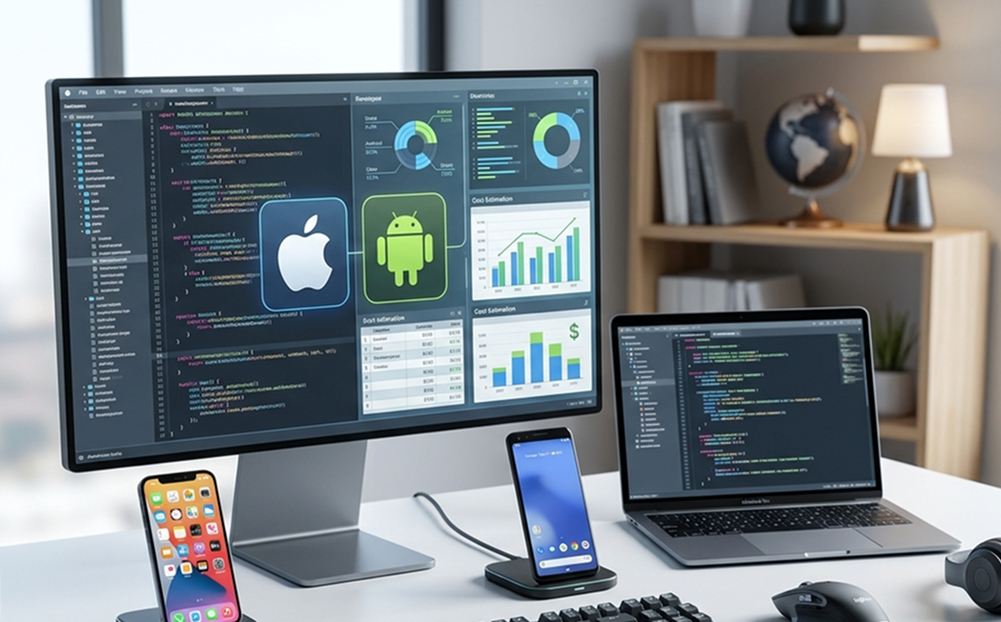
Flutter and React Native remain the two dominant frameworks, and both have matured significantly. What was once seen as a trade-off — cross-platform reach in exchange for reduced performance — is increasingly not a trade-off at all. Modern Flutter applications are pixel-perfect, performant, and capable of delivering native-quality experiences on both iOS and Android from a single codebase. Kotlin Multiplatform is gaining traction for teams that need to share business logic while keeping platform-specific UI layers.
For startups and SMEs in particular, cross-platform development is often the most responsible path. It reduces time-to-market, lowers ongoing maintenance costs, and ensures feature parity across platforms without doubling the engineering effort. For enterprises, the calculus involves weighing these benefits against specific performance requirements or platform-exclusive capabilities.
The right choice depends on your product, your team, and your roadmap. Developex’s cross-platform development services help teams make this decision with a clear-eyed view of the trade-offs — and then build it right.
8. Monetization Features That Maximize Lifetime Value
Mobile monetization in 2026 is sophisticated, multi-layered, and increasingly subscription-driven. Subscriptions now account for over 65% of iOS App Store consumer spending, a dramatic rise from 30% in 2016. Understanding and implementing the right monetization features is as important as any user-facing capability.
The freemium model remains dominant — 98% of global mobile app revenue comes from freemium apps. The key is designing the free tier to genuinely deliver value while creating natural upgrade moments that feel like opportunities rather than paywalls. Hard-stopping users with locked content the moment they engage is a well-documented path to churn.
Feature flagging infrastructure, A/B testing capabilities, and in-app analytics are the technical backbone of effective monetization. Without them, teams are making pricing and packaging decisions based on intuition rather than data. In 2026, the most sophisticated teams run continuous monetization experiments — testing price points, trial lengths, feature bundling, and upgrade prompts — and use cohort analysis to understand which experiments improve lifetime value without harming retention.
In-app purchases, consumables, and one-time unlocks remain important alongside subscriptions, particularly in gaming and creative tools. The most successful monetization strategies in 2026 are flexible and user-respecting — giving users meaningful choices about how they want to pay for value.
9. Developex Expertise: Building Mobile Apps That Win
Developex is a custom software development company with deep expertise in mobile application development across a wide range of industries, including healthcare, IoT, gaming, SaaS, and enterprise software. Our teams have delivered production mobile applications for clients across Europe and North America, working across iOS, Android, and cross-platform frameworks including Flutter and React Native.
What distinguishes our approach is the integration of product thinking with engineering excellence. We do not just write code — we help clients make the right architectural and feature decisions from the start, so that apps are built to scale, built to perform, and built to serve real user needs. Our Product Design services — spanning Business Analysis, UI/UX Design, Architecture Design, and MVP Development — ensure that every engagement begins with clarity about what we are building and why.
Our experience with AI/ML integration, performance-critical embedded and mobile systems, IoT-connected applications, and QA-tested releases means we bring a full spectrum of capabilities to mobile projects. Whether a client is launching a greenfield consumer app, modernizing a legacy mobile product, or scaling an existing platform to new markets, Developex provides the technical depth and delivery consistency to get it done.
We work in flexible models: dedicated teams, time and material, and outstaffing for clients who want to extend their existing engineering capacity with senior mobile developers. Our track record of long-term client relationships reflects our commitment to outcomes over outputs.
10. Key Takeaways: What to Build (and What to Prioritize First)
Choosing which features to build and in what order is ultimately a product strategy question — but the research and trends of 2025–2026 point clearly toward a set of priorities that apply across most mobile products.
- Start with the foundation. Performance, security, smooth onboarding, and reliable push notifications are the non-negotiables. No amount of AI or AR compensates for an app that is slow, confusing, or insecure.
- Invest in AI where it solves a real problem. Personalization, predictive UX, and conversational AI deliver measurable retention and revenue improvements — but only when applied to genuine user pain points.
- Design for trust. Privacy-first architecture, transparent data practices, and robust security are increasingly a competitive differentiator as users and regulators demand more accountability.
- Think cross-platform. For most teams in 2026, building once and deploying to both iOS and Android with Flutter or React Native is the most efficient path to market without sacrificing quality.
- Measure everything. Treat your product as a living system — continuously testing, measuring, and improving based on real user behavior rather than assumptions.
The mobile app landscape in 2026 rewards teams that combine strong engineering discipline with deep empathy for users. Features matter — but only when they serve a clear purpose and are implemented with genuine craft.
Ready to Build a Mobile App That Wins in 2026?
The mobile apps that earn loyalty in 2026 are not the ones with the longest feature lists — they are the ones built with clear purpose, strong foundations, and the discipline to keep improving based on real user behavior. Getting there requires the right technical decisions from day one: the right architecture, the right frameworks, the right balance between what to build now and what to defer.
Developex has spent over a decade helping companies across Europe and North America build production mobile applications that perform in the real world — not just in demos. Whether you are launching a greenfield product, scaling an existing platform, or modernizing a legacy app, our team brings the engineering depth and product thinking to move fast without cutting corners. Contact the Developex team to discuss your project and get a clear-eyed view of what it takes to build right.