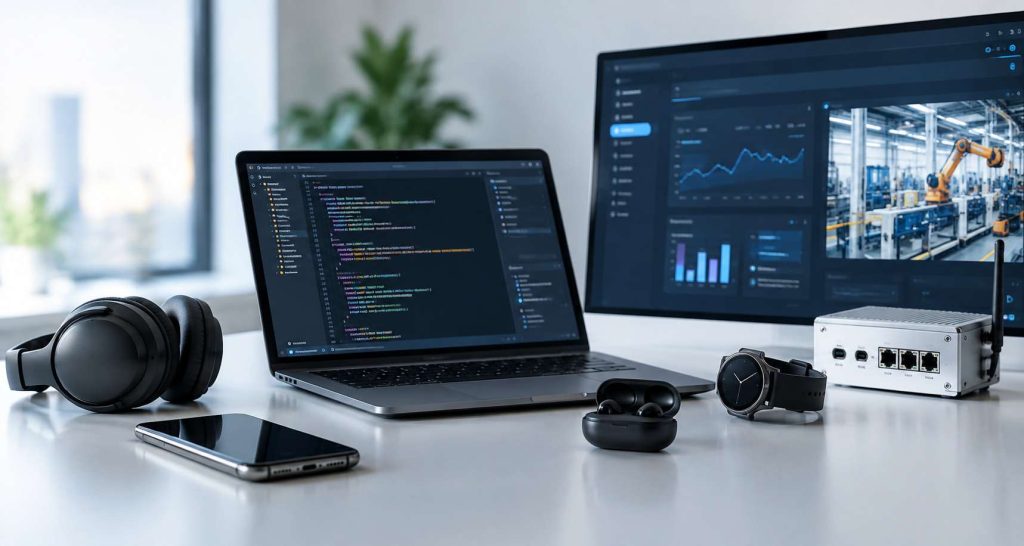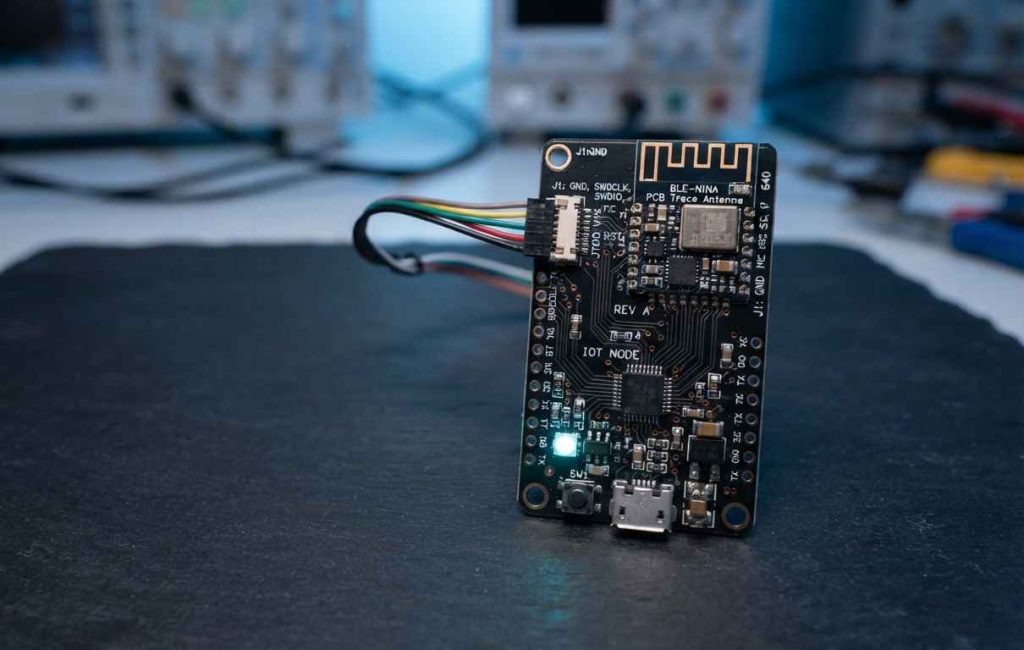
A companion app is rarely judged on its screens alone. Long before a user sees a dashboard or taps a control, the app has to find a device and prove it’s the right one. Then it has to hold a stable connection while sensor data, firmware updates, and commands move back and forth. That invisible layer — the wireless protocol stack — has quietly become one of the biggest differentiators between a connected product that feels effortless and one that generates support tickets.
Three technologies are doing most of the heavy lifting in 2026. Bluetooth Low Energy remains the default entry point for almost every consumer device, now maturing with precision-sensing and audio features that go well beyond simple pairing. Ultra-wideband has moved past its early “Apple-only” reputation and is showing up in mainstream phones, wearables, cars, and access systems, turning vague proximity into centimeter-accurate location. And Matter, the cross-vendor smart home standard, is finally reaching the density of certified products needed to make “works with everything” a realistic promise rather than a marketing line. None of these technologies operates alone anymore — most connected products now combine at least two of them.
For teams building or maintaining a companion app, this shift changes real engineering decisions: how onboarding is designed, how a phone discovers nearby hardware, how “nearby” gets interpreted, and how one app can coexist with a dozen other ecosystems on the same network. In this post we will discuss how BLE, UWB and Matter are individually evolving in 2025–2026, and what their convergence means for pairing, device discovery, proximity-based interactions, and cross-device interoperability in companion apps.
Why Connectivity Choices Now Define the Companion App Experience
Companion apps used to be judged mostly on UI polish and feature completeness. That’s no longer enough. A fitness band that takes twelve seconds to reconnect. A smart lock that occasionally misses the phone in a user’s pocket. A speaker that won’t join a competitor’s smart home hub. All three fail for the same underlying reason — a connectivity layer that wasn’t designed with the app experience in mind from day one. The Bluetooth Low Energy devices market alone is projected to grow from $24.52 billion in 2025 to $25.49 billion in 2026. That’s a signal that the installed base of BLE-connected hardware companion apps have to support is still expanding rather than plateauing.
At the same time, the ecosystems these devices plug into are multiplying. A single wearable might need to pair directly over BLE, expose precise ranging through UWB, and also announce itself as a Matter-compatible accessory inside Apple Home, Google Home, or Amazon Alexa. That means the “connectivity stack” is no longer a single protocol decision made once during hardware bring-up — it’s an ongoing architectural conversation between firmware, mobile, and cloud teams that touches every companion app release. Product teams that treat this as a solved problem after the first pairing screen ships tend to be the ones fielding the most connectivity-related support tickets a year later.
BLE in 2026: Still the Default, But a Lot Smarter
Bluetooth Low Energy is not being replaced — it’s absorbing new capabilities that make it relevant for use cases it was never originally designed for. Bluetooth SIG’s own 2025 progress reporting, summarized with input from engineers at OPPO, Samsung, and Sony, points to a broader shift. Bluetooth is moving beyond basic connectivity toward precision, accessibility, and richer low-power applications, driven largely by wider deployment of Channel Sounding, LE Audio, and Auracast broadcast audio.
For companion apps, a few of these developments matter more than others:
- Channel Sounding brings distance-ranging capability to standard BLE chips, giving developers a lower-cost alternative to UWB for coarse proximity detection — useful for auto-unlock features, “find my device” flows, and presence-based automations that don’t need centimeter accuracy.
- LE Audio and Auracast change how companion apps manage multi-device audio sessions, enabling one broadcast to reach many receivers simultaneously — relevant for public venues, shared listening experiences, and accessibility features like assistive listening.
- Industrial and IoT expansion is pushing BLE into wireless monitoring and real-time process visibility roles that were previously the territory of proprietary RF or Zigbee, widening the range of “companion app” use cases beyond consumer electronics into light industrial monitoring.
- Continued SoC innovation from chip vendors is shrinking power draw and cost, which keeps BLE the practical choice for coin-cell-powered accessories, trackers, and sensors where a UWB or Wi-Fi radio would be overkill.
The practical takeaway is that BLE pairing flows in 2026 need to account for more than a simple connect/disconnect state. Apps increasingly need to negotiate audio roles, ranging capabilities, and security levels that vary by chipset generation — which raises the bar for companion app QA well beyond “does it pair.”
UWB: From Novelty to a Genuine Spatial Layer
Ultra-wideband spent its first few years as a feature exclusive to flagship iPhones and a handful of Samsung and Xiaomi models. That phase is ending. The global UWB market is forecast to grow from $8.48 billion in 2025 to $17.62 billion by 2030. Leading smartphone and wearable manufacturers — including Apple, Samsung, and Xiaomi — have now standardized UWB chips in their flagship devices, creating a mass-market adoption pathway. By 2024, roughly 60% of all UWB chips shipped were embedded in smartphones. Regulatory changes are also removing what used to be a major adoption bottleneck: expanded EU and China spectrum allocations have widened outdoor range and simplified certification. National rollouts in Japan and South Korea are going further still, enabling large-scale use cases such as transit payments and OEM digital car keys. Recent market forecasting also links UWB-based asset tracking to measurable drops in industrial collision claims, reinforcing the technology’s move from novelty to operational tool.
What makes UWB different from BLE isn’t raw connectivity — it’s precision. Time-of-flight ranging over UWB delivers centimeter-level accuracy on both distance and direction, compared to BLE’s signal-strength estimates, which are typically accurate to only a few meters. For a companion app, this distinction changes what “proximity-based” actually means:
| Capability | BLE (with Channel Sounding) | UWB |
|---|---|---|
| Typical range accuracy | ~1–3 meters | ~2–10 centimeters |
| Power consumption | Very low | Low to moderate |
| Best-fit use cases | Presence detection, auto-connect, wearables | Secure keyless entry, item finding, indoor navigation |
| Security against relay attacks | Limited | Strong (time-of-flight based) |
| Typical chipset cost | Lower | Higher, but declining |
| Ecosystem maturity in 2026 | Universal | Mainstream in flagship devices, expanding to mid-range |
This is why UWB is showing up less as a replacement for BLE and more as a companion technology to it: BLE handles initial discovery and low-power background presence, while UWB takes over the moment an app needs to know exactly how far away — and in which direction — a device or user actually is. A well-designed companion app for a smart lock, an asset tag, or a wearable increasingly needs to orchestrate both radios rather than choosing one.
Matter: The Interoperability Layer Companion Apps Can No Longer Ignore
If BLE and UWB are about finding and measuring devices, Matter is about making sure that once found, a device can talk to platforms it was never explicitly built for. Backed by the Connectivity Standards Alliance and its founding members — Apple, Google, Amazon, and Samsung — Matter has moved from a promising standard to genuine market infrastructure. By early 2026, more than 4,000 products had been certified under the standard, and Matter has become what one industry review calls the de facto standard for cross-brand smart home interoperability.
Two releases in the past year illustrate how quickly the standard is maturing. Matter 1.5, announced by the Connectivity Standards Alliance in November 2025, expanded the standard with additional high-impact device categories, including cameras. That’s historically the highest-revenue and most ecosystem-locked smart home category. Matter 1.6, released mid-2026, went further: the Alliance describes it as a focused feature release that enhances how devices interact across ecosystems, improves their ability to adapt to user preferences, and provides a deeper understanding of device status. It also introduced NFC-based commissioning, letting a device be set up before it’s even fully installed or powered on.
Adoption data backs up the momentum. Roughly 40% of newly shipped smart home devices supported Matter as of Q4 2025, up from under 5% two years earlier. Thread border router functionality is now quietly built into most popular smart speakers and streaming boxes on the market. Consumer expectations have shifted accordingly — nearly three-quarters of prospective US smart home buyers now treat Matter compatibility as an essential purchasing criterion. That’s in a segment projected to grow from roughly $14.8 billion in 2025 to $52.6 billion by 2034.
For companion app teams, this creates a genuine strategic question. An app that only talks to its own hardware over a proprietary BLE profile is increasingly competing against a market where users expect their device to also show up natively inside Apple Home or Google Home. Ignoring Matter doesn’t remove the standard from the conversation — it just means users will notice the gap.
Security and Certification Now Move at the Same Pace as Features
None of this convergence would matter much to end users if it came at the cost of security, and 2025–2026 has been notable for how closely security certification is tracking feature releases rather than trailing behind them. Alongside Matter 1.6, the Connectivity Standards Alliance also released Product Security 1.1 — a certification framework designed to unify fragmented international cybersecurity requirements for connected products. It covers not just individual devices but full IoT systems, including companion apps, gateways, and remote processes. For a manufacturer, that means a companion app is no longer a security afterthought sitting outside the certification boundary — it is explicitly part of what gets assessed.
UWB’s time-of-flight ranging brings a security advantage that’s easy to overlook in feature comparisons. Because distance is measured from the actual speed of signal propagation — not inferred from signal strength — it’s significantly harder to spoof with a relay attack than BLE-only proximity detection. That’s one reason automakers have gravitated toward UWB for passive keyless entry instead of RSSI-based approaches. BLE itself isn’t standing still on the security front either — Channel Sounding was explicitly designed with relay-attack resistance in mind, giving companion app developers a lower-cost way to harden proximity-based auto-unlock features without a full UWB radio. For teams building anything access-control-adjacent, from smart locks to fleet vehicles, the choice of ranging technology is now as much a security decision as a UX one.
How BLE, UWB and Matter Are Rewriting Pairing and Discovery
Pairing used to be a one-time, one-protocol event: scan for BLE advertisements, show a list, confirm a PIN, done. That model is breaking down as devices increasingly need to be discoverable across multiple radios and multiple ecosystem controllers at once.
Modern onboarding flows now typically start with BLE, which remains the lowest-power and most universally supported way for a phone to discover an unprovisioned device at close range. From there, many flows hand off to Wi-Fi or Thread for the device’s ongoing network connection. UWB — where present — takes over for any interaction that depends on knowing exact distance or direction, rather than simple presence. Matter adds another layer on top. A device can complete BLE-based commissioning into a companion app and, in the same flow, register itself with a Thread or Wi-Fi-based Matter fabric — so it becomes visible to whichever smart home platform the user already relies on. NFC-based commissioning in Matter 1.6 pushes this even earlier in the journey, allowing a device to be paired before its BLE radio is even powered up. That’s a meaningful improvement for products like ceiling fixtures or built-in appliances, where a QR code becomes physically inaccessible once installed.
The practical effect on companion apps is that “device discovery” is no longer a single scan-and-list screen. It’s a small state machine now. It has to gracefully handle multiple simultaneous protocols, partial failures on any one of them, and a growing set of platforms the device might already be registered with before the app is even opened. Getting this wrong is exactly the kind of hidden complexity that shows up in one-star reviews about “won’t connect” rather than in any feature request. Communication protocols, authentication mechanisms, and platform ecosystems each impose their own constraints — and those constraints compound the moment a device has to work across several of them at once. That’s the challenge that shapes how a robust, unified companion app architecture for consumer devices has to be structured from the ground up.
Proximity-Based Interactions Are Becoming a Core UX Pattern
Precision ranging is quietly turning “is my device nearby” into a design primitive that product teams can build real features around, rather than a background technical detail. A few patterns are becoming common across consumer categories in 2025–2026:
- Auto-unlock and hands-free entry — a phone or wearable authenticates a user the moment they’re within a defined UWB or BLE Channel Sounding range of a door, car, or locker, without requiring an explicit tap or app open.
- Item-finding experiences that guide a user with directional arrows rather than a vague “getting warmer” signal strength bar, made possible by UWB’s angle-of-arrival data.
- Context-aware automation — a smart home hub triggers different behavior depending on which room a Matter-connected device or tagged user is actually in, rather than simply whether they’re connected to the home Wi-Fi network at all.
- Multi-device handoff — audio, video, or a workflow moves seamlessly from one device to another as a user physically walks from one proximity zone to the next, an experience LE Audio and Auracast are specifically designed to support for shared listening.
- Asset and fleet tracking inside warehouses and retail floors, where UWB’s centimeter accuracy is already producing measurable operational gains, including the drop in collision-related insurance claims noted after UWB-based tracking rollouts in industrial settings.
None of these experiences are exclusive to a single protocol. The more interesting engineering work in 2026 is in deciding which radio handles which layer of the interaction: coarse presence, precise location, or persistent low-power background awareness. The goal is to design the companion app so that switching between them feels invisible to the user, similar to how well-tuned BLE beacon deployments already balance broadcast frequency against battery life for reliable proximity detection.
Designing Companion Apps for a Multi-Protocol, Multi-Ecosystem World
The through-line across BLE’s precision upgrades, UWB’s mainstreaming, and Matter’s interoperability push is that companion apps can no longer be designed around a single radio or a single platform assumption. A product roadmap that treats connectivity as “the BLE team’s problem” tends to produce apps that work perfectly in a lab and unreliably in a customer’s actual home, car, or office. Real environments are full of competing 2.4 GHz traffic, inconsistent Thread border router coverage, and users who already own devices from three other ecosystems.
Three practical shifts follow from this. First, connectivity architecture decisions increasingly need to be made jointly across firmware and app teams from the earliest hardware planning stages, rather than handed to the mobile team after silicon is already locked in. This approach is reflected in how end-to-end device ecosystem development treats firmware, companion apps, and cloud services as one continuous system instead of three handoffs. Second, Matter compatibility is becoming a product decision as much as a technical one. Supporting it well enough to satisfy the platforms users already trust is now a competitive baseline rather than a nice-to-have — particularly for categories like lighting, locks, sensors, and cameras, where Matter adoption is already highest. Third, proximity and ranging features need dedicated UX design rather than being treated as an afterthought bolted onto an existing pairing screen. Users increasingly expect location-aware behavior to feel automatic, not something they have to configure manually inside custom mobile app development work for wearables, trackers, and smart accessories.
Developex Expertise in Connected Device Software
Developex has been building software for connected consumer electronics and IoT products since 2001. The company works across firmware, companion apps, and cloud infrastructure for clients including Logitech and Corsair, primarily across North America and Western Europe. That history spans exactly the kind of multi-protocol complexity this article describes: BLE pairing flows for gaming peripherals and wearables, beacon-based proximity systems, and companion apps that need to coexist with platform ecosystems the original hardware team never anticipated.
Our approach to software development for the electronics industry treats connectivity as a shared responsibility across the full stack, rather than something owned by a single team. Firmware, mobile, and cloud engineers coordinate closely throughout a project, so connectivity features behave consistently across the product regardless of which team builds or maintains them. This kind of full-stack ownership — rather than treating the companion app as a separate deliverable bolted onto finished hardware — is what allows a product line to add new connectivity capabilities later, such as UWB ranging or Matter certification, without a ground-up rewrite of the app’s connectivity layer. For manufacturers evaluating how their next product generation should handle pairing, discovery, and cross-ecosystem compatibility, this kind of integrated approach matters. It’s often the difference between a connectivity feature that ships on time and one that becomes an ongoing source of support tickets.
Frequently Asked Questions
Looking Ahead
BLE, UWB, and Matter are no longer competing options on a technology selection slide — they’re complementary layers that most connected products will need to combine by the end of this decade. BLE keeps its role as the universal, low-power entry point. UWB is rapidly becoming the default for anything that needs genuine spatial precision, rather than a rough proximity guess. And Matter is closing the gap between “this device works” and “this device works with everything the user already owns.” Companion apps that treat these three as one coordinated connectivity strategy — rather than three separate integrations — are the ones most likely to deliver the fast, reliable, cross-ecosystem experience users increasingly expect as the default in 2026.